
Larval Stages in Invertebrates
(From Porifera to Echinodermata)
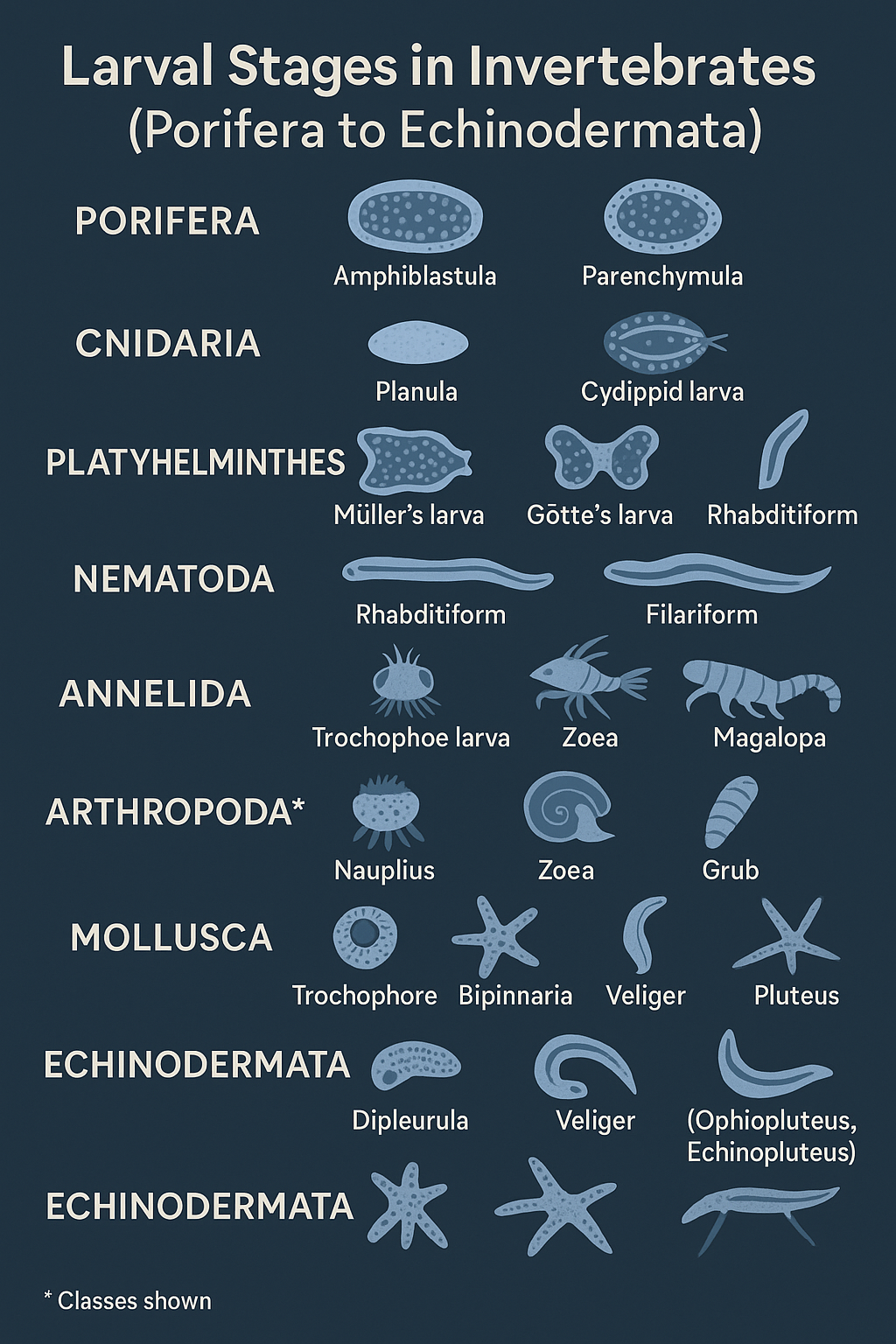
Invertebrates, though lacking a backbone, exhibit an astonishing variety of larval stages across phyla. These larval forms serve essential roles in dispersal, survival, and metamorphosis. Below is a detailed summary of key larval stages from simple sponges to complex echinoderms.
| Phylum | Larval Stage(s) | Description |
|---|---|---|
| Porifera | Amphiblastula, Parenchymula | Free-swimming larvae with flagella; involved in dispersal and metamorphosis. |
| Cnidaria | Planula | Ciliated, free-swimming larva that settles to form a polyp. |
| Ctenophora | Cydippid larva | Looks like a mini adult; direct development with minimal changes. |
| Platyhelminthes | Müller’s larva, Götte’s larva, Rhabditiform | Seen in free-living flatworms and parasitic forms. |
| Nematoda | Rhabditiform, Filariform | Characteristic of parasitic nematodes like Ascaris. |
| Annelida | Trochophore | Ciliated, free-swimming larva found in marine annelids. |
| Arthropoda | Nauplius, Zoea, Mysis, Megalopa, Caterpillar, Grub | Diverse larval forms in crustaceans and insects. |
| Mollusca | Trochophore, Veliger | Trochophore develops into veliger with beginnings of shell and foot. |
| Echinodermata | Dipleurula, Bipinnaria, Brachiolaria, Auricularia, Pluteus | Bilateral larvae that transform into radial adult forms. |