
Exercise 5.1 Solutions (Class 9)
Introduction to Euclid’s Geometry
1. Which of the following statements are true and which are false? Give reasons for your answers.
(i) Only one line can pass through a single point.
False. An infinite number of lines can be drawn through a single point.
(ii) There are an infinite number of lines which pass through two distinct points.
False. According to Euclid’s Postulate 1, only one unique line can be drawn through any two distinct points.
(iii) A terminated line can be produced indefinitely on both the sides.
True. This is Euclid’s Postulate 2.
(iv) If two circles are equal, then their radii are equal.
True. If two circles are equal, their areas and circumferences are equal. This is only possible if their radii are equal. They would superimpose on each other.
(v) In Fig. 5.9, if AB = PQ and PQ = XY, then AB = XY.

2. Give a definition for each of the following terms. Are there other terms that need to be defined first? What are they, and how might you define them?
(i) Parallel lines: Two lines in a plane are said to be parallel if they do not intersect each other, no matter how far they are extended.
(ii) Perpendicular lines: Two lines in a plane are said to be perpendicular if they intersect at a right angle (90°).
(iii) Line segment: A part of a line that has two fixed endpoints.
(iv) Radius of a circle: The fixed distance from the center of a circle to any point on its circumference.
(v) Square: A quadrilateral in which all four sides are equal and all four angles are right angles.
Yes, there are other terms that need to be defined first. These are the “undefined terms” in geometry upon which other definitions are built. They include:
- Point: A dimensionless dot which has a position but no magnitude.
- Line: A breathless length which consists of an infinite number of points.
- Plane: A flat surface that extends infinitely in all directions.
- Angle: The figure formed by two rays sharing a common endpoint.
3. Consider two ‘postulates’ given below:
(i) Given any two distinct points A and B, there exists a third point C which is in between A and B.
(ii) There exist at least three points that are not on the same line.
Do these postulates contain any undefined terms? Are these postulates consistent? Do they follow from Euclid’s postulates? Explain.
Undefined Terms: Yes, these postulates contain undefined terms like ‘point’ and ‘line’.
Consistency: Yes, the postulates are consistent. They deal with two different situations and do not contradict each other. Postulate (i) talks about points on a single line (collinear points), while postulate (ii) talks about points in a plane (non-collinear points). Together, they describe fundamental properties of a plane.
Relation to Euclid’s Postulates: These postulates do not directly follow from Euclid’s five postulates. They are axioms that are taken for granted in modern geometry.
Postulate (i) is implied by Euclid’s geometry but not explicitly stated as one of the five main postulates. It establishes that a line is continuous and contains infinite points.
Postulate (ii) ensures that geometry is not just one-dimensional (a single line). It establishes the existence of a plane. This is an axiom in its own right.
4. If a point C lies between two points A and B such that AC = BC, then prove that AC = 1/2 AB. Explain by drawing the figure.
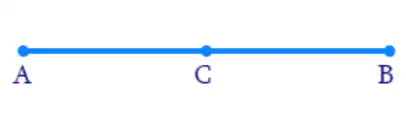
Given: A point C lies between A and B such that AC = BC.
From the figure, we can see that the line segment AB is the sum of AC and BC.
AB = AC + BC. (Axiom: The whole is equal to the sum of its parts).
Substitute BC with AC (since they are given as equal):
AB = AC + AC.
AB = 2 * AC.
Dividing by 2, we get AC = 1/2 AB. (Proved)
5. In Question 4, point C is called a mid-point of line segment AB. Prove that every line segment has one and only one mid-point.
Proof:
Let’s assume a line segment AB has two different mid-points, C and D.
If C is the mid-point of AB, then by definition:
AC = 1/2 AB. —(1)
If D is also a mid-point of AB, then by definition:
AD = 1/2 AB. —(2)
From equations (1) and (2), using Euclid’s axiom that things which are equal to the same thing are equal to one another, we get:
AC = AD.
This equation implies that the distance from A to C is the same as the distance from A to D. This is only possible if the points C and D are the same point (i.e., they coincide).
Therefore, our initial assumption that a line segment can have two different mid-points is false. Every line segment has one and only one mid-point. (Proved)
6. In Fig. 5.10, if AC = BD, then prove that AB = CD.
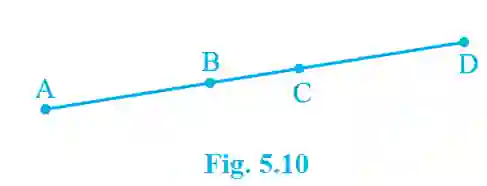
Given: AC = BD.
From the figure, we can express AC as the sum of its parts:
AC = AB + BC. —(1)
Similarly, we can express BD as the sum of its parts:
BD = BC + CD. —(2)
Since we are given AC = BD, we can equate equations (1) and (2):
AB + BC = BC + CD.
According to Euclid’s axiom, “If equals are subtracted from equals, the remainders are equal.” Subtracting BC from both sides of the equation, we get:
AB = CD. (Proved)
7. Why is Axiom 5, in the list of Euclid’s axioms, considered a ‘universal truth’? (Note that the question is not about the fifth postulate.)
Euclid’s fifth axiom states: “The whole is greater than the part.”
This is considered a ‘universal truth’ because it is a self-evident concept that applies to everything in the universe, not just to mathematical figures in geometry.
For example:
- A continent (the whole) is always larger than a country within it (the part).
- A complete book (the whole) has more pages than a single chapter of it (the part).
- The population of the world (the whole) is greater than the population of any single country (the part).
Because this principle holds true in all fields and situations without needing any proof, it is accepted as a universal truth.