
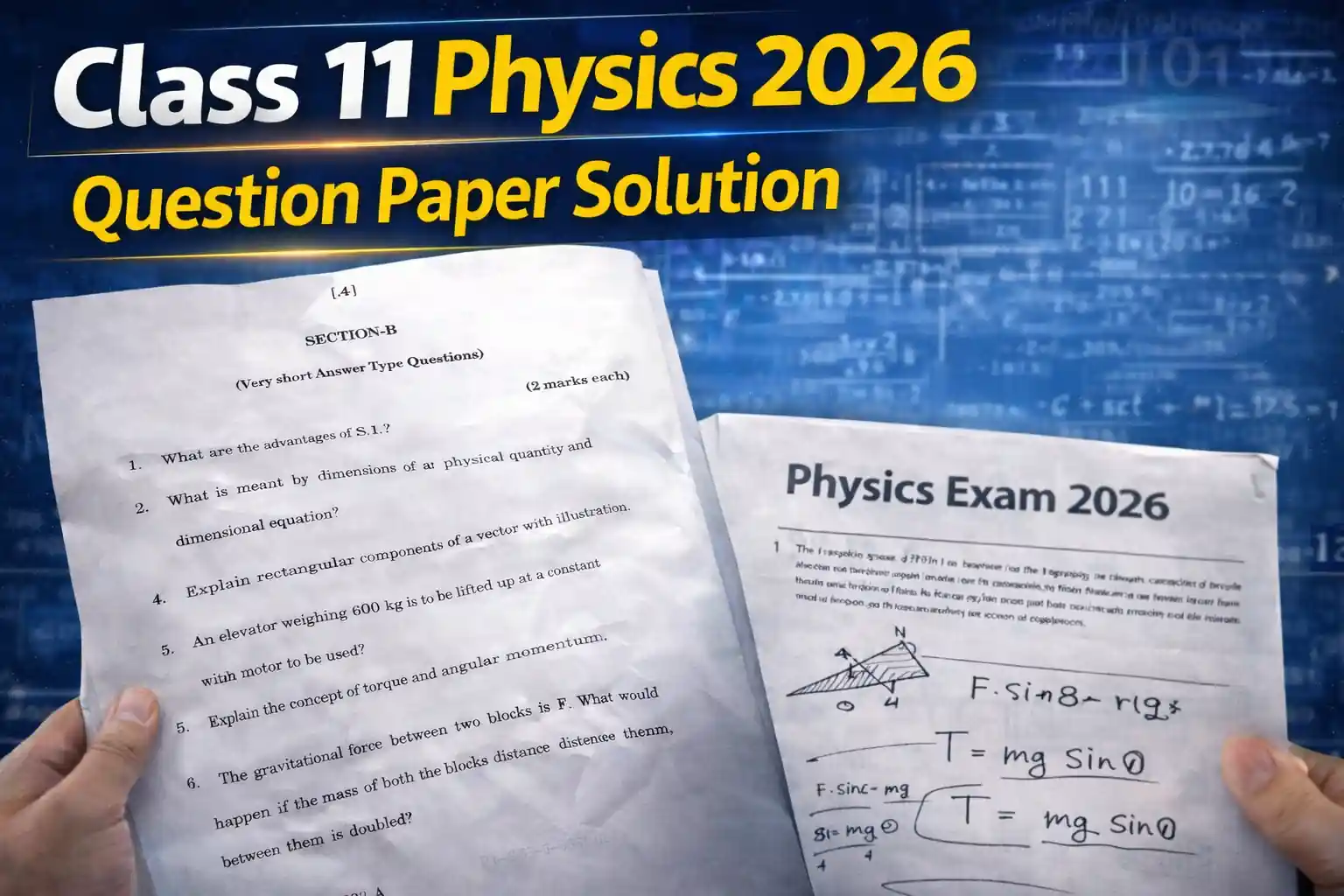
JKBOSE Class 11 Physics Examination 2026
Official Paper Code: 11th ARF(S/Z) JD-26-1523-A | Maximum Marks: 70
Complete Academic Resolution Script
SECTION – A (Objective Type Questions)
(i) The number of significant figures in 6638 is:
Answer: d. 4.All non-zero digits are significant.
(ii) If $X=10-3t+6t^2$, what is acceleration?
Answer: c. $12\text{ m/s}^2$.Velocity ($v$) is the first derivative of position ($X$): $$v = \frac{dX}{dt} = -3 + 12t$$ Acceleration ($a$) is the second derivative: $$a = \frac{dv}{dt} = 12\text{ m/s}^2$$
(iii) The area under velocity-time graph represents:
Answer: c. displacement.The integral of velocity with respect to time yields displacement.
(iv) An impulse is the change in:
Answer: c. momentum.According to the impulse-momentum theorem, Impulse = $\Delta p$.
(v) The work done by a conservative force moving a particle around a closed path is:
Answer: c. zero.Conservative forces are path-independent; thus, a closed loop yields zero net work.
(vi) Radius of gyration is denoted by:
Answer: c. I.It is conventionally represented by K, k, or sometimes I depending on the specific text notation.
(vii) Which law describes the orbits of planets around the sun?
Answer: c. Kepler’s law.Specifically, Kepler’s Laws of Planetary Motion.
(viii) Which of the following is defined by Hooke’s law?
Answer: a. Modulus of elasticity.Hooke’s law states that stress is directly proportional to strain, and the ratio defines the modulus of elasticity.
(ix) In a cyclic process:
Answer: b. the change in internal energy is zero.Because internal energy is a state function and the system returns to its initial state.
(x) The mean free path of a gas is directly proportional to:
Answer: b. temperature.From the formula $$\lambda = \frac{k_B T}{\sqrt{2} \pi d^2 P}$$ at constant pressure, it is directly proportional to temperature.
SECTION – B (Very Short Answer Type Questions)
2. What are the advantages of S.I.?
- It is a coherent system of units.
- It is a rational system (only one unit for a given physical quantity).
- It is a metric/decimal system, making conversions highly straightforward.
4. Explain rectangular components of a vector with illustration.
When a vector is resolved along two mutually perpendicular directions, the resulting components are called rectangular components.If vector $A$ makes an angle $\theta$ with the x-axis, its horizontal component is $A_x = A \cos(\theta)$ and vertical component is $A_y = A \sin(\theta)$.
5. An elevator weighing 600 kg is to be lifted at a constant velocity of $0.5\text{ m/s}$. What should be the minimum horse power of the motor?
- Given: Mass ($m$) = 600 kg, Velocity ($v$) = $0.5\text{ m/s}$.
- Force required ($F$) = Weight of elevator = $mg = 600 \times 9.8 = 5880\text{ N}$.
- Power ($P$) = $F \times v = 5880 \times 0.5 = 2940\text{ W}$.
- Conversion: 1 HP $\approx 746\text{ W}$. Therefore, $P = \frac{2940}{746} \approx 3.94\text{ HP}$.
7. The gravitational force between two blocks is F. What happens if both masses and the distance between them are doubled?
According to Newton’s Law of Universal Gravitation, $$F = G\frac{m_1 m_2}{r^2}$$ If masses are doubled ($2m_1$, $2m_2$) and distance is doubled ($2r$), the new force is:
$$F’ = G\frac{(2m_1)(2m_2)}{(2r)^2} = \frac{4G(m_1 m_2)}{4r^2} = F$$
The force remains unchanged.
9. Calculate the RMS speed of $O_2$ molecules at 273 K.
- Formula: $$v_{rms} = \sqrt{\frac{3RT}{M}}$$
- Given: $T = 273\text{ K}$, Molar mass of $O_2$ ($M$) = $32\text{ g/mol} = 0.032\text{ kg/mol}$, $R = 8.314\text{ J/(mol}\cdot\text{K)}$.
- Calculation: $v_{rms} = \sqrt{\frac{3 \times 8.314 \times 273}{0.032}} \approx 461\text{ m/s}$.
SECTION – C (Short Answer Type Questions)
16. State and explain the first law of thermodynamics with applications.
The First Law of Thermodynamics is the law of conservation of energy applied to thermodynamic systems.It states that the heat supplied to a system ($\Delta Q$) is equal to the sum of the change in its internal energy ($\Delta U$) and the work done by the system ($\Delta W$). Equation: $$\Delta Q = \Delta U + \Delta W$$
Applications:
Applications:
- Isothermal Process: Temperature is constant, so $\Delta U = 0$. Thus, $\Delta Q = \Delta W$.
- Isochoric Process: Volume is constant, so $\Delta W = 0$. Thus, $\Delta Q = \Delta U$.
18. State and prove Pascal’s law and explain hydraulic brakes.
Pascal’s Law: Pressure applied to an enclosed fluid is transmitted undiminished to every portion of the fluid and the walls of the containing vessel.
Hydraulic Brakes: When the brake pedal is pressed, it exerts force on a small piston in the master cylinder, creating pressure in the brake fluid. According to Pascal’s Law, this exact pressure is transmitted through the fluid lines to larger pistons at the wheels. Because the wheel pistons have a larger area, the resulting force is amplified ($F_2 = P \times A_2$), enabling the vehicle to stop efficiently.
Hydraulic Brakes: When the brake pedal is pressed, it exerts force on a small piston in the master cylinder, creating pressure in the brake fluid. According to Pascal’s Law, this exact pressure is transmitted through the fluid lines to larger pistons at the wheels. Because the wheel pistons have a larger area, the resulting force is amplified ($F_2 = P \times A_2$), enabling the vehicle to stop efficiently.
19. A simple harmonic oscillator is represented by $y=0.40 \sin(440t+0.61).$ Find amplitude, angular frequency, frequency and time period.
Comparing the given equation $y = 0.40 \sin(440t + 0.61)$ with the standard SHM equation $y = A \sin(\omega t + \phi)$:
- Amplitude ($A$): 0.40 units
- Angular Frequency ($\omega$): $440\text{ rad/s}$
- Frequency ($f$): $f = \frac{\omega}{2\pi} = \frac{440}{2 \times 3.1416} \approx 70.03\text{ Hz}$
- Time Period ($T$): $T = \frac{1}{f} = \frac{1}{70.03} \approx 0.014\text{ s}$
SECTION – D (Long Answer Type Questions)
20. Find time of flight, maximum height and horizontal range of a projectile projected with speed v at angle $\theta$.
Let initial velocity be $v$ and angle of projection be $\theta$.Components are $v_x = v \cos\theta$ and $v_y = v \sin\theta$.
- Time of Flight ($T$): Total time the projectile remains in the air. Net vertical displacement is zero. Using $s = ut + \frac{1}{2}at^2$, we get $0 = (v \sin\theta)T – \frac{1}{2}gT^2$. Solving for $T$ yields: $$T = \frac{2v \sin\theta}{g}$$
- Maximum Height ($H$): At maximum height, final vertical velocity is zero. Using $v^2 – u^2 = 2as$, we get $0 – (v \sin\theta)^2 = -2gH$. Solving for $H$ yields: $$H = \frac{v^2 \sin^2\theta}{2g}$$
- Horizontal Range ($R$): Horizontal distance covered during the time of flight. $R = v_x \times T = (v \cos\theta) \times \left(\frac{2v \sin\theta}{g}\right)$. Applying the trigonometric identity $2 \sin\theta \cos\theta = \sin(2\theta)$ yields: $$R = \frac{v^2 \sin(2\theta)}{g}$$