100+ Most important MCQS on dogra dynasty with explanation
MCQS on dogra dynasty Your Score: 0.00 Previous Next

MCQS on dogra dynasty Your Score: 0.00 Previous Next
MCQs on the history of jammu and kashmir [1947 – 2025] Your Score: 0.00 Previous Next
MCQs on Jammu and Kashmir reorganisation act 2019 Your Score: 0.00 Previous Next
CSIR NET Life Science Syllabus PDF Download (Latest & Updated) CSIR NET Life Science Syllabus PDF Download Welcome, CSIR-NET aspirants! The first and most crucial step in your preparation journey is to thoroughly understand the syllabus. It is the official roadmap that guides your study plan and helps you focus on what truly matters. To … Read more
exercise 4.2 class 9- Linear Equations in Two Variables Solutions: Exercise 4.2 1. Which one of the following options is true, and why? y = 3x + 5 has (i) a unique solution, (ii) only two solutions, (iii) infinitely many solutions The correct option is (iii) infinitely many solutions. Reason: For every real value of … Read more
exercise 4.1 class 9 – Linear Equations in Two Variables Solutions: Exercise 4.1 1. The cost of a notebook is twice the cost of a pen. Write a linear equation in two variables to represent this statement. Let the cost of the notebook be ₹ x. Let the cost of the pen be ₹ y. … Read more

Class 9 Maths Chapter 5 Exercise 5.1 – Euclid’s Geometry Exercise 5.1 Solutions (Class 9) Introduction to Euclid’s Geometry 1. Which of the following statements are true and which are false? Give reasons for your answers. (i) Only one line can pass through a single point. False. An infinite number of lines can be drawn … Read more
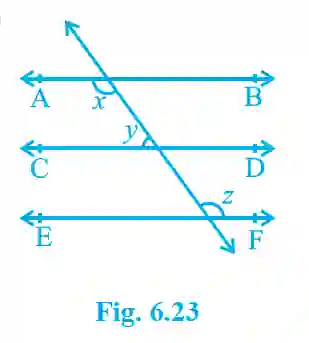
class 9 exercise 6.2 solutions – Lines and Angles Exercise 6.2 Solutions (Class 9) Lines and Angles 1. In Fig. 6.23, if AB || CD, CD || EF and y : z = 3 : 7, find x. Since AB || CD and CD || EF, then lines parallel to the same line are parallel … Read more

class 9 maths chapter 6 exercise 6.1- Lines and Angles (Class 9) Exercise 6.1 Solutions (Class 9) Lines and Angles 1. In Fig. 6.13, lines AB and CD intersect at O. If ∠AOC + ∠BOE = 70° and ∠BOD = 40°, find ∠BOE and reflex ∠COE. ∠AOC = ∠BOD (Vertically opposite angles). Since ∠BOD = … Read more
triangles class 9 extra questions (R.D. Sharma Level – Class 9) Extra Practice Questions Triangles (R.D. Sharma Level – Class 9) 1. In quadrilateral ACBD, AC = AD and BC = BD. Prove that AB is the perpendicular bisector of CD. Proof: First, in ΔACB and ΔADB: • AC = AD (Given) • BC = … Read more