
Chapter 2: Structure of Atom
1. Introduction to the Atomic World
The concept of an atom as the fundamental, indivisible unit of matter has its roots in ancient Greek philosophy, proposed by thinkers like Democritus. For over two millennia, this remained a philosophical idea. It was John Dalton, in the early 19th century, who elevated this concept to a scientific theory. Dalton’s Atomic Theory provided a powerful framework for understanding chemical reactions, postulating that all matter is composed of tiny, indestructible atoms. However, the late 19th and early 20th centuries witnessed a series of revolutionary experiments that shattered the image of the indivisible atom. Scientists discovered that the atom itself was a complex system composed of even smaller, or subatomic, particles. This chapter embarks on a journey through these pivotal discoveries, exploring the experiments that unveiled the electron, proton, and neutron, and tracing the evolution of atomic models from simple spheres to the probabilistic quantum world.
2. Discovery of Subatomic Particles
The notion of a featureless, solid atom could not explain emerging phenomena like electricity and radioactivity. The path to understanding the atom’s inner structure began with the investigation of electrical discharge in gases.
2.1 The Electron (e⁻): Unveiling the First Particle
The first piece of the atomic puzzle was the electron, discovered through studies of cathode rays.
The Cathode Ray Discharge Tube Experiment
In the 1850s, scientists like William Crookes began studying the passage of electricity through gases at very low pressures in a sealed glass tube known as a cathode ray tube. When a high voltage (around 10,000 V) was applied across the electrodes, a stream of particles was observed moving from the negative electrode (cathode) to the positive electrode (anode). These were named cathode rays.

Key Properties of Cathode Rays:
- Linear Propagation: They travel in straight lines. If an object is placed in their path, it casts a sharp shadow.
- Mechanical Effect: They possess kinetic energy and can rotate a small, light paddle wheel placed in their path, indicating they are material particles, not just waves.
- Negative Charge: In the presence of an electric or magnetic field, the rays are deflected in a manner consistent with negatively charged particles. For instance, they bend towards the positive plate of an electric field.
- Heating Effect: They produce heat when they strike a metal foil.
- X-ray Production: When they strike a dense metal target like tungsten, they produce X-rays.
J.J. Thomson’s Contribution (1897)
While others had studied cathode rays, it was J.J. Thomson who conducted quantitative experiments to determine their nature. By applying carefully controlled electric and magnetic fields, he was able to measure the charge-to-mass ratio (e/m) of these particles. He found a remarkable fact: the e/m ratio was constant, regardless of the gas in the tube or the metal used for the cathode. This value was approximately 1.758820 × 10¹¹ C/kg.
This universality led Thomson to a profound conclusion: these particles, which he called “corpuscles,” were a fundamental constituent of all atoms. The name “electron,” proposed earlier by G.J. Stoney, was soon adopted. Thomson’s discovery proved that atoms were, in fact, divisible.
Charge and Mass of the Electron
While Thomson determined the e/m ratio, the actual charge ‘e’ and mass ‘m’ remained unknown. In 1909, Robert A. Millikan, through his famous Oil-Drop Experiment, succeeded in measuring the charge of an electron with great precision. He found that the charge on any oil droplet was always an integral multiple of a fundamental charge, 1.602 × 10⁻¹⁹ Coulombs. This was taken as the charge of a single electron.
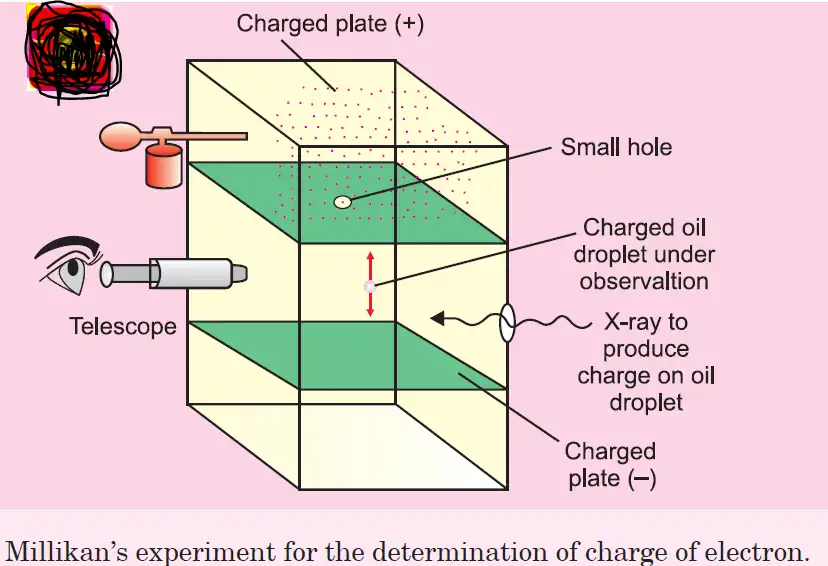
With the values of e/m and e known, the mass of the electron (mₑ) could be calculated:
This mass is approximately 1/1837th the mass of a hydrogen atom, confirming that electrons are incredibly light particles.
2.2 The Proton (p⁺): The Positive Heart of the Atom
Since atoms are electrically neutral, the existence of negatively charged electrons implied an equal amount of positive charge. Evidence for this positive particle came from modified discharge tube experiments.
Discovery of Anode Rays (Canal Rays)
In 1886, Eugen Goldstein used a discharge tube with a perforated cathode. He observed a new set of luminous rays passing through the holes (or “canals”) of the cathode and moving in the opposite direction to the cathode rays. These were named canal rays or anode rays.
Properties of Anode Rays:
- They consist of positively charged particles.
- Unlike cathode rays, their charge-to-mass ratio was not constant. It depended on the nature of the gas taken in the tube.
- The e/m ratio was found to be maximum when hydrogen gas was used. This suggested that the positive particle obtained from hydrogen was the lightest and most fundamental.
This fundamental positive particle was named the proton by Ernest Rutherford, who later, in 1919, conclusively showed its existence by bombarding nitrogen gas with alpha particles and detecting the ejected protons. A proton carries a positive charge equal in magnitude to that of an electron (+1.602 × 10⁻¹⁹ C) and has a mass of 1.672 × 10⁻²⁷ kg.
2.3 The Neutron (n⁰): The Missing Mass
After the discovery of the proton and electron, the main puzzle was the atomic mass. For instance, a helium atom has 2 protons (atomic number 2), but its mass is about four times that of a hydrogen atom. This discrepancy suggested the presence of a neutral particle with a mass similar to a proton.
Chadwick’s Experiment (1932)
The search for this neutral particle ended in 1932 when James Chadwick bombarded a thin sheet of beryllium with alpha particles. He observed that a highly penetrating radiation was produced, which was not deflected by electric or magnetic fields, proving it was neutral. By having this radiation strike a paraffin wax target, he observed that it knocked out protons with high velocity. Through conservation of energy and momentum calculations, Chadwick concluded that the radiation consisted of neutral particles with a mass slightly greater than that of a proton. He named this particle the neutron.
3. Atomic Number, Mass Number, and Isotopes
With the composition of the atom understood, we can define its fundamental characteristics.
Atomic Number (Z): The number of protons in the nucleus of an atom. It is the “identity card” of an element, as it uniquely determines which element it is. In a neutral atom, the number of electrons is equal to the number of protons (Z).
Mass Number (A): The total number of protons and neutrons in the nucleus. These particles are collectively called nucleons.
3.1 Isotopes, Isobars, and Isotones
Atoms of elements are not all identical. Variations in the number of neutrons lead to different forms.
Isotopes
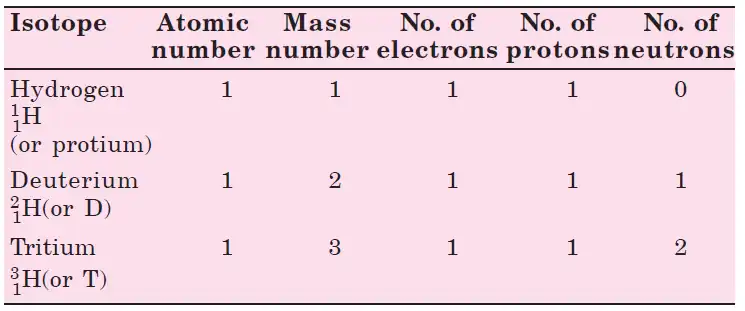
Isotopes are atoms of the same element (i.e., having the same atomic number, Z) but different mass numbers (A). This difference arises because they have different numbers of neutrons in their nuclei. Since they have the same number of protons and electrons, isotopes have identical chemical properties.
Isobars
Isobars are atoms of different elements that have the same mass number (A) but different atomic numbers (Z). They have different chemical and physical properties.
Example: Argon-40 (⁴⁰₁₈Ar) and Calcium-40 (⁴⁰₂₀Ca) are isobars.
Isotones
Isotones are atoms of different elements that have the same number of neutrons (N).
Example: Carbon-14 (¹⁴₆C) and Oxygen-16 (¹⁶₈O) are isotones, as both have 8 neutrons.
4. Early Models of the Atom
4.1 Thomson’s “Plum Pudding” Model (1904)
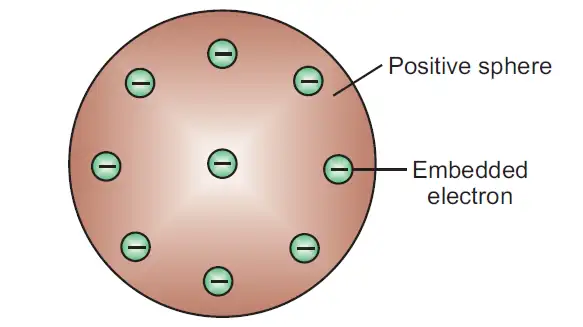
J.J. Thomson proposed that an atom was a sphere of uniformly distributed positive charge, with negatively charged electrons embedded within it. This model explained the neutrality of atoms but failed to explain the results of Rutherford’s experiment.
4.2 Rutherford’s Nuclear Model (1911)
Thomson’s model was decisively refuted by the alpha-particle scattering experiment.
The Gold Foil Experiment: A Detailed Look
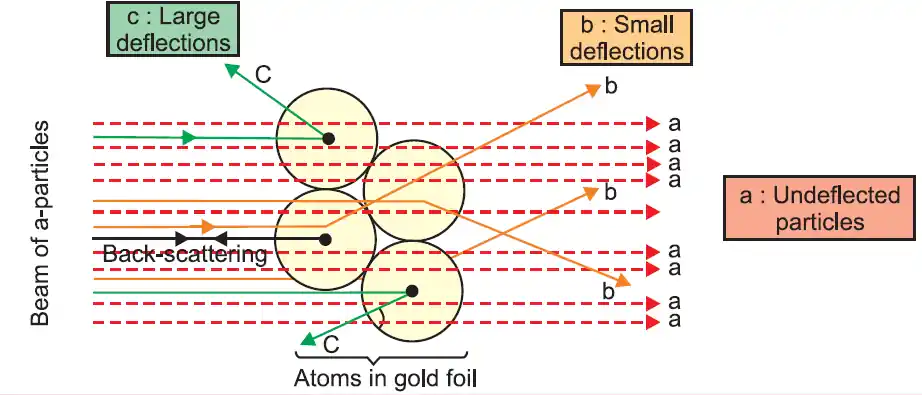
Rutherford’s team directed a beam of high-energy alpha particles onto an extremely thin sheet of gold foil.
Observations and Astonishing Conclusions
- Most particles passed through undeflected: This implied that most of the atom is empty space.
- A few particles were deflected by small angles: This suggested a central region of positive charge that repelled the alpha particles.
- A very small number bounced back: This could only be explained if the atom’s positive charge and mass were concentrated in a tiny, dense central core, which he named the nucleus.
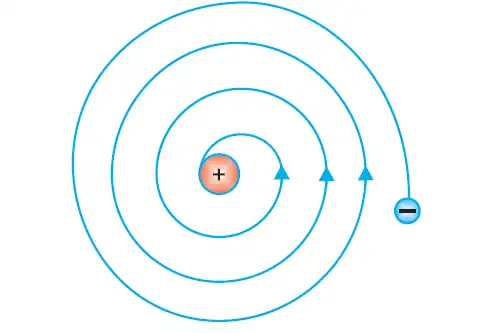
From these results, Rutherford proposed his nuclear model: a tiny, dense, positive nucleus with electrons orbiting it.
Drawbacks of Rutherford’s Model
According to classical physics, an orbiting electron is an accelerating charge and should continuously radiate energy, causing it to spiral into the nucleus. This would make the atom unstable. The model was incomplete.
5. Developments Leading to Bohr’s Model
5.1 Wave Nature of Electromagnetic Radiation
Electromagnetic radiation (like light) propagates as waves characterized by wavelength (λ) and frequency (ν).
5.2 Planck’s Quantum Theory (1900)
Max Planck proposed that energy is emitted or absorbed in discrete packets called quanta. The energy of a quantum (a photon for light) is given by:
Here, h is Planck’s constant (6.626 × 10⁻³⁴ J·s).
5.3 The Photoelectric Effect
This is the ejection of electrons from a metal surface by light. Albert Einstein explained it using quantum theory.

Einstein’s Photoelectric Equation:
The energy of an incoming photon (hν) is used to overcome the metal’s work function (W₀), with the remainder becoming the electron’s kinetic energy.
Here, ν₀ is the threshold frequency, the minimum frequency required for emission.
6. Bohr’s Model for the Hydrogen Atom (1913)
Niels Bohr merged classical physics with quantum concepts to create a successful model for the hydrogen atom.
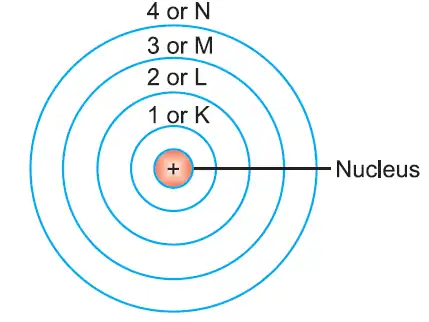
Postulates of Bohr’s Atomic Model:
- Electrons revolve in fixed circular paths of definite energy called “stationary orbits.”
- While in an orbit, an electron does not radiate energy.
- The angular momentum of an electron is quantized: mvr = n(h/2π)
- Energy is emitted or absorbed when an electron jumps between orbits: ΔE = E₂ – E₁ = hν
Key Results from Bohr’s Theory
Radius of the n-th orbit (rₙ):
Energy of the electron in the n-th orbit (Eₙ):
Explanation of the Hydrogen Spectrum
Bohr’s model explained the line spectrum of hydrogen. When an electron jumps from a higher level (n₂) to a lower one (n₁), the wavelength of the emitted photon is given by the Rydberg formula:

7. Towards the Quantum Mechanical Model
7.1 The Dual Nature of Matter: de Broglie’s Hypothesis (1924)
Louis de Broglie proposed that all matter has a dual nature (wave and particle). A moving particle has an associated wavelength:
7.2 Heisenberg’s Uncertainty Principle (1927)
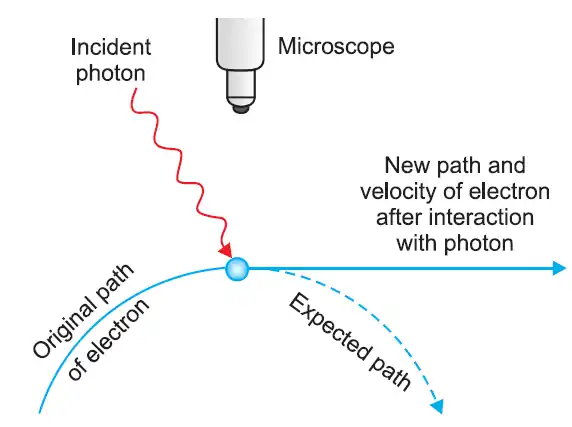
Werner Heisenberg stated that it is impossible to determine simultaneously and with perfect accuracy both the exact position (Δx) and the exact momentum (Δp) of a microscopic particle.
8. The Quantum Mechanical Model of the Atom
This model, developed by Erwin Schrödinger, describes the atom in terms of probabilities.
8.1 Schrödinger’s Wave Equation
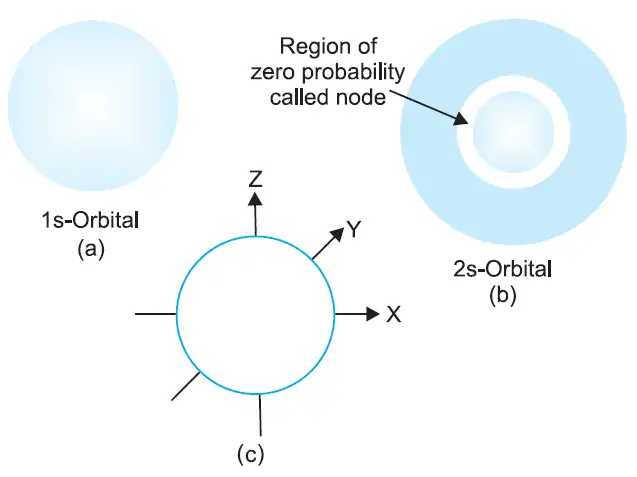
Schrödinger’s equation describes the wave-like behavior of an electron. Its solutions are wave functions (ψ). The square of the wave function, ψ², gives the probability density of finding an electron. A region of high probability is called an atomic orbital.
8.2 Quantum Numbers: An Electron’s Address
Four quantum numbers describe an electron in an atom:
- Principal Quantum Number (n): Main energy level or shell (n = 1, 2, 3, …).
- Azimuthal Quantum Number (l): Shape of the orbital or subshell (l = 0 to n-1). l=0 (s), l=1 (p), l=2 (d).
- Magnetic Quantum Number (mₗ): Orientation of the orbital in space (mₗ = -l to +l).
- Spin Quantum Number (mₛ): Electron’s spin (+1/2 or -1/2).
8.3 Shapes of Atomic Orbitals
s-orbitals are spherical, p-orbitals are dumbbell-shaped, and d-orbitals have more complex shapes.


9. Filling Electrons in Orbitals
The electron configuration is governed by three rules.
9.1 Aufbau Principle
Electrons fill orbitals starting from the lowest energy level first.

9.2 Pauli Exclusion Principle
No two electrons in an atom can have the same four quantum numbers. An orbital can hold a maximum of two electrons with opposite spins.
9.3 Hund’s Rule of Maximum Multiplicity
Electrons occupy degenerate orbitals singly before pairing up.
9.4 Stability of Half-Filled and Fully-Filled Configurations
Subshells that are exactly half-filled (p³, d⁵) or completely filled (p⁶, d¹⁰) have extra stability due to symmetry and exchange energy. This explains the electron configurations of Cr ([Ar] 4s¹3d⁵) and Cu ([Ar] 4s¹3d¹⁰).