Priority order of functional groups in IUPAC nomenclature
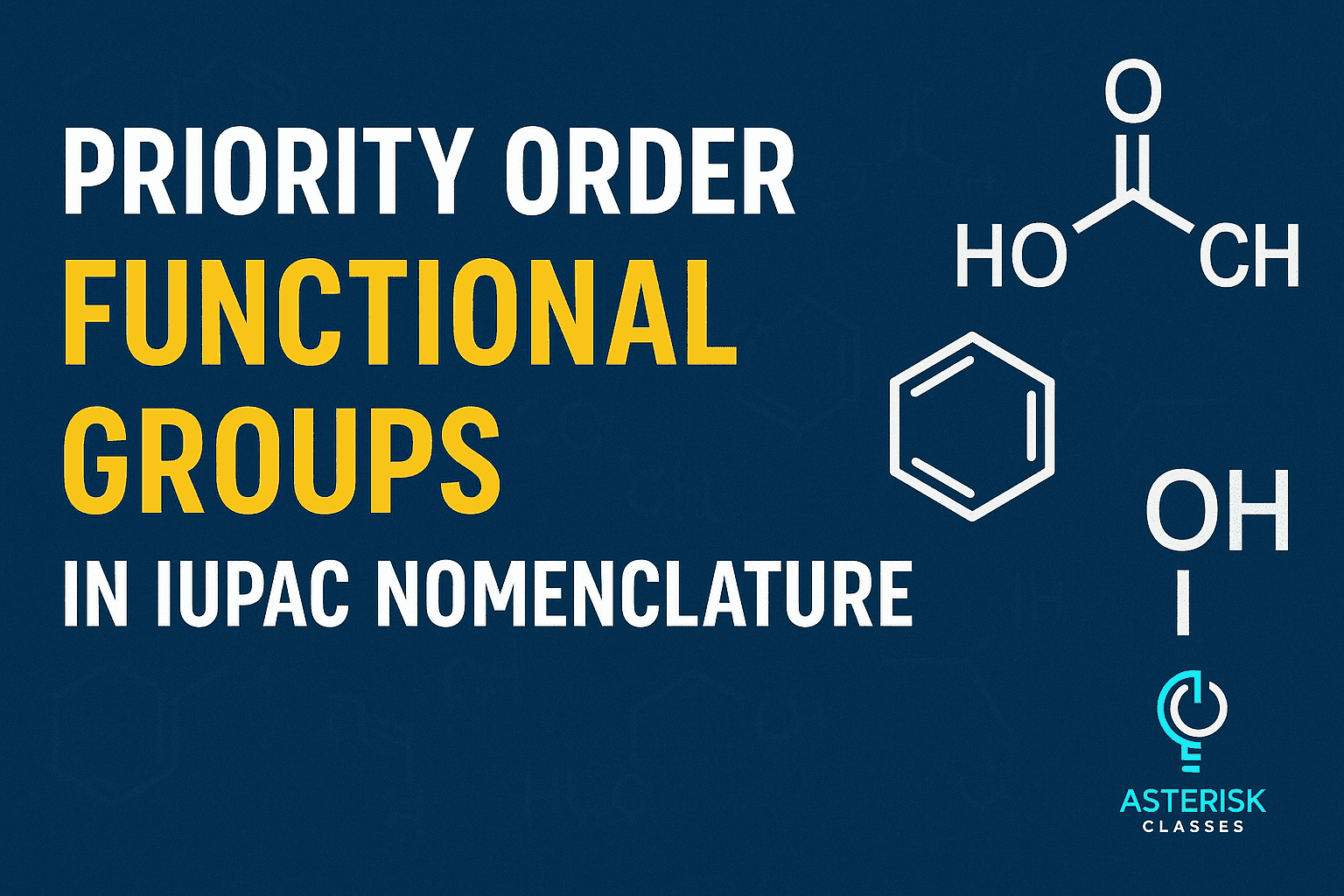
Priority order of functional groups in iupac nomenclature

Priority order of functional groups in iupac nomenclature Master the hierarchy of functional groups for organic compound naming Priority Order of Functional Groups 1. Carboxylic Acids -oic acid 2. Esters -oate 3. Amides -amide 4. Nitriles -nitrile 5. Aldehydes -al 6. Ketones -one 7. Alcohols -ol 8. Amines -amine 9. Alkenes/Alkynes -ene/-yne 10. Ethers/Haloalkanes alkoxy-/halo- … Read more
All important stoichiometry notes on a few pages pdf

Complete Stoichiometry Guide – All Concepts on Few Pages All important stoichiometry notes on a few pages All essential concepts condensed into a powerful reference guide Mole Concept Balancing Equations Limiting Reactants Solution Stoichiometry NEET/JEE Focus Why Stoichiometry Matters Stoichiometry is the quantitative study of reactants and products in chemical reactions. It’s the foundation for: … Read more

Chemical Kinetics notes

Chemical Kinetics: The Study of Reaction Rates Chemical Kinetics: The Study of Reaction Rates Reaction Dynamics Understanding how fast chemical reactions occur and the factors that influence their rates What is Chemical Kinetics? Chemical kinetics is the branch of physical chemistry that studies the rates of chemical reactions and the molecular mechanisms by which they … Read more

Chemical kinetics ncert solutions class 12

chemical kinetics

​ Chemical kinetics ncert solutions​ Chemical kinetics ncert solutions Detailed solutions to all intext and exercise questions from Chemical Kinetics Intext Questions Solutions 3.1 For the reaction R → P, the concentration of a reactant changes from 0.03M to 0.02M in 25 minutes. Calculate the average rate of reaction using units of time both in … Read more

Redox reaction class 11 notes

Redox reaction class 11 notes: Electron Transfer in Chemistry Redox reaction class 11 notes: Electron Transfer in Chemistry Electrochemistry Exploring oxidation-reduction reactions that power batteries, biological systems, and industrial processes What Are Redox Reactions? Redox (reduction-oxidation) reactions involve the transfer of electrons between chemical species. These reactions are fundamental to energy production, corrosion, metabolism, and … Read more

pH and Its Importance class 10

pH and Its Importance pH and Its Importance Chemistry Insights What is pH? The term pH stands for “potential of hydrogen”. It measures the acidity or basicity of aqueous solutions on a scale from 0 (very acidic) to 14 (very basic), with 7 being neutral (pure water). Acids: pH < 7 (higher H+ concentration) Bases: ... Read more

Physical Properties of Metals and Non-metals class 10

Physical Properties of Metals and Non-metals | Chemistry Blog Physical Properties of Metals and Non-metals A comprehensive guide for students preparing for exams Introduction Elements are broadly classified into metals and non-metals based on their physical and chemical properties. Understanding these properties is fundamental to chemistry and helps explain how different elements behave in various … Read more

Chemical Properties of Metals class 10

Chemical Properties of Metals | Chemistry Blog Chemical Properties of Metals Understanding how metals react in different chemical environments Introduction The chemical properties of metals are primarily determined by their tendency to lose electrons and form positive ions (cations). Unlike their physical properties which describe appearance and behavior, chemical properties describe how metals interact with … Read more

Action of Water on Metals class 10

Action of Water on Metals Action of Water on Metals Water is one of the most common substances on Earth, and understanding how it interacts with metals is crucial for both theoretical chemistry knowledge and practical applications. In this blog post, we’ll explore how different metals react with water, the patterns of reactivity, and the … Read more

Action of Air on Metals class 10

Action of Air on Metals | Chemistry Blog Action of Air on Metals Understanding how different metals react with components of air Introduction Air is a mixture of gases, primarily nitrogen (78%), oxygen (21%), carbon dioxide (0.04%), and trace amounts of other gases including water vapor. When metals are exposed to air, they may undergo … Read more