Class 10 maths chapter 2 exercise 2.2

2.2

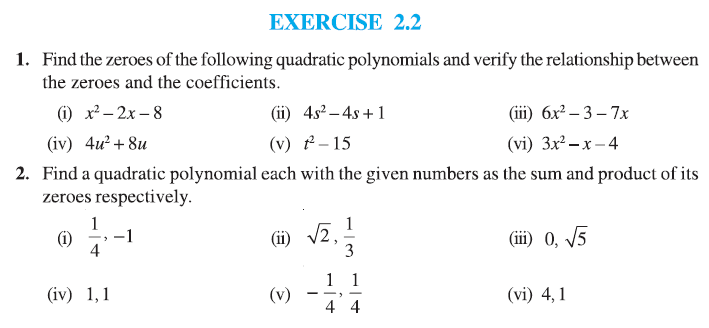
Exercise 1.3 Solutions – Real Numbers (Class 10) class 10 maths chapter 2 exercise 2.2 Quadratic Polynomials – Middle Term Splitting Method Question 1: Find the zeroes and verify relationships (i) x² – 2x – 8 Step 1: Factorize using middle term splitting x² – 2x – 8 = x² – 4x + 2x – … Read more
Exercise 2.1 Class 10 NCERT Solution

Exercise 2.1 class 10

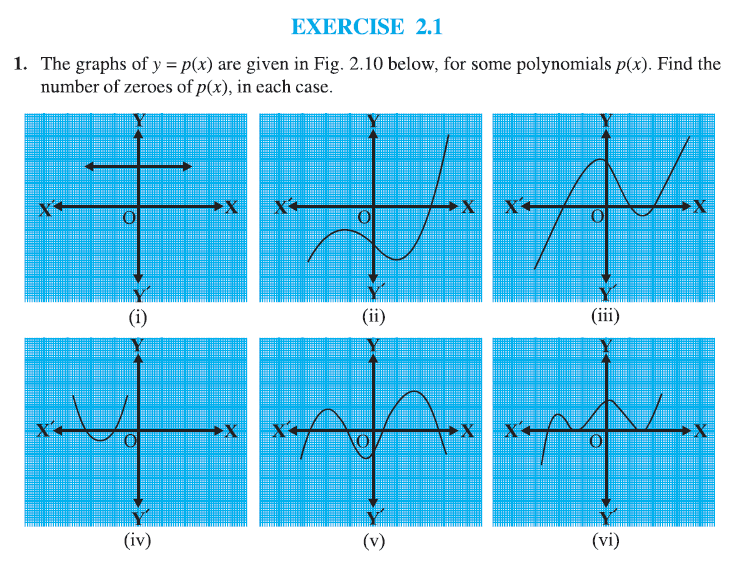
Exercise 1.3 Solutions – Real Numbers (Class 10) Exercise 2.1 Class 10 Problem Statement: The graphs of y = p(x) are given in Fig. 2.10 (not shown here) for some polynomials p(x). Find the number of zeroes of p(x), in each case. Note: Since the actual graphs aren’t provided, this solution assumes typical polynomial graph … Read more

Polynomials Exercise 2.1 Solution from the New syllabus of NCERT Book

Polynomials Exercise 2.1 Solutions with Practice Question from the RD Sharma Books with Latest NCERT Syllabus Class 9th Mathematics (Exercise 2.1) Polynomials Exercise 2.1 Solutions with Practice Question from the RD Sharma Books with Latest NCERT Syllabus Class 9th Mathematics Exercise 2.1 Solutions 1. Identify Polynomials in One Variable (i) \(4x^2 – 3x + 7\) … Read more

Class 9th maths exercise 1.3

class 9th maths exercise 1.3

Class 9 Maths Chapter 1 Exercise 1.3 Solutions Class 9 Maths Chapter 1: Number Systems class 9th maths exercise 1.3 1. Decimal Forms and Expansion Types (i) \(\frac{36}{100} = 0.36\) (Terminating) (ii) \(\frac{1}{11} = 0.\overline{09}\) (Non-terminating repeating) (iii) \(4\frac{3}{8} = 4.375\) (Terminating) (iv) \(\frac{3}{13} = 0.\overline{230769}\) (Non-terminating repeating) (v) \(\frac{2}{11} = 0.\overline{18}\) (Non-terminating repeating) (vi) … Read more

Class 9th maths exercise 1.2

class 9th maths exercise 1.2

Class 9 Maths Chapter 1 Exercise 1.2 Solutions Class 9 Maths Chapter 1: Number Systems class 9th maths exercise 1.2 Question 1: State True/False with justification (i) Every irrational number is a real number. True: Real numbers consist of both rational and irrational numbers (\(\mathbb{R} = \mathbb{Q} \cup \mathbb{I}\)) (ii) Every point on the number … Read more