
Don’t Miss Out our Quizzes!
Check out these related posts to enhance your learning experience:
Tissue Notes CBSE 9th Science QuizTissue class 9 notes pdf
A tissue is a group of cells having similar structure and function. In multicellular organisms, cells specialize to perform specific functions through the formation of tissues. This chapter explores plant and animal tissues, their types, structures and functions.
1. Plant Tissues
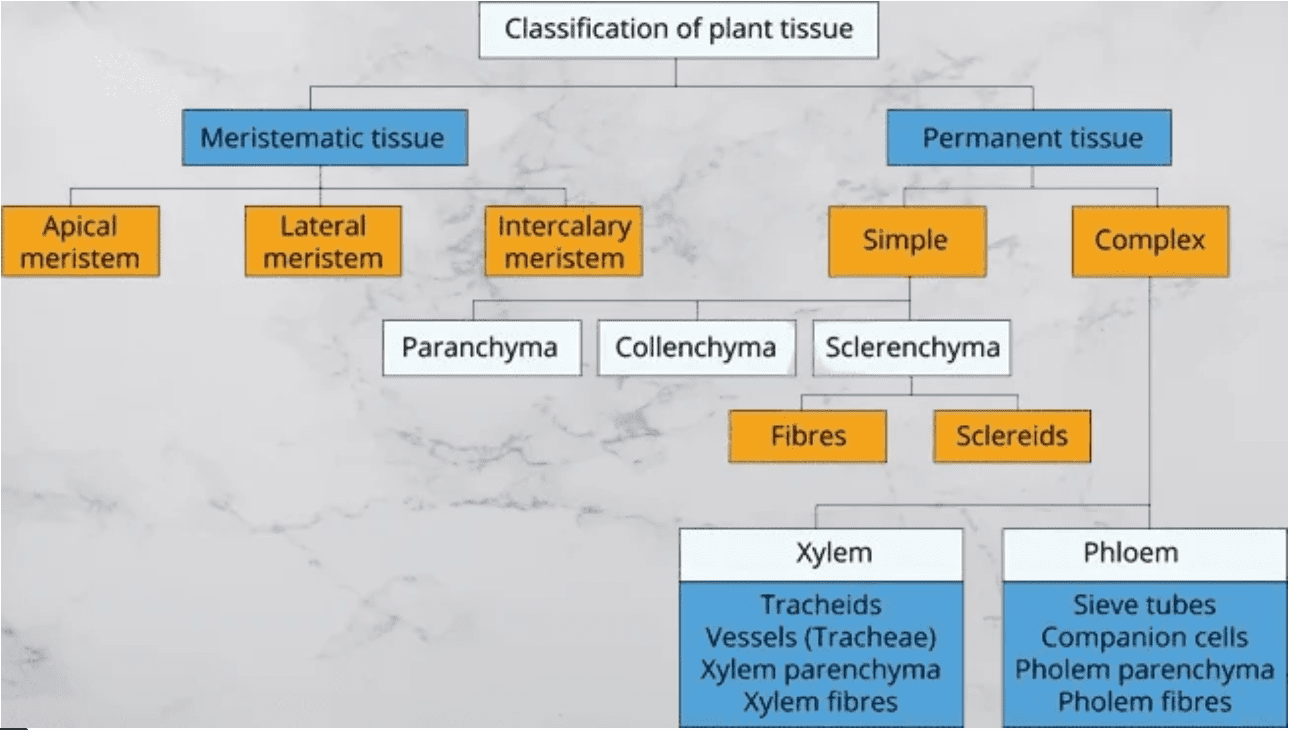
1.1 Meristematic Tissue
- Composed of actively dividing cells
- Responsible for plant growth
- Cells are small, thin-walled with dense cytoplasm
- No intercellular spaces
Types of Meristematic Tissue:
| Type | Location | Function |
|---|---|---|
| Apical Meristem | Tips of roots and stems | Primary growth (increase in length) |
| Lateral Meristem | Laterally placed in stems and roots | Secondary growth (increase in girth) |
| Intercalary Meristem | Base of leaves or internodes | Growth of internodes and leaves |

Location of meristematic tissues in plants
1.2 Permanent Tissue
Formed from meristematic tissue that has lost the ability to divide
A. Simple Permanent Tissue
Made of one type of cells:
| Tissue | Structure | Function | Location |
|---|---|---|---|
| Parenchyma | Thin-walled, living cells with intercellular spaces | Storage, photosynthesis, secretion | Leaves, fruits, roots |
| Collenchyma | Thickened at corners, living cells | Mechanical support, flexibility | Below epidermis in stems, petioles |
| Sclerenchyma | Thick lignified walls, dead cells | Rigid support, protection | Stems, veins of leaves, seed coats |
Simple permanent tissues in plants
B. Complex Permanent Tissue
Made of more than one type of cells (conducting tissues):
| Tissue | Components | Function | Direction of flow |
|---|---|---|---|
| Xylem | Tracheids, vessels, xylem parenchyma, xylem fibers | Water and mineral transport, mechanical support | Roots to shoots (upward) |
| Phloem | Sieve tubes, companion cells, phloem fibers, phloem parenchyma | Food transport | Leaves to other parts (bidirectional) |

Xylem and phloem tissues (replace with actual image)
2. Animal Tissues
2.1 Epithelial Tissue
- Covers body surfaces and lines body cavities
- Cells are tightly packed with little intercellular matrix
- Basement membrane present
- Avascular (no blood vessels)
Types of Epithelial Tissue:
| Type | Structure | Location | Function |
|---|---|---|---|
| Squamous | Flat, scale-like cells | Alveoli, blood vessels | Diffusion, filtration |
| Cuboidal | Cube-shaped cells | Kidney tubules, glands | Secretion, absorption |
| Columnar | Tall, pillar-like cells | Intestine lining | Secretion, absorption |
| Ciliated | Columnar cells with cilia | Respiratory tract | Movement of mucus |
| Glandular | Modified columnar cells | Glands | Secretion |
2.2 Connective Tissue
- Most abundant and widely distributed tissue
- Cells are scattered in extracellular matrix
- Functions: binding, support, protection, transport
Types of Connective Tissue:
| Type | Structure | Location | Function |
|---|---|---|---|
| Areolar | Gel-like matrix with fibroblasts, macrophages | Beneath skin, between muscles | Support, elasticity |
| Adipose | Fat globules in matrix | Subcutaneous layer, around organs | Storage, insulation |
| Bone | Hard matrix with calcium salts | Skeleton | Support, protection |
| Cartilage | Solid, pliable matrix (chondrin) | Ear, nose, trachea | Support, flexibility |
| Blood | Fluid matrix (plasma) with RBCs, WBCs, platelets | Blood vessels | Transport, defense |
| Ligaments | Very elastic fibers | Bone to bone joints | Connection |
| Tendons | Non-elastic fibers | Muscle to bone | Connection |
2.3 Muscular Tissue
- Composed of elongated cells (muscle fibers)
- Specialized for contraction and movement
- Contains contractile proteins (actin and myosin)
Types of Muscular Tissue:
| Type | Structure | Location | Control | Function |
|---|---|---|---|---|
| Skeletal (Striated) | Long, cylindrical, multinucleated with striations | Attached to bones | Voluntary | Body movement |
| Smooth (Non-striated) | Spindle-shaped, uninucleated | Walls of hollow organs | Involuntary | Organ movement |
| Cardiac | Branched, uninucleated with intercalated discs | Heart | Involuntary | Heart contraction |
2.4 Nervous Tissue
- Composed of neurons and neuroglia
- Neurons are excitable cells that transmit impulses
- Neuroglia are supporting cells
Structure of Neuron:
- Cell body (Cyton): Contains nucleus and cytoplasm
- Dendrites: Short fibers that receive impulses
- Axon: Long fiber that transmits impulses away from cell body
- Myelin sheath: Fatty covering that insulates axon (not present in all neurons)
3. Comparison of Plant and Animal Tissues
| Feature | Plant Tissues | Animal Tissues |
|---|---|---|
| Growth | Throughout life (meristems present) | Limited to certain period |
| Structural organization | Simple | Complex |
| Energy storage | As starch | As glycogen |
| Dead cells | Many (sclerenchyma, xylem) | Few (stratum corneum) |
| Movement | Localized (tropisms) | Organism-wide |
4. Frequently Asked Questions
Q: Why are xylem and phloem called complex tissues?
A: They are called complex tissues because they are made of more than one type of cells that work together as a unit.
Q: What is the function of intercalary meristem?
A: Intercalary meristem located at the base of leaves or internodes helps in the growth of internodes and leaves, allowing the plant to regrow lost parts.
Q: Why is blood considered a connective tissue?
A: Blood is considered connective tissue because it has a fluid matrix (plasma) in which cells are suspended, and it connects different parts of the body by transporting substances.
Q: What are the differences between tendons and ligaments?
A: Tendons connect muscles to bones and are made of non-elastic white fibers. Ligaments connect bones to bones at joints and are made of elastic yellow fibers.
5. Summary
- Tissues are groups of similar cells performing specific functions
- Plant tissues are of two main types: meristematic and permanent
- Permanent plant tissues include simple (parenchyma, collenchyma, sclerenchyma) and complex (xylem, phloem)
- Animal tissues include four main types: epithelial, connective, muscular and nervous
- Epithelial tissues cover and protect, connective tissues support and connect, muscular tissues contract, and nervous tissues conduct impulses
For better understanding, try these activities:
- Prepare temporary mounts of onion peel (epidermal cells) and observe under microscope
- Observe prepared slides of different animal tissues
- Compare the flexibility of different plant parts (leaf vs stem) to understand tissue differences
Don’t Miss Out our Quizzes!
Check out these related posts to enhance your learning experience:
10th Science Quiz 9th Science Quiz