

1. Introduction & Octet Rule
Atoms combine to attain stability by completing their octet (8 electrons in valence shell), similar to noble gases.
Exceptions to Octet Rule:
- Incomplete Octet: Central atom has < 8 e- (e.g., LiCl, BeH2, BCl3).
- Expanded Octet (Hypervalent): Central atom has > 8 e- (e.g., PCl5, SF6). Possible due to d-orbitals.
- Odd Electron Species: NO, NO2.
Types of Bonds
| Ionic Bond | Covalent Bond |
|---|---|
| Complete transfer of electrons. | Sharing of electrons. |
| Metal (Low IE) + Non-metal (High EA). | Non-metal + Non-metal. |
| Favored by High Lattice Energy. | Can be Polar or Non-polar. |
Formal Charge (F.C.):
F.C. = V - L - ½S
(V=Valence e-, L=Lone pair e-, S=Shared e-)
2. Bond Parameters
- Bond Order: Number of bonds between two atoms. B.O. ∝ Stability ∝ Bond Energy ∝ 1/Bond Length.
- Resonance: When a single Lewis structure cannot explain all properties. The actual structure is a Resonance Hybrid. (e.g., in Ozone, both O-O bond lengths are identical).
- Dipole Moment (μ): Measure of polarity. μ = q × d. Unit: Debye (D).
Resultant μ = √(μ12 + μ22 + 2μ1μ2 cosθ)
3. VSEPR Theory
Valence Shell Electron Pair Repulsion Theory: Shapes depend on the number of valence electron pairs around the central atom.
Repulsion Order:
[Image of VSEPR molecular geometries chart]
Lone Pair-Lone Pair > LP-BP > Bond Pair-Bond Pair
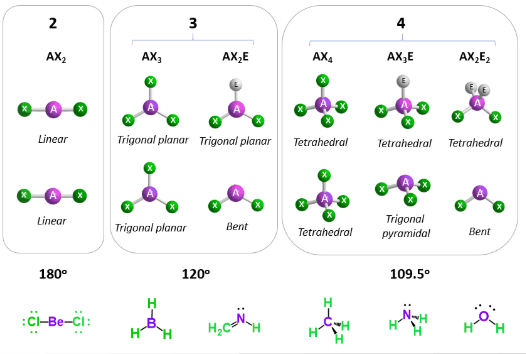
| Pairs (BP+LP) | Geometry | Shape (if LP exists) | Example |
|---|---|---|---|
| 2 (2+0) | Linear | Linear | BeCl2 |
| 3 (2+1) | Trigonal Planar | Bent / V-shape | SO2 |
| 4 (3+1) | Tetrahedral | Pyramidal | NH3 |
| 4 (2+2) | Tetrahedral | Bent / V-shape | H2O |
| 5 (4+1) | Trigonal Bipyramidal | See-Saw | SF4 |
| 5 (3+2) | Trigonal Bipyramidal | T-Shape | ClF3 |
4. VBT & Hybridization
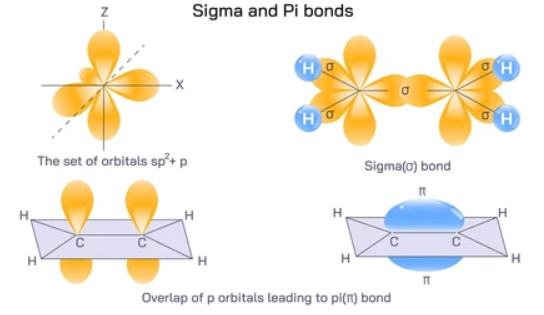
Sigma (σ) vs Pi (π) Bond:
- σ-bond: Head-on overlap (s-s, s-p, p-p). Stronger. Free rotation possible.
- π-bond: Sideways overlap (p-p). Weaker. No rotation. Always present with σ.
Hybridization
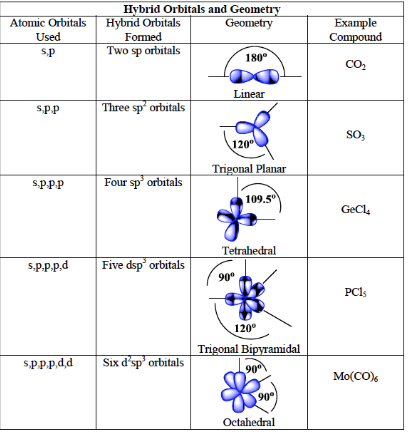
Intermixing of atomic orbitals to form new equivalent hybrid orbitals.
How to find (Steric Number):
Z = ½ [V + M - C + A]
V = Valence e-, M = Monovalent atoms, C/A = Charge
- sp (Z=2): Linear (180°). e.g., BeCl2, C2H2.
- sp2 (Z=3): Trigonal Planar (120°). e.g., BCl3, C2H4.
- sp3 (Z=4): Tetrahedral (109.5°). e.g., CH4.
- sp3d (Z=5): Trigonal Bipyramidal. e.g., PCl5.
- sp3d2 (Z=6): Octahedral. e.g., SF6.
- sp3d3 (Z=7): Pentagonal Bipyramidal. e.g., IF7.
5. Hydrogen Bonding
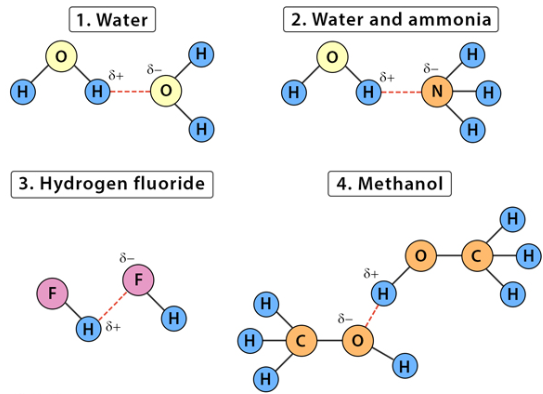
Electrostatic attraction between H atom covalently bonded to highly electronegative atom (F, O, N) and another electronegative atom.
| Inter-molecular | Between different molecules. Effect: Increases BP, MP, viscosity. Ex: H2O, HF. |
| Intra-molecular | Within same molecule. Effect: Decreases BP (prevents association). Ex: o-Nitrophenol. |
Numericals & HOTS
Important Formulae & Trends
20 Golden Facts (NEET)
- 1. Dipole Moment Paradox: NH3 has a higher dipole moment than NF3. In NH3, orbital dipole and bond dipole are in same direction; in NF3, they oppose each other.
- 2. Bond Angle Trends: Bond angle decreases as the number of Lone Pairs increases (VSEPR): CH4 (109.5°) > NH3 (107°) > H2O (104.5°).
- 3. Resonance Hybrid: In Ozone (O3) or Carbonate (CO32-), all bond lengths are identical and intermediate between single and double bonds.
- 4. Hybridization of Solids: PCl5 in gaseous state is sp3d (TBP), but in solid state it exists as [PCl4]+ (sp3) and [PCl6]- (sp3d2).
- 5. Isoelectronic Molecules: Species with same no. of electrons often have same shape and bond order (e.g., CO and N2 have B.O. = 3).
- 6. H-Bonding Strength: The order of H-bond strength is H—F > H—O > H—N, following the electronegativity of the atom.
- 7. Ortho- vs Para- Nitrophenol: o-Nitrophenol is steam volatile due to Intramolecular H-bonding, while p-Nitrophenol has Intermolecular H-bonding and higher boiling point.
- 8. SF4 Shape: It has 4 BPs and 1 LP. Shape is See-Saw. The lone pair always occupies an equatorial position to minimize repulsion.
- 9. Back Bonding: BF3 is a Lewis acid, but its acidity is less than BCl3 due to pπ-pπ back bonding between B and F.
- 10. Symmetry & Dipole: Symmetrical molecules like BF3, CCl4, SF6 have μ = 0, even if individual bonds are polar.
- 11. Bond length in PCl5: Axial bonds are longer than equatorial bonds due to greater repulsion from equatorial bond pairs.
- 12. Hybridization in BeCl2: In vapor phase it is sp (linear); in solid state, it polymerizes to form chloro-bridges with sp3 hybridization.
- 13. Lattice Enthalpy: Increases with higher ionic charges and smaller ionic radii (U ∝ q1q2/r).
- 14. Paramagnetism of O2: Cannot be explained by VBT; Molecular Orbital Theory (MOT) explains it due to two unpaired electrons in antibonding orbitals.
- 15. Bond Order of CO+: Exceptional case; B.O. of CO is 3, but B.O. of CO+ is 3.5 (electron removed from antibonding orbital).
- 16. Solubility: Ionic compounds are soluble in polar solvents (high dielectric constant like H2O) but insoluble in non-polar solvents.
- 17. Coordinate Bond: Also called Dative bond. Once formed, it is indistinguishable from a regular covalent bond.
- 18. Melting Point of NaCl: Very high because of strong non-directional electrostatic forces in the 3D crystal lattice.
- 19. Sigma vs Pi Strength: Sigma bond is always stronger than Pi bond because head-on overlap is more effective than lateral overlap.
- 20. Formal Charge Rule: The structure with the lowest formal charges on atoms is the most stable and preferred Lewis structure.
📱 Practice MCQs for this topic inside our App
📱 Practice MCQs for this topic inside our App
📱 Practice MCQs for this topic inside our App
📱 Practice MCQs for this topic inside our App