

1. Basic Terminology
Coordination Compounds: Compounds containing a central metal atom bonded to a fixed number of ions or molecules (ligands) by coordinate bonds. Example: K4[Fe(CN)6].
- Double Salt: Dissociates completely into ions in water (e.g., Mohrs salt, Potash Alum).
- Complex: Retains identity in solid and solution state. The complex ion [Fe(CN)6]4- does not dissociate into Fe2+ and CN-.
Key Terms
- Coordination Entity: The central metal + ligands enclosed in square brackets [ ].
- Central Metal: Lewis Acid (accepts electron pairs). Usually transition metals.
- Ligands: Lewis Bases (donate electron pairs). Can be neutral (NH3), negative (Cl-), or positive (NO+).
- Coordination Number (CN): Number of coordinate bonds formed with the central metal. (For monodentate ligands, CN = Number of ligands).
2. Ligands & Nomenclature
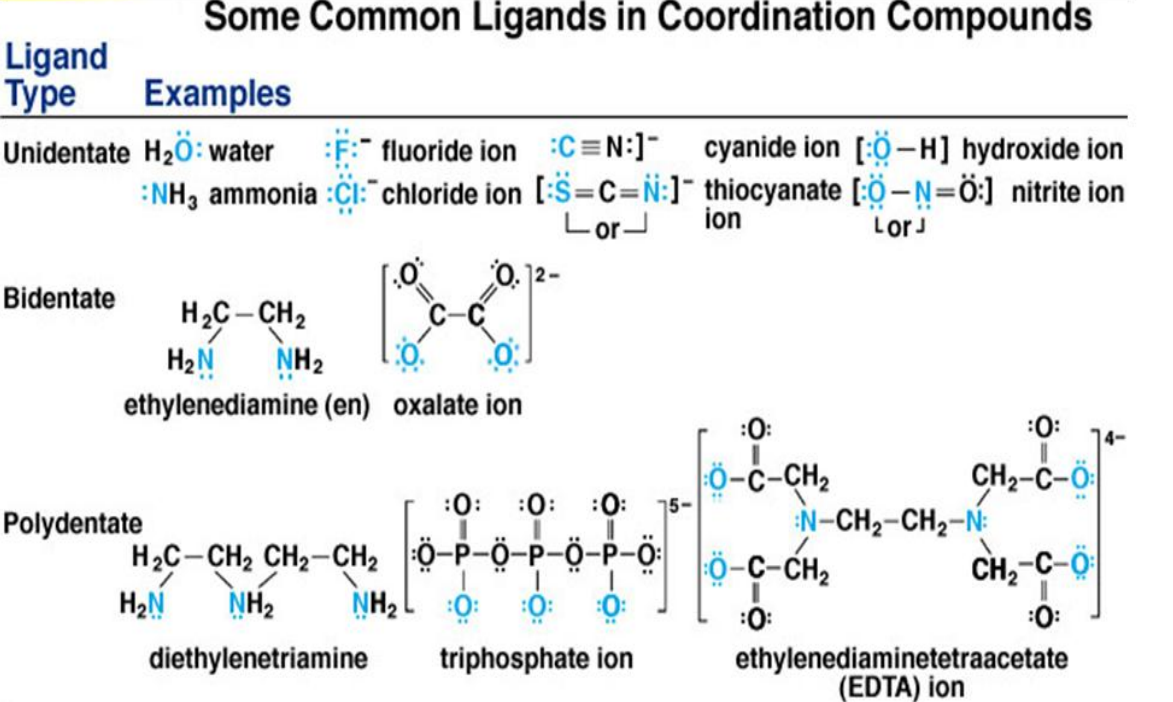
Types of Ligands
| Type | Description | Examples |
|---|---|---|
| Unidentate | Donates 1 pair. | H2O (aqua), NH3 (ammine), Cl- (chlorido) |
| Bidentate | Donates 2 pairs. | en (ethane-1,2-diamine), ox (oxalate) |
| Polydentate | Multiple pairs. | EDTA4- (Hexadentate) |
| Ambidentate | Two donor atoms but uses one. | NO2- (N-nitrito), ONO- (O-nitrito) |
- Cation is named first, then anion.
- Ligands are named alphabetically before the metal.
- Prefixes (di, tri, tetra) used. For complex ligands (bis, tris, tetrakis).
- Oxidation state of metal in Roman numerals ( ).
- If complex is anionic, metal ends in -ate (e.g., Ferrate, Argentate).
3. Werner's Theory
Alfred Werner proposed that metals show two types of valencies:
- Primary Valency: Ionizable. Equals oxidation state. Satisfied by anions. (Represented by dotted lines).
- Secondary Valency: Non-ionizable. Equals coordination number. Satisfied by ligands. (Represented by solid lines). Directional (gives geometry).
4. Isomerism
Structural Isomerism
- Linkage: Ambidentate ligands (NO2 vs ONO).
- Coordination: Exchange of ligands between cationic and anionic entities.
- Ionization: Different ions in solution (Counter ion becomes ligand). e.g., [Co(NH3)5SO4]Br vs [Co(NH3)5Br]SO4.
- Solvate (Hydrate): Water as ligand vs water of crystallization.
Stereoisomerism
Common in CN=4 (Square Planar) and CN=6 (Octahedral).
Fac-Mer Isomerism: In Octahedral [MA3B3]. Fac (facial) and Mer (meridional).
Note: Tetrahedral complexes do NOT show geometrical isomerism.
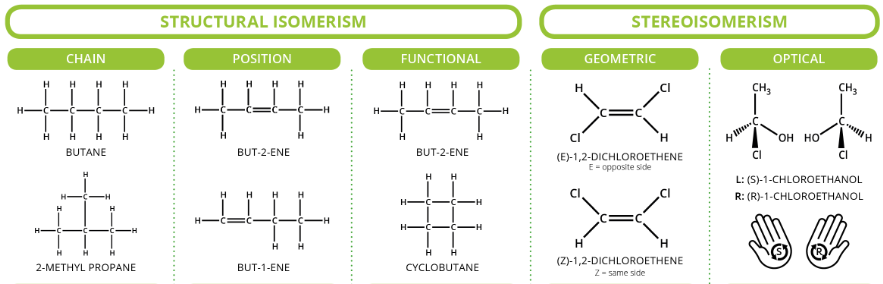
Non-superimposable mirror images. Chiral. Common in octahedral complexes with bidentate ligands (e.g., [Co(en)3]3+).
5. Bonding (VBT & CFT)
Valence Bond Theory (VBT)
Hybridization determines geometry.
| CN=4 | sp3 (Tetrahedral) | dsp2 (Square Planar) |
| CN=6 | sp3d2 (Outer Orbital) | d2sp3 (Inner Orbital) |
Crystal Field Theory (CFT)
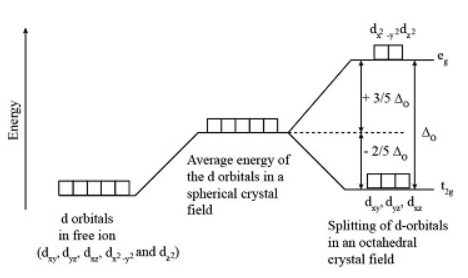
Considers ionic interaction. Ligands split metal d-orbitals.
Split into t2g (lower energy, dxy, dyz, dzx) and eg (higher energy, dx2-y2, dz2).
- Strong Field Ligand: High Δo. Causes pairing. (Low Spin).
- Weak Field Ligand: Low Δo. No pairing. (High Spin).
I- < Br- < Cl- < F- < OH- < H2O < NH3 < en < CN- < CO
(Weak Field → Strong Field)
6. Colour & Applications
Due to d-d transition. Electron absorbs light to jump from t2g to eg. The complementary colour is observed.
Anhydrous CuSO4 is white (no ligands, no splitting). CuSO4·5H2O is blue.
- Hardness of Water: Estimation using EDTA.
- Medicine: Cis-platin (Cancer treatment).
- Extraction: Silver and Gold (Cyanide process).
- Biology: Hemoglobin (Fe), Chlorophyll (Mg), Vitamin B12 (Co).
Important Formulae
20 Golden Facts (NEET)
- 1. Synergic Bonding: In Metal Carbonyls (e.g., [Ni(CO)4]), the M-C bond possesses both σ and π character. M ← C (σ bond) and M → C (π back-bond). This strengthens the M-C bond and weakens the C-O bond.
- 2. Chelate Effect: Complexes with chelating ligands (like en, EDTA) are significantly more stable than those with monodentate ligands. This is an entropy-driven process.
-
3. Tetrahedral vs Square Planar: For Coordination Number 4:
Weak Field Ligand → Tetrahedral (sp3).
Strong Field Ligand → Square Planar (dsp2).
Exception: [Ni(CO)4] is tetrahedral despite Strong Field CO (d10 case). - 4. Hybridization of [Cu(NH3)4]2+: It is dsp2 (Square Planar). One 3d electron is promoted to 4p orbital to make d-orbital available.
- 5. Optical Isomerism: Square planar complexes usually do NOT show optical isomerism because they possess a plane of symmetry. Tetrahedral complexes with unsymmetrical bidentate ligands can show it.
- 6. Zero Oxidation State: Transition metals in metal carbonyls (e.g., Ni(CO)4, Fe(CO)5) have zero oxidation state.
- 7. Colour Intensity: Tetrahedral complexes are generally more intensely coloured than octahedral ones because "d-p mixing" is allowed (lack of center of symmetry), relaxing the selection rules.
-
8. Spectrochemical Series: I- < Br- < Cl- < F- < OH- < H2O < NH3 < en < CN- < CO.
(Halogens are weak, Carbon/Nitrogen donors are strong). - 9. Stability Constant (K): Higher value of log K means higher stability. Stability decreases with increase in ionic radius of central metal.
- 10. Linkage Isomerism: Shown by ambidentate ligands like NO2 (binds through N) and ONO (binds through O), or SCN and NCS.
-
11. Inner vs Outer Orbital:
d2sp3 = Inner Orbital = Low Spin (Strong Ligand).
sp3d2 = Outer Orbital = High Spin (Weak Ligand). - 12. Brown Ring Complex: Formula is [Fe(H2O)5(NO)]2+. Here Iron is in +1 Oxidation State (rare) and NO is NO+.
- 13. Wilkinson Catalyst: [(Ph3P)3RhCl]. Used for hydrogenation of alkenes.
- 14. Denticity of EDTA: It is a hexadentate ligand with 4 Oxygen and 2 Nitrogen donor atoms. Used to treat Lead poisoning.
-
15. Unpaired Electrons:
Strong field ligands force pairing (reduce n).
Weak field ligands do not force pairing (max n). - 16. Splitting Energy Order: Δsp (Square Planar) > Δo (Octahedral) > Δt (Tetrahedral).
-
17. Facial & Meridional: Stereoisomers of [MA3B3] type.
Facial (fac): Ligands on same face.
Meridional (mer): Ligands on the meridian. - 18. Zeise's Salt: K[PtCl3(η2-C2H4)]. First organometallic compound synthesized. Ethene is the ligand.
-
19. Magnetic Moment of Fe3+:
Weak Ligand (H2O): d5 (5 unpaired), μ = 5.9 B.M.
Strong Ligand (CN-): d5 (1 unpaired), μ = 1.73 B.M. - 20. Cis-Platin: [Pt(NH3)2Cl2] (cis-isomer). Used as an anti-cancer drug. The trans-isomer is toxic and inactive.