

1. General Introduction
d-Block Elements: Elements in which the last electron enters the d-orbital of the penultimate shell (n-1).
Position: Groups 3 to 12.
Elements which have incompletely filled d-orbitals in their ground state or in any of their stable oxidation states.
Note: Zn, Cd, Hg are d-block elements but NOT transition elements (full d10 config in ground & stable states).
2. Characteristic Properties
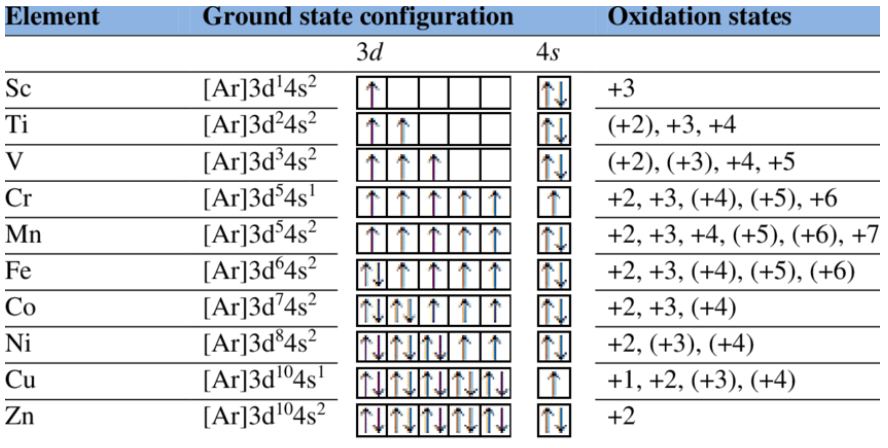
1. Variable Oxidation States
They show variable O.S. because energy difference between (n-1)d and ns orbitals is small.
• Mn shows max range (+2 to +7).
• Os and Ru show highest O.S. (+8).
• Stability depends on d0, d5, d10 config.
2. Magnetic Properties
Most are Paramagnetic due to unpaired electrons.
Spin Only Magnetic Moment (μ):
(n = number of unpaired electrons)
3. Formation of Colored Ions
Color is due to d-d transition of electrons.
• Unpaired d-electrons absorb light from visible region to jump to higher energy d-orbitals (Crystal Field Splitting).
• Ions with d0 (Sc3+) or d10 (Zn2+) are Colorless.
4. Catalytic Properties
Due to variable valency (can form unstable intermediates) and large surface area. (e.g., V2O5 in Contact Process, Fe in Haber’s Process).
5. Interstitial Compounds & Alloys
- Interstitial: Small atoms (H, C, N) trapped in crystal lattice. (Hard, high MP, chemically inert).
- Alloys: Formed because transition metals have similar radii, allowing atoms to replace each other in lattice (e.g., Brass, Bronze).
3. Important Compounds
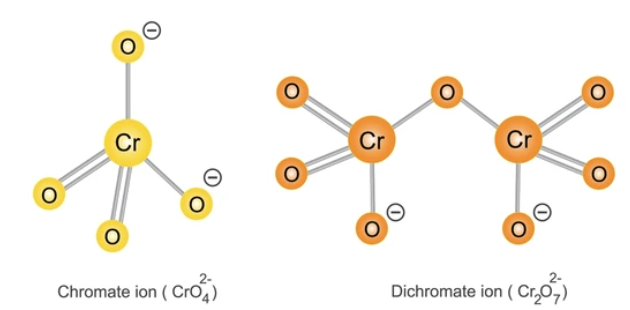
Prepared from Chromite Ore (FeCr2O4).
Chromate-Dichromate Equilibrium:
2CrO42- (Yellow) + 2H+ ↔ Cr2O72- (Orange) + H2O.
(Yellow in Alkali, Orange in Acid).
Prepared from Pyrolusite Ore (MnO2).
MnO2 → MnO42- (Green Manganate) → MnO4- (Purple Permanganate).
Strong Oxidizing Agent in Acidic, Basic, and Neutral media.
4. f-Block Elements
Last electron enters (n-2)f orbitals. General Config: (n-2)f1-14 (n-1)d0-1 ns2.
Lanthanoids (4f Series)
- Oxidation State: Most common is +3. Ce shows +4 (Noble gas config). Eu shows +2 (Half-filled f7).
- Chemical Reactivity: Similar to Calcium. React with water to release H2.
The steady decrease in atomic and ionic radii from La to Lu.
Cause: Poor shielding effect of 4f electrons.
Consequences:
1. Similarity in size of 4d and 5d series (e.g., Zr ≈ Hf).
2. Difficulty in separating Lanthanides.
3. Decrease in basic strength of hydroxides (La(OH)3 > Lu(OH)3).
Actinoids (5f Series)
- Contraction: Actinoid contraction is greater than Lanthanoid contraction (5f shielding is poorer than 4f).
- Oxidation States: Show wider range (+3, +4, +5, +6, +7) because energy gap between 5f, 6d, and 7s is very small.
5. Uses
- Titanium: Structural metal for aerospace (light & strong).
- Mischmetal: Alloy of Lanthanides (~95%) + Iron (~5%). Used in lighter flints and bullets.
- Ziegler-Natta Catalyst: (TiCl4 + Al(C2H5)3) for polythene manufacture.
- V2O5: Catalyst for H2SO4 manufacture.
Numericals & HOTS
Important Formulae & Reactions
20 Golden Facts (NEET)
- 1. Highest Oxidation State: Osmium (Os) and Ruthenium (Ru) show the highest oxidation state of +8 (e.g., OsO4). In 3d series, Manganese shows max +7 (KMnO4).
- 2. Enthalpy of Atomization: Transition metals have high ΔaH° because of strong metallic bonding involving both ns and (n-1)d electrons. Max at middle of series (Cr, Mo, W).
- 3. Lanthanoid Contraction: The atomic radii of 4d and 5d metals in the same group (e.g., Zr and Hf) are almost identical (160 pm and 159 pm). This makes their separation difficult.
-
4. Colour of Ions:
• Cu+ (3d10): Colourless
• Cu2+ (3d9): Blue
• Zn2+, Sc3+, Ti4+: Colourless (d0 or d10). - 5. E° Value of Cu: Copper has a positive E° (Cu2+/Cu = +0.34 V). This is because the high hydration enthalpy of Cu2+ does not compensate for the high sum of ionization enthalpies (IE1 + IE2). Hence, Cu does not liberate H2 from acids.
- 6. Interstitial Compounds: They are chemically inert but physical properties change (e.g., steel is harder than pure iron). They retain metallic conductivity.
- 7. Mischmetal: An alloy of Lanthanoids (~95%), Iron (~5%) and traces of S, C, Ca, Al. Used in magnesium-based alloy for bullets and lighter flints.
- 8. KMnO4 Analysis: In volumetric analysis, KMnO4 acts as a self-indicator. The end point is the appearance of a permanent light pink colour. HCl is NOT used to acidify KMnO4 because it gets oxidized to Cl2.
- 9. Europium & Ytterbium: While most Lanthanoids are +3, Eu (4f7) and Yb (4f14) show +2 oxidation states due to half-filled and full-filled stability. They act as strong Reducing Agents.
- 10. Spin Only Formula: The magnetic moment of transition metals is determined mainly by spin angular momentum. Orbital contribution is quenched by the crystal field.
-
11. Cr2+ vs Mn3+: Both have d4 config.
• Cr2+ is Reducing (wants to go to stable d3 t2g3).
• Mn3+ is Oxidizing (wants to go to stable d5 Mn2+). - 12. Coinage Metals: Cu, Ag, Au (Group 11). They have d10s1 config but are transition metals because Cu2+ (d9) and Au3+ (d8) have incomplete d-shells.
- 13. Actinoid Contraction: It is greater than Lanthanoid contraction from element to element because 5f electrons shield the nuclear charge less effectively than 4f electrons.
- 14. Density Trend: Density increases from Sc to Cu. Huge jump in density from 3d to 4d/5d series (e.g., Osmium density ~22.6 g/cc).
- 15. Basicity of Lanthanoids: La(OH)3 is the most basic and Lu(OH)3 is the least basic. This is because size decreases (La → Lu), Covalent character increases, and ability to lose OH- decreases.
- 16. MnO4- Geometry: Permanganate ion has a Tetrahedral geometry involving d3s hybridization of Manganese. The purple colour is due to Charge Transfer (O → Mn), not d-d transition.
- 17. Photography: AgBr is used in photography. Hypo (Na2S2O3) is used as a fixer to remove unexposed AgBr by forming a soluble complex.
- 18. Hg is Liquid: Mercury is a liquid metal because its 6s2 electrons are very stable (Relativistic effect) and do not participate well in metallic bonding (weak bonding).
- 19. Disproportionation of Mn: Mn(VI) (Green Manganate, MnO42-) is unstable in acidic medium and disproportionates to Mn(VII) (Purple) and Mn(IV) (Brown MnO2).
- 20. Catalytic Activity: Transition metals are good catalysts (e.g., Fe, V2O5, Ni) because they provide a surface for adsorption and can change oxidation states to form intermediates.