

1. Position & Isotopes
Hydrogen is the first element (1s1). It shows anomalous behavior because it resembles both Alkali Metals (Group 1) and Halogens (Group 17).
- Resemblance with Alkali Metals: Electronic config (ns1), forms unipositive ion (H+), forms oxides and halides.
- Resemblance with Halogens: Ionization enthalpy is high, requires one electron to complete octet (He config), forms diatomic molecule (H2).
Isotopes of Hydrogen
| Isotope | Symbol | Neutrons | Nature |
|---|---|---|---|
| Protium | 1H1 | 0 | Common (99.9%) |
| Deuterium | 1H2 (D) | 1 | Stable (Heavy) |
| Tritium | 1H3 (T) | 2 | Radioactive (β-) |
2. Preparation & Hydrides
Commercial Preparation:
- Electrolysis of Water: With traces of acid/base using Pt electrodes. High purity H2 (>99.95%) obtained from Ba(OH)2.
- Bosch Process: From Water Gas (CO + H2).
C + H2O → CO + H2 (Water Gas Shift Reaction uses FeCrO4 catalyst).
Types of Hydrides
1. Ionic (Saline) Hydrides:
Formed by s-block elements (NaH, CaH2). Crystalline, non-volatile, conduct electricity in molten state.
2. Covalent (Molecular) Hydrides:
Formed by p-block elements. Classified into:
- Electron Deficient: Group 13 (e.g., B2H6). Lewis Acids.
- Electron Precise: Group 14 (e.g., CH4). Tetrahedral.
- Electron Rich: Group 15-17 (e.g., NH3, H2O). Have lone pairs (Lewis Bases).
3. Metallic (Interstitial) Hydrides:
Formed by d & f block. H occupies interstitial sites. Non-stoichiometric (e.g., LaH2.87). Good for H-storage.
3. Water & Hardness
Hardness: Due to presence of Ca2+ and Mg2+ salts. It prevents lather formation with soap.
| Type | Caused By | Removal Methods |
|---|---|---|
| Temporary | Bicarbonates (HCO3-) of Ca, Mg | 1. Boiling 2. Clark's Method (Ca(OH)2) |
| Permanent | Chlorides & Sulphates of Ca, Mg | 1. Washing Soda (Na2CO3) 2. Calgon Method 3. Ion Exchange (Zeolite) 4. Synthetic Resin |
4. Hydrogen Peroxide (H2O2)
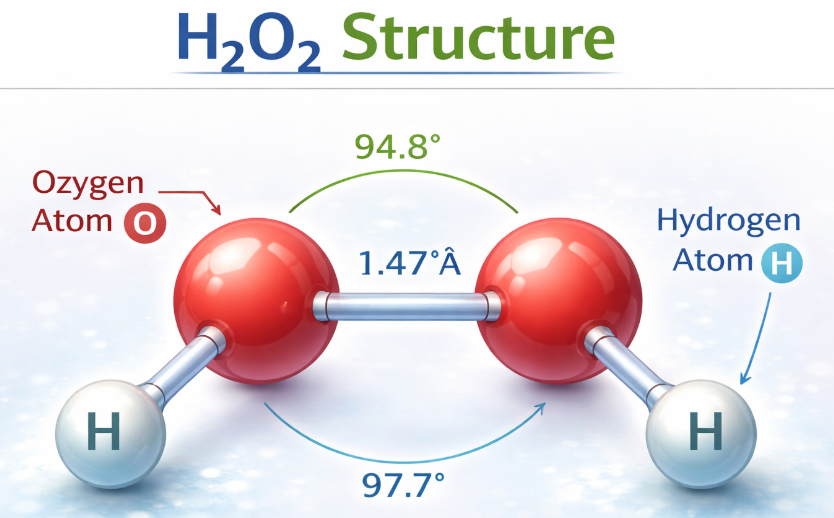
Structure:
Non-planar structure. Often called "Open Book" structure. Dihedral angle is 111.5° in gas phase and 90.2° in solid phase.
Non-planar structure. Often called "Open Book" structure. Dihedral angle is 111.5° in gas phase and 90.2° in solid phase.
Chemical Properties
Acts as both Oxidizing and Reducing agent in acidic and basic media.
- Oxidizing: PbS(s) + 4H2O2 → PbSO4 + 4H2O (Bleaching action).
- Reducing: HOCl + H2O2 → H3O+ + Cl- + O2 (Antichlor).
5. Uses & Hydrogen Economy
Hydrogen Economy:
The transportation and storage of energy in the form of liquid or gaseous dihydrogen. Advantages:
- High calorific value.
- Pollution free (Product is water).
- Used in fuel cells for electric power.
Specific Uses:
- Liquid H2: Rocket fuel.
- Atomic Hydrogen Torch: For cutting and welding (temp ~4000 K).
- Vegetable Ghee: Hydrogenation of vegetable oils.
Numericals & HOTS
Important Formulae & Reactions
20 Golden Facts (NEET)
- 1. Tritium: The only radioactive isotope of Hydrogen. It is a low energy β- emitter and has a half-life of 12.33 years.
- 2. Hydride Gap: Metals of Group 7, 8, and 9 do NOT form hydrides. This region in the periodic table is called the Hydride Gap. (Exception: CrH only).
- 3. Ortho vs Para Hydrogen: At room temp, H2 is 75% Ortho (parallel nuclear spin) and 25% Para (anti-parallel). At very low temps, Para form is more stable (100% Para at 0K).
- 4. Density of Ice: Ice has a cage-like structure due to H-bonding, leaving vacant spaces. Thus, Density of Ice < Density of Water. Max density of water is at 4°C.
- 5. 10 Volume H2O2: This means 1 Litre of this H2O2 solution will produce 10 Litres of O2 at STP. It corresponds to ~3% strength.
- 6. H2O2 Storage: It decomposes slowly on exposure to light. Stored in wax-lined glass or plastic bottles in dark. Urea is added as a stabilizer.
- 7. Temporary Hardness: Caused by Bicarbonates (HCO3-) of Ca and Mg. Removed simply by Boiling (converts to insoluble carbonates) or Clark's method.
- 8. Permanent Hardness: Caused by Chlorides and Sulphates. Removed by Washing Soda, Calgon, or Ion-Exchange (Zeolites/Resins). Boiling does NOT remove it.
- 9. Heavy Water (D2O): Prepared by exhaustive electrolysis of water. Used as a moderator in nuclear reactors to slow down neutrons.
- 10. Non-stoichiometric Hydrides: Transition metals (d-block) form hydrides like LaH2.87, TiH1.5-1.8. They are good potential hydrogen storage media.
- 11. Antichlor: H2O2 is used as an antichlor to remove excess chlorine from fabrics after bleaching.
- 12. Structure of H2O2: It has a non-planar, Open Book structure. The dihedral angle is 111.5° in Gas phase and 90.2° in Solid phase.
- 13. Atomic Hydrogen Torch: Recombination of atomic hydrogen generates very high temp (4000 K), used for cutting and welding high-melting metals.
- 14. Nascent Hydrogen: Hydrogen produced in situ (e.g., Zn + H2SO4) is called Nascent Hydrogen. It is a much stronger reducing agent than molecular H2.
- 15. Permutit/Zeolite: Hydrated Sodium Aluminium Silicate (NaAlSiO4). Used for softening water by exchanging Na+ with Ca2+/Mg2+.
- 16. High Ionization Enthalpy: Hydrogen has a very high IE (1312 kJ/mol) for a single electron species, resembling Halogens more than Alkali metals in this aspect.
- 17. Oxidizing Action of H2O2: In acidic medium, H2O2 oxidizes Fe2+ to Fe3+ (Ferrous to Ferric) and PbS to PbSO4 (Black to White).
- 18. Clark's Method: Calculates exact amount of Lime (Ca(OH)2) needed. If excess lime is added, water becomes hard again due to formation of soluble Calcium Bicarbonate.
- 19. Synthetic Resin: Cation exchange resins (R-SO3H) exchange H+ for Ca2+, and Anion exchange resins (R-NH2) exchange OH- for Cl-. This produces demineralized water.
- 20. Fuel of Future: Dihydrogen yields more energy per unit mass than petrol (approx 3 times). However, storage (requires heavy cylinders) is the main challenge.
📱 Practice MCQs for this topic inside our App
📱 Practice MCQs for this topic inside our App
📱 Practice MCQs for this topic inside our App
📱 Practice MCQs for this topic inside our App