

1. General Properties
Elements where the last electron enters the outermost p-orbital. General Config: ns2np1-6.
The reluctance of ns2 electrons to participate in bonding due to poor shielding by d and f electrons.
Consequence: Stability of lower oxidation state increases down the group. (e.g., Tl+1 > Tl+3).
2. Group 13 (Boron Family)
Config: ns2np1. Elements: B, Al, Ga, In, Tl.
Important Compounds of Boron
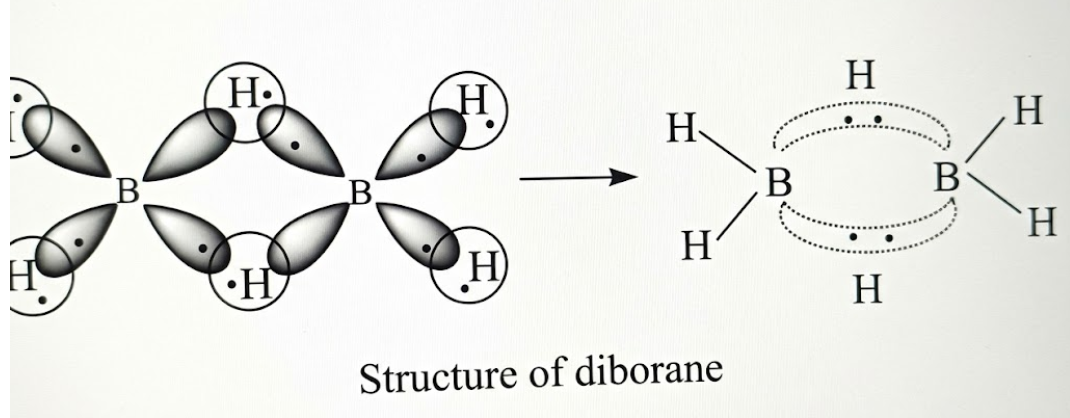
Electron deficient hydride. Contains Banana Bonds (3-center-2-electron bonds).
• Four terminal H-atoms are normal (2c-2e).
• Two bridging H-atoms are banana bonds.
• Hybridization of Boron: sp3.
Used in Borax Bead Test (detects colored cations like Co2+, Cu2+).
Aqueous solution is alkaline.
Monobasic weak Lewis acid (accepts OH-). Layered structure due to H-bonding.
3. Group 14 (Carbon Family)
Config: ns2np2. Elements: C, Si, Ge, Sn, Pb.
Property of self-linking. Order: C >> Si > Ge ≈ Sn. Carbon forms strong C-C bonds.
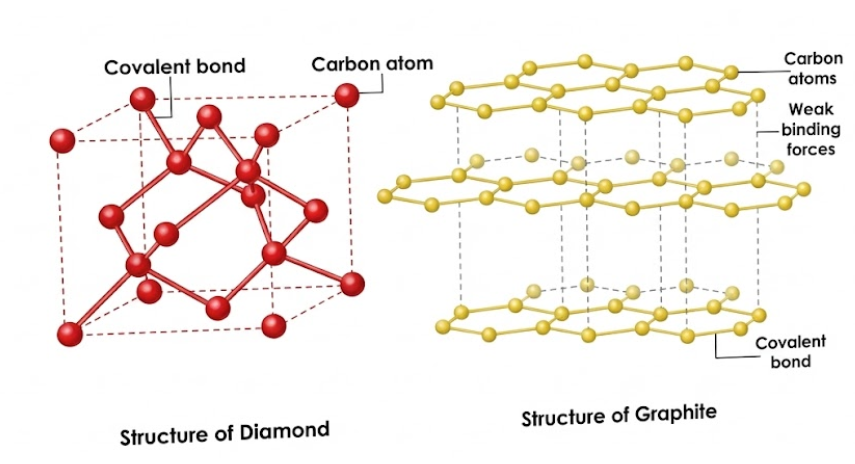
Allotropes of Carbon
- Diamond: sp3 hybridized. Hardest substance. Insulator. 3D network.
- Graphite: sp2 hybridized. Layered hexagonal structure. Conductor (free electron). Lubricant.
- Fullerenes: C60 (Buckminsterfullerene). Soccer ball shape. sp2.
Silicon Compounds
- Silicones: Polymers with R2SiO repeating units. Water repellent, heat resistant.
- Silicates: Basic unit SiO44- (Tetrahedral). Examples: Zeolites (Shape selective catalysts).
4. Group 15 (Nitrogen Family)
Config: ns2np3. Elements: N, P, As, Sb, Bi.
Small size, high electronegativity, absence of d-orbitals. Forms pπ-pπ multiple bonds (N≡N is inert gas). P forms pπ-dπ bonds.
Important Compounds
- Ammonia (NH3): Haber's Process. Basic, trigonal pyramidal.
- Nitric Acid (HNO3): Ostwald's Process. Strong oxidizing agent. Makes Iron passive.
- Phosphorus:
• White P: P4 tetrahedron, highly reactive, glow in dark (chemiluminescence).
• Red P: Polymeric, less reactive. - Phosphine (PH3): Rotten fish smell. Used in Holme's signals.
5. Group 16 (Chalcogens)
Config: ns2np4. Elements: O, S, Se, Te, Po.
Prepared by silent electric discharge on O2. Strong oxidizing agent (liberates nascent oxygen). Depleted by CFCs and NO.
Tailings of Mercury: Hg loses meniscus in contact with O3.
King of Chemicals. Prepared by Contact Process (V2O5 catalyst). Strong dehydrating agent (chars sugar to Carbon).
6. Group 17 (Halogens)
Config: ns2np5. Elements: F, Cl, Br, I.
Most electronegative. Bond dissociation enthalpy of F2 is lower than Cl2 due to e--e- repulsion in small F atom. Forms H-bonds (HF is liquid).
Interhalogen Compounds
XX', XX'3, XX'5, XX'7 (where X is larger halogen). More reactive than pure halogens (except F2) because X-X' bond is weaker.
7. Group 18 (Noble Gases)
Config: ns2np6. Elements: He, Ne, Ar, Kr, Xe, Rn.
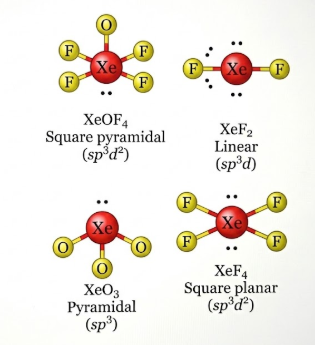
Xenon Compounds (Neil Bartlett)
| Compound | Hybridization | Shape |
|---|---|---|
| XeF2 | sp3d | Linear |
| XeF4 | sp3d2 | Square Planar |
| XeF6 | sp3d3 | Distorted Octahedral |
| XeO3 | sp3 | Pyramidal |
Numericals & HOTS
Important Reactions
20 Golden Facts (NEET)
- 1. Inert Pair Effect: The stability of +1 oxidation state increases down Group 13 (Tl+1 > Tl+3) and +2 increases down Group 14 (Pb+2 > Pb+4) due to poor shielding of d/f electrons holding ns2 electrons tight.
- 2. Inorganic Benzene: Borazine (B3N3H6) is isoelectronic and isostructural with Benzene. However, unlike benzene, it is reactive due to the polarity of B-N bonds.
- 3. Back Bonding: BF3 acts as a Lewis acid. Its acidity is less than BCl3 because of pπ-pπ back bonding between filled p-orbital of F and empty p-orbital of B.
- 4. Graphite Stability: Thermodynamically, Graphite is the most stable allotrope of Carbon. (ΔfH° of Graphite = 0, Diamond = 1.90 kJ/mol).
-
5. Producer vs Water Gas:
Water Gas (Syn Gas): CO + H2 (High Calorific Value).
Producer Gas: CO + N2 (Lower Calorific Value). - 6. Holme's Signal: A mixture of Calcium Carbide (CaC2) and Calcium Phosphide (Ca3P2). In water, they produce Acetylene (burns) and Phosphine (smoke/spontaneous combustion).
- 7. Bond Angle Trend: NH3 (107.8°) > PH3 (93.6°) > AsH3 (91.8°) > SbH3 (91.3°). Drago's Rule explains the sharp drop (almost pure p-orbitals used in PH3).
-
8. Boiling Point Anomaly:
Group 15: PH3 < AsH3 < NH3 < SbH3 < BiH3.
Group 16: H2S < H2Se < H2Te < H2O.
(NH3 and H2O have high BP due to H-bonding). - 9. Nitric Acid Passivity: Concentrated HNO3 makes Iron and Aluminium passive (non-reactive) due to the formation of a thin impervious oxide layer on the surface.
- 10. Solid PCl5: In solid state, PCl5 exists as an ionic solid: [PCl4]+ (Tetrahedral) and [PCl6]- (Octahedral).
- 11. Oxygen's Magnetism: O2 is paramagnetic (2 unpaired electrons in π* orbitals). S2 (in vapor state) is also paramagnetic like O2.
- 12. SF6 Inertness: SF6 is chemically inert due to steric hindrance; the S atom is protected by 6 F atoms. It is used as a gaseous insulator.
-
13. Bleaching Actions:
• Cl2 bleaches by Oxidation (Permanent).
• SO2 bleaches by Reduction (Temporary). - 14. Electron Gain Enthalpy: Unexpectedly, Cl > F and S > O. Fluorine and Oxygen have small sizes, causing inter-electronic repulsion, making it slightly harder to add an electron compared to Cl and S.
- 15. Glass Etching: HF is the only acid that attacks glass (SiO2) to form H2SiF6 (Fluorosilicic acid). Hence, HF is stored in wax-lined bottles.
- 16. Neil Bartlett: He prepared the first Noble Gas compound (Xe+[PtF6]-). He realized O2 and Xe have similar Ionization Enthalpies (1175 kJ/mol vs 1170 kJ/mol).
- 17. Aqua Regia: A mixture of Conc. HCl and Conc. HNO3 in the ratio 3:1. It dissolves Gold (Au) and Platinum (Pt) by forming soluble chloride complexes (HAuCl4).
- 18. Hydride Acidity: Acidic strength increases down the group: HF < HCl < HBr < HI. This is because Bond Dissociation Enthalpy decreases as size increases.
- 19. Phosphinic Acid: H3PO2 (Hypophosphorous acid) is monobasic (one P-OH) and a strong reducing agent due to two P-H bonds.
- 20. ClF3 Structure: It has a T-shaped structure (sp3d hybridization) with 2 lone pairs at equatorial positions to minimize repulsion.