

1. History of Classification
Arranged elements in groups of three. The atomic weight of the middle element was approx the average of the other two.
Example: Li (7), Na (23), K (39). (7+39)/2 = 23.
Every 8th element had properties similar to the 1st (like musical notes).
Limitation: Valid only up to Calcium (Atomic mass 40).
Law: Properties are a periodic function of their Atomic Masses.
- Merits: Predicted existence of undiscovered elements (Eka-Aluminium = Gallium, Eka-Silicon = Germanium). Left gaps.
- Demerits: Position of Isotopes, Hydrogen's position, Anomalous pairs (Ar-K, Co-Ni).
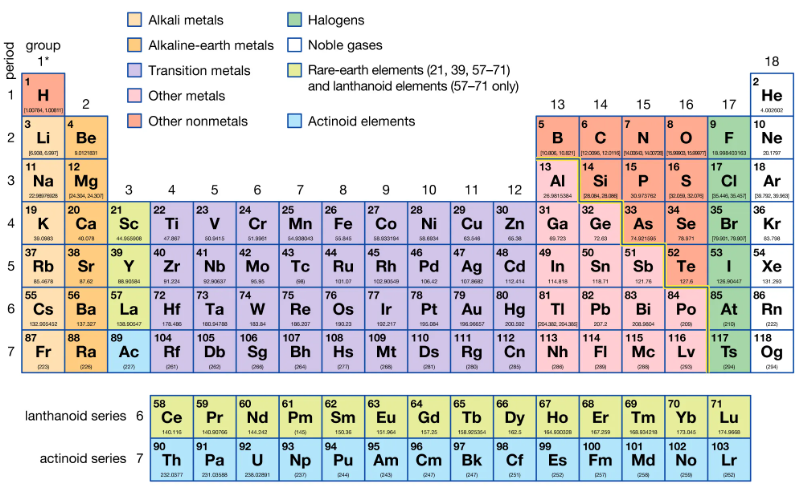
2. Modern Periodic Table
Physical and chemical properties of elements are a periodic function of their Atomic Numbers.
Structure (Long Form)
- Periods (Horizontal Rows): 7 Periods. Represent principal quantum number (n).
- Groups (Vertical Columns): 18 Groups. Elements have same valence shell configuration.
| Block | General Config | Nature |
|---|---|---|
| s-block | ns1-2 | Reactive Metals |
| p-block | ns2np1-6 | Metals, Non-metals, Metalloids |
| d-block | (n-1)d1-10ns0-2 | Transition Metals |
| f-block | (n-2)f1-14...ns2 | Inner Transition |
3. Periodic Trends
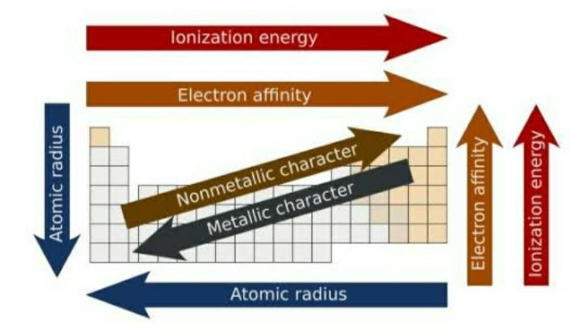
- Across Period: Decreases (Effective nuclear charge Zeff increases).
- Down Group: Increases (Number of shells increases).
- Order: Covalent < Metallic < Van der Waals radius.
- Cation: Smaller than parent atom (Cation < Atom).
- Anion: Larger than parent atom (Anion > Atom).
- Isoelectronic Species: Radius ∝ 1/Z (Atomic Number).
Example: Al3+ < Mg2+ < Na+ < F- < O2-.
Energy required to remove an electron from gaseous atom.
Trend: Increases across period, Decreases down group.
Be > B (Penetration effect of 2s)
N > O (Half-filled stability of 2p3)
Energy released when electron is added.
Highest EGE: Chlorine (Cl), NOT Fluorine. (F has small size repulsion).
Noble Gases: Positive EGE (Stable octet).
Tendency to attract shared pair of electrons.
Most EN Element: Fluorine (4.0).
Trend: Increases across period, Decreases down group.
4. Chemical Behavior
Valency
- Across Period: Increases from 1 to 4 with respect to Oxygen, then decreases. With respect to Hydrogen, increases 1 to 4 then decreases to 1.
- Down Group: Remains constant.
Metallic Character
- Across Period: Decreases (Non-metallic increases).
- Down Group: Increases (Metallic increases).
Nature of Oxides
| Basic | Na2O, MgO (Metals) |
| Acidic | Cl2O7, SO3 (Non-metals) |
| Amphoteric | Al2O3, ZnO, BeO |
| Neutral | CO, NO, N2O |
Numericals & HOTS
Important Relations
20 Golden Facts (NEET/JEE)
- 1. Highest Electron Affinity: Chlorine (Cl) has the highest electron affinity, NOT Fluorine. F has a small size, leading to inter-electronic repulsion, making it harder to add an electron.
-
2. IE1 Exception (Period 2): Order is Li < B < Be < C < O < N < F < Ne.
Be > B (Full filled 2s orbital penetration).
N > O (Half filled 2p orbital stability). - 3. Lanthanoid Contraction: The atomic radii of 4d and 5d series elements in the same group are almost identical (e.g., Zr ≈ Hf, Nb ≈ Ta) due to poor shielding by 4f electrons.
- 4. Noble Gas Radii: Noble gases have the largest atomic radii in their respective periods because they are measured as Van der Waals radii, which are larger than Covalent radii.
- 5. Amphoteric Oxides: Remember the list: Zn, Al, Be, Sn, Pb, Ga (Znabhi Aliyona Gayi Punjabi Song). Examples: ZnO, Al2O3, BeO, SnO2, PbO.
- 6. Neutral Oxides: Only three common neutral non-metal oxides: CO, NO, N2O (Laughing gas).
- 7. Highest Density: Osmium (Os) and Iridium (Ir) have the highest densities (~22.6 g/cm3).
-
8. Liquid Elements:
Metal: Mercury (Hg).
Non-metal: Bromine (Br).
Metals liquid just above room temp: Ga, Cs, Fr. -
9. Most Electronegative: Fluorine (4.0).
Most Electropositive: Cesium (Cs). -
10. Diagonal Relationship:
Li ↔ Mg
Be ↔ Al
B ↔ Si
Due to similar ionic potential (Charge/Size ratio). -
11. Successive IE: IE2 is always > IE1 because it is harder to remove an electron from a positive ion.
Huge jump in IE occurs when breaking a noble gas configuration (e.g., Na IE1 is low, IE2 is extremely high). - 12. Highest Melting Point: Tungsten (W) among metals. Carbon (Diamond) among non-metals.
-
13. Group 16 & 17 EA:
Group 16: S > Se > Te > Po > O (O is lowest).
Group 17: Cl > F > Br > I. - 14. Inert Pair Effect: Heavier p-block elements (Tl, Pb, Bi) show stability in oxidation states that are 2 units lower than the group valence (e.g., Tl+1, Pb+2, Bi+3).
- 15. Acidic Character of Oxides: Increases across a period (Na2O < MgO < ... < Cl2O7). Increases with oxidation state (MnO < Mn2O7).
- 16. Order of Screening Effect: s > p > d > f. Due to their shape, 's' orbitals shield nucleus most effectively, 'f' orbitals shield least (leading to lanthanoid contraction).
- 17. Coinage Metals: Group 11 (Cu, Ag, Au). Also known as noble metals due to low reactivity.
- 18. Zero Group: Mendeleev added the Zero group (Noble gases) later without disturbing the original table.
- 19. Representative Elements: s-block and p-block elements (except Noble gases) are collectively called Representative Elements.
- 20. Transuranic Elements: Elements with atomic number Z > 92 (Uranium). They are all synthetic and radioactive.