
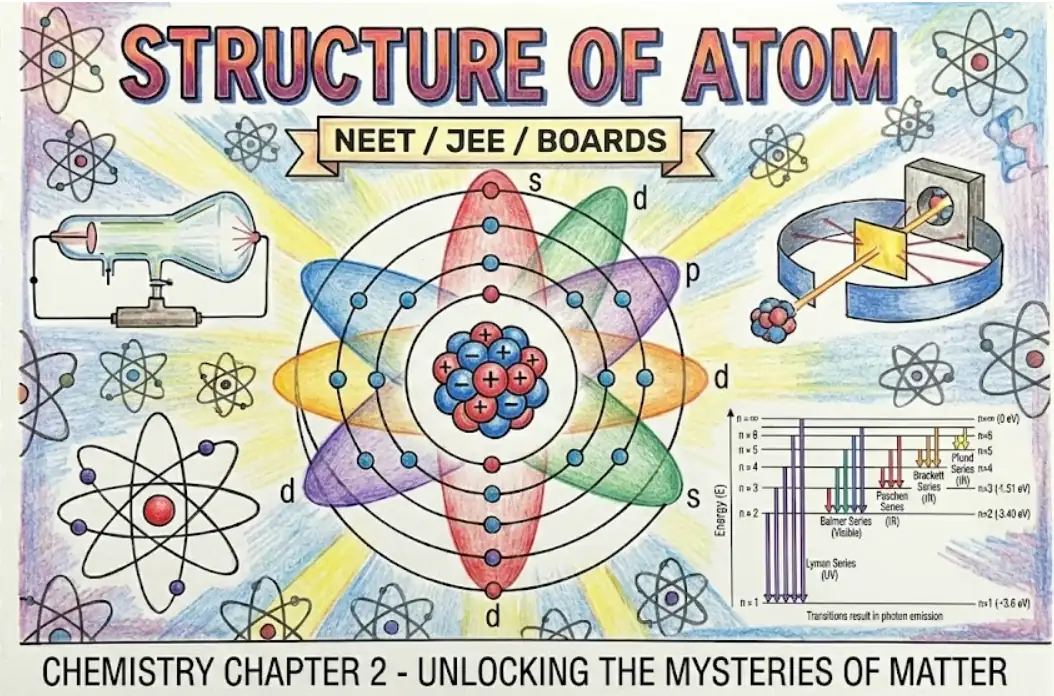
1. Introduction to Atom
Definition: The atom is the smallest unit of ordinary matter that constitutes a chemical element. The word comes from the Greek "atomos," meaning indivisible.
Historical Perspectives
- Maharishi Kanad (600 BC): Proposed that matter is made of tiny indestructible particles called 'Parmanu'.
- Democritus (400 BC): Suggested that if you keep cutting matter, you reach a point where it cannot be cut further (Atomos).
- Dalton's Theory (1808): Formalized the idea that atoms are indivisible particles (later disproven).
2. Discovery of Sub-Atomic Particles
2.1 Electron (e-)
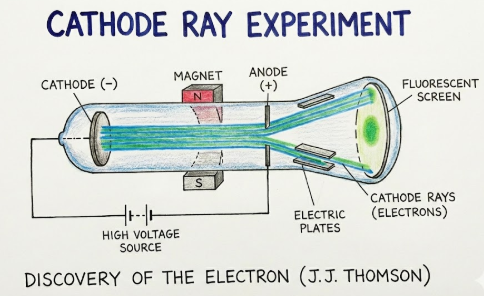
- Discoverer: J.J. Thomson (1897).
- Experiment: Cathode Ray Tube (CRT). At low pressure (0.01 mm Hg) and high voltage (10,000V), rays moved from cathode to anode.
- Properties: Negatively charged, travel in straight lines, cast shadows, possess kinetic energy.
- Charge/Mass (e/m): 1.7588 × 10¹¹ C/kg.
2.2 Proton (p+)
Discoverer: Goldstein (1886) observed "Canal Rays" (Anode rays) moving opposite to cathode rays.
Nature: Positively charged gaseous ions. Unlike electrons, their e/m ratio depends on the gas used.
2.3 Neutron (n0)
Discoverer: James Chadwick (1932).
Experiment: Bombarding Beryllium sheets with alpha particles:
4Be9 + 2He4 → 6C12 + 0n1 (Neutron).
| Particle | Charge (C) | Mass (kg) |
|---|---|---|
| Electron | -1.6 × 10⁻¹⁹ | 9.1 × 10⁻³¹ |
| Proton | +1.6 × 10⁻¹⁹ | 1.672 × 10⁻²⁷ |
| Neutron | 0 | 1.675 × 10⁻²⁷ |
3. Atomic Models
3.1 Thomson's Model ("Plum Pudding")
Atom is a sphere of positive charge with electrons embedded in it like seeds in a watermelon.
3.2 Rutherford's Model (Nuclear Model)
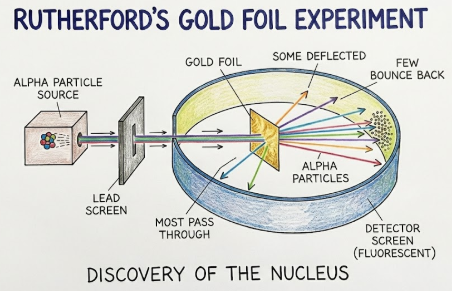
- Experiment: α-particle scattering on Gold foil.
- Observation: Most α-particles passed straight; very few bounced back.
- Conclusion: Positive charge is concentrated in a tiny center called the Nucleus. Electrons revolve around it.
3.3 Bohr's Model
Applicable only for single-electron species (H, He+, Li2+).
- Electrons revolve in fixed orbits called "stationary states".
- Angular Momentum: mvr = nh / 2π (Quantized).
- Energy is absorbed/emitted only when an electron jumps orbits.
4. Dual Nature of Matter
4.1 Photoelectric Effect
Ejection of electrons from a metal surface when light of suitable frequency hits it.
(ν0 = Threshold Frequency)
4.2 De-Broglie Wavelength
Matter has both particle and wave nature.
5. Electromagnetic Radiation
Oscillating electric and magnetic fields perpendicular to each other and direction of propagation.
Speed (c): 3 × 10⁸ m/s
Order of Spectrum (Increasing λ):
Cosmic < Gamma < X-rays < UV < Visible < IR < Microwave < Radio
6. Bohr's Theory (Maths)
(Energy becomes less negative as n increases)
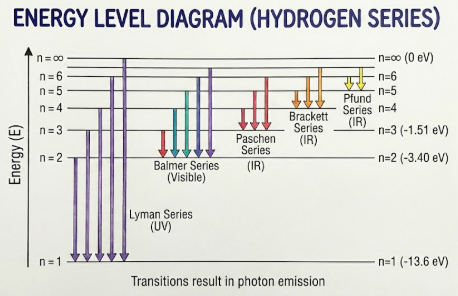
7. Hydrogen Spectrum
Emission spectrum of Hydrogen is a line spectrum.
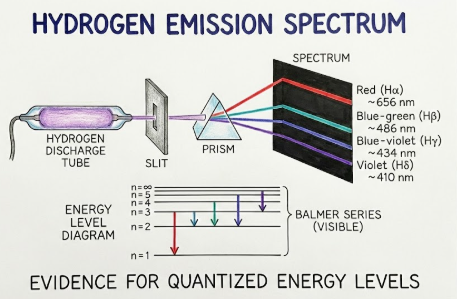
| Series | n1 | n2 | Region |
| Lyman | 1 | 2,3... | UV |
| Balmer | 2 | 3,4... | Visible |
| Paschen | 3 | 4,5... | Near IR |
| Brackett | 4 | 5,6... | Mid IR |
| Pfund | 5 | 6,7... | Far IR |
8. Quantum Mechanical Model
8.1 Heisenberg Uncertainty
Impossible to determine exact position and momentum simultaneously.
8.2 Schrodinger & Wave Function
- Ψ (Psi): Wave function. Represents the amplitude of electron wave. No physical significance.
- Ψ2: Probability density. Gives the probability of finding an electron in a region.
9. Orbitals & Quantum Numbers
Describes Size and Energy. Values: 1, 2, 3...
Describes Shape. Values: 0 to n-1.
- l=0 (s): Spherical
- l=1 (p): Dumb-bell
- l=2 (d): Double Dumb-bell
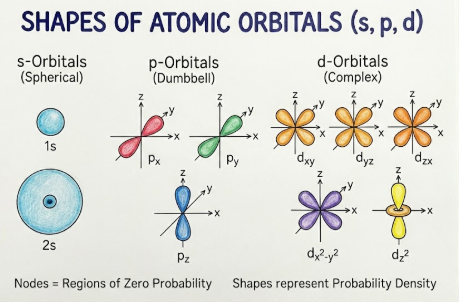
Orientation. Values: -l to +l.
Clockwise (+1/2) or Anti-clockwise (-1/2).
11. Electronic Configuration
- Aufbau Principle: Fill lower energy first. Order: 1s < 2s < 2p < 3s < 3p < 4s < 3d...
- Pauli Exclusion: No two electrons can have same 4 quantum numbers.
- Hund's Rule: Pairing happens only after subshell is half-filled.
12. Stability of Orbitals
Half-filled (d5) and Fully-filled (d10) orbitals are extra stable.
1. Symmetry: More symmetrical distribution of electrons.
2. Exchange Energy: Electrons with parallel spins exchange positions, releasing energy. Max exchanges = Max stability.
Expected: [Ar] 4s2 3d4
Actual: [Ar] 4s1 3d5 (Due to stability of half-filled d-orbital)
Numericals & HOTS
Important Formulae
20 Golden Facts (NEET)
- 1. e/m Ratio: The charge-to-mass ratio of cathode rays (electrons) is universal and independent of the gas in the tube. For anode rays (protons), it depends on the gas.
- 2. Heaviest Particle: Neutron is slightly heavier than proton. Order: n > p > e. (Mass of neutron ≈ Mass of proton ≈ 1837 × Mass of electron).
- 3. Isotopes: Same atomic number (Z), different mass number (A). Chemical properties are same (depend on Z), physical properties differ (depend on mass).
- 4. Isobars: Different Z, same A (e.g., 40Ar and 40Ca). They have different chemical properties.
- 5. Isotones: Species having same number of neutrons. Formula: A - Z is constant. (e.g., 14C6 and 16O8; both have 8 neutrons).
- 6. Distance of Closest Approach: Used to estimate nucleus size. At this distance, Kinetic Energy of α-particle = Potential Energy of repulsion.
- 7. Bohr's Limit: Bohr theory fails for multi-electron atoms and cannot explain the Zeeman effect (splitting in magnetic field) or Stark effect (electric field).
- 8. Negative Energy: The total energy of an electron is negative, indicating it is bound to the nucleus. At n=∞, energy is zero (free electron).
- 9. Line Spectrum: Known as the "fingerprint" of atoms. No two elements have the same line spectrum.
- 10. Lyman Series: The only series in the Hydrogen spectrum found in the Ultraviolet (UV) region. All transitions jump to n=1.
- 11. Limiting Line: The spectral line corresponding to the transition from n=∞ to a specific shell. It represents the shortest wavelength (highest energy) in that series.
- 12. Max Spectral Lines: When an electron jumps from n to 1 in a sample of atoms, max lines = n(n-1)/2.
- 13. Macroscopic Objects: de Broglie wavelength is negligible for heavy objects (like a cricket ball) because mass is in the denominator (λ ∝ 1/m).
- 14. Nodal Plane: A plane passing through the nucleus where the probability of finding an electron is zero. s-orbital has 0 nodal planes; p-orbital has 1.
- 15. Spin Quantum Number: It does not arise from the solution of the Schrodinger Wave Equation. It was introduced later to account for electron spin.
- 16. 4s vs 3d Energy: Even though 4s is filled before 3d (Aufbau), 4s electrons are removed before 3d electrons during ionization (because 4s is the outermost shell).
- 17. Copper Exception: Cu (Z=29) is [Ar] 3d10 4s1, not 3d9 4s2. Fully filled d-orbitals are more stable.
- 18. Violet vs Red: In the visible spectrum, Violet has the shortest wavelength (~400 nm) and highest energy; Red has longest wavelength (~700 nm) and lowest energy.
- 19. Probability Density: Ψ2 is always positive. Ψ can be positive or negative. At a node, Ψ2 = 0.
- 20. Magnetic Moment of Fe2+: Config is [Ar] 3d6. It has 4 unpaired electrons. μ = √(4(6)) = √24 ≈ 4.9 B.M.