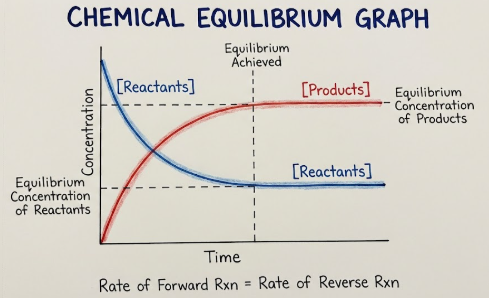
Chemical Equilibrium is the state in a reversible reaction where the rate of the forward reaction equals the rate of the backward reaction, and the concentrations of reactants and products remain constant.
Types of Reactions
Irreversible: Proceed only in one direction (e.g., Precipitation). Cannot establish equilibrium.
Reversible: Proceed in both directions. Represented by double arrow (↔).
Nature: Equilibrium is Dynamic, not static. Reactions continue to occur at the molecular level, but net change is zero.
[Image of concentration vs time graph for equilibrium]
2. Law of Mass Action & Constants
Guldberg & Waage: The rate of a chemical reaction is directly proportional to the product of the active masses (molar concentrations) of reactants raised to the power of their stoichiometric coefficients.
aA + bB ↔ cC + dD
1. Concentration Constant (Kc):
Kc = [C]c [D]d / [A]a [B]b
(Active mass = Molar Conc. = n/V)
2. Pressure Constant (Kp):
Kp = (pC)c (pD)d / (pA)a (pB)b
(Valid only for gaseous species)
Relation Between Kp and Kc
Kp = Kc (RT)Δng
Δng = (Moles of gaseous products) - (Moles of gaseous reactants).
R = 0.0821 L atm K-1 mol-1.
4. Characteristics of K
Operation on Reaction
New Constant (K')
Reaction Reversed
K' = 1/K
Multiplied by 'n'
K' = Kn
Divided by 'n'
K' = K1/n
Two reactions added
K' = K1 × K2
Note: The value of K depends ONLY on Temperature. It is independent of catalyst, pressure, or initial concentration.
5. Reaction Quotient (Q)
Q is calculated exactly like Kc but at any time (not necessarily equilibrium).
Q < Kc: Reactants → Products (Forward shift).
Q > Kc: Products → Reactants (Backward shift).
Q = Kc: Reaction is at Equilibrium.
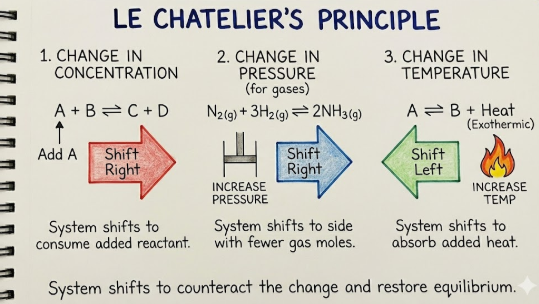
6. Le Chatelier's Principle
"If a system at equilibrium is subjected to a change in conc, pressure, or temp, the equilibrium shifts in a direction that nullifies the effect of the change."
Summary of Effects
1. Concentration:
Add Reactant → Forward shift.
Add Product → Backward shift.
2. Pressure (For Gaseous Rxn):
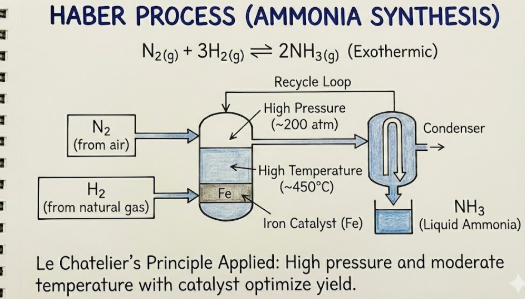
Increase P → Shifts to side with lesser moles.
Decrease P → Shifts to side with more moles.
If Δng = 0, Pressure has NO effect.
3. Temperature (changes value of K):
Exothermic (ΔH < 0): Low Temp favors Forward. (K decreases as T increases).
Endothermic (ΔH > 0): High Temp favors Forward. (K increases as T increases).
4. Inert Gas Addition:
At Constant Volume: No effect.
At Constant Pressure: Shifts to side with more moles (Volume increases).
Here, Qc (250) < Kc (278). Since Q < K, the reaction will proceed in the Forward direction.
Q5. Vapor Density Method
For the reaction PCl5 ↔ PCl3 + Cl2, the vapor density of the equilibrium mixture is 62. Calculate the degree of dissociation. (Molar mass of PCl5 = 208.5)
Given: 2NO2(g) (Brown) ↔ N2O4(g) (Colorless); ΔH = -57 kJ.
What happens to the color of the mixture if:
(a) Pressure is increased?
(b) Temperature is increased?
Solution:
(a) Pressure Increase: Shifts to side with fewer moles (Product side, N2O4). Color fades (becomes lighter).
(b) Temp Increase: Reaction is Exothermic (ΔH < 0). High T favors backward reaction (Reactant NO2). Color deepens (becomes darker brown).
Q8. Kp Calculation (Solid)
Solid Ammonium Carbamate dissociates as: NH2COONH4(s) ↔ 2NH3(g) + CO2(g). The total pressure at equilibrium is 0.3 atm. Calculate Kp.
Solution:
Let P be partial pressure of CO2.
Then P(NH3) = 2P (stoichiometry 2:1).
Total Pressure = 2P + P = 3P = 0.3 atm.
So, P = 0.1 atm.
1. Only Temperature Matters: The value of the Equilibrium Constant (K) changes ONLY with temperature. It remains constant with changes in pressure, volume, concentration, or catalyst.
2. Catalyst Role: A catalyst does NOT change the value of K or the state of equilibrium. It only reduces the time taken to reach equilibrium by lowering activation energy.
3. Active Mass of Solids: The concentration (active mass) of pure solids and pure liquids is taken as UNITY (1) and ignored in K expression.
4. Unit of K: The unit of Kc is (mol/L)Δng and Kp is (atm)Δng. If Δng = 0, K has no unit.
5. Inert Gas (Const V): Adding an inert gas at constant volume has NO EFFECT on equilibrium because partial pressures of reactants/products do not change.
6. Inert Gas (Const P): Adding an inert gas at constant pressure increases volume. Equilibrium shifts to the side with more number of moles.
7. Reaction Quotient (Q): If Q < K, the reaction moves Forward (reactant consumption). If Q > K, it moves Backward (product consumption).
8. Exothermic Reaction: For ΔH < 0, increasing temperature decreases K. High yield is obtained at Low Temperature.
9. Endothermic Reaction: For ΔH > 0, increasing temperature increases K. High yield is obtained at High Temperature.
10. Pressure Effect: High pressure favors the reaction which proceeds with a decrease in the number of gaseous moles (Volume contraction).
11. Δng = 0 Case: Reactions like H2 + I2 ↔ 2HI have equal moles on both sides. Volume or Pressure changes have NO EFFECT on equilibrium position.
12. Reverse Reaction: If the equilibrium constant for a reaction is K, the constant for the reverse reaction is 1/K.
13. Multi-Step Rxn: If a reaction is the sum of two steps with constants K1 and K2, the overall constant is K = K1 × K2.
14. Boiling Point: At boiling point, Liquid ↔ Vapor are in equilibrium. Increasing pressure favors liquid state (less volume), so boiling point Increases.
15. Melting of Ice: Ice (more volume) ↔ Water (less volume). High pressure favors water (lower volume), so melting point of ice Decreases.
16. Vapor Density: As dissociation increases, the number of moles increases, so the average molar mass decreases. Thus, observed Vapor Density Decreases.
17. Strong Electrolytes: Substances like NaCl or HCl do not establish equilibrium between ions and molecules in solution because they are 100% ionized.
18. Meaning of K > 103: If K is very large, the reaction proceeds almost to completion. Products predominate.
19. Meaning of K < 10-3: If K is very small, the reaction hardly proceeds. Reactants predominate.
20. Stability: The larger the value of the stability constant (K for complex formation), the more stable is the complex ion.