

1. Electrolytes & Ionization
Ionic Equilibrium: The equilibrium established between unionized molecules and ions in the solution of weak electrolytes.
Types of Substances
- Non-Electrolytes: Do not conduct electricity (e.g., Urea, Glucose).
- Strong Electrolytes: Ionize almost completely (α ≈ 1). (e.g., HCl, NaOH, NaCl).
- Weak Electrolytes: Ionize partially (α < 1). Equilibrium exists. (e.g., CH3COOH, NH4OH).
Degree of Ionization (α):
Fraction of total molecules dissociated into ions.
Fraction of total molecules dissociated into ions.
α = (Number of molecules dissociated) / (Total number of molecules)
Ostwald's Dilution Law
For weak electrolytes, degree of ionization increases with dilution.
α = √(Ka / C)
(Valid only for weak electrolytes)
2. Acids, Bases & pH Scale
1. Ionic Product of Water (Kw):
Product of conc. of H+ and OH- ions.
Kw = [H+][OH-] = 10-14 (at 25°C)
pKw = pH + pOH = 14
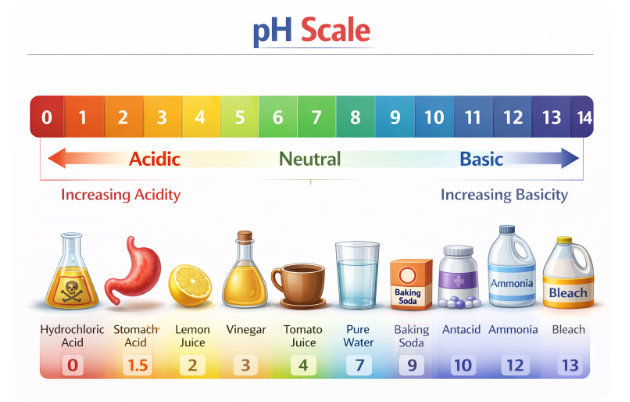
2. pH Scale:
Negative logarithm of H+ ion concentration.
pH = -log [H+]
Ionization Constants
- Acid Dissociation Constant (Ka): Measure of acid strength. High Ka = Strong Acid.
- Base Dissociation Constant (Kb): Measure of base strength. High Kb = Strong Base.
- Relation: Ka × Kb = Kw (for conjugate pair).
3. Hydrolysis of Salts
Reaction of cation or anion of salt with water to produce acidity or alkalinity.
| Type | Example | Nature | pH Formula |
|---|---|---|---|
| Strong Acid + Strong Base | NaCl | Neutral | pH = 7 |
| Weak Acid + Strong Base | CH3COONa | Basic (Anionic Hyd.) | 7 + ½(pKa + log C) |
| Strong Acid + Weak Base | NH4Cl | Acidic (Cationic Hyd.) | 7 - ½(pKb + log C) |
| Weak Acid + Weak Base | CH3COONH4 | Depends | 7 + ½(pKa - pKb) |
4. Buffer Solutions
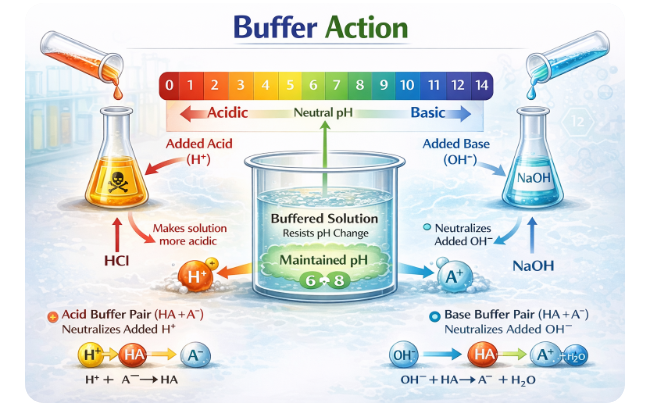
Solutions which resist change in pH upon addition of small amounts of acid or base.
Types & Henderson-Hasselbalch Equation
1. Acidic Buffer:
Weak Acid + Salt with Strong Base (e.g., CH3COOH + CH3COONa).
Weak Acid + Salt with Strong Base (e.g., CH3COOH + CH3COONa).
pH = pKa + log ([Salt] / [Acid])
2. Basic Buffer:
Weak Base + Salt with Strong Acid (e.g., NH4OH + NH4Cl).
Weak Base + Salt with Strong Acid (e.g., NH4OH + NH4Cl).
pOH = pKb + log ([Salt] / [Base])
5. Solubility Product (Ksp)
Product of molar concentrations of ions in a saturated solution, raised to power of stoichiometric coefficients.
General Formula:
AxBy ↔ xAy+ + yBx-
Ksp = (xs)x (ys)y = xxyy s(x+y)
Conditions for Precipitation
- Qsp < Ksp: Unsaturated solution (No PPT).
- Qsp = Ksp: Saturated solution (Equilibrium).
- Qsp > Ksp: Super-saturated (Precipitation occurs).
6. Common Ion Effect
Suppression of degree of dissociation of a weak electrolyte by adding a strong electrolyte containing a common ion.
Result:
1. Solubility of salt Decreases.
2. Used in purification (Salting out of soap, NaCl purification).
3. Used in salt analysis (Group II and Group IV precipitation).
1. Solubility of salt Decreases.
2. Used in purification (Salting out of soap, NaCl purification).
3. Used in salt analysis (Group II and Group IV precipitation).
Numericals & HOTS
Important Formulae
20 Golden Facts (NEET)
- 1. Temp Effect on pH: As temperature increases, Kw increases. [H+] increases, so pH of pure water decreases (< 7). However, water remains neutral because [H+] = [OH-].
- 2. Conjugate Pairs: Strong Acid has a Weak Conjugate Base. Weak Acid has a Strong Conjugate Base. (e.g., HCl is strong, Cl- is a very weak base).
- 3. Common Ion Effect: Adding a strong electrolyte with a common ion to a weak electrolyte suppresses the ionization of the weak electrolyte. (e.g., adding HCl to H2S reduces S2- conc).
- 4. Buffer Capacity: It is maximum when [Salt] = [Acid] or [Salt] = [Base]. At this point, pH = pKa or pOH = pKb.
- 5. Amphoteric Solvents: Water behaves as an acid with NH3 and as a base with HCl.
- 6. Dilution Effect: On dilution, pH of an acidic solution increases towards 7, and pH of a basic solution decreases towards 7.
- 7. Very Dilute Acid: For 10-8 M HCl, pH is NOT 8. You must add contribution from water (10-7 M). pH ≈ 6.98.
- 8. Mixing Equal Volumes: Mixing pH 2 and pH 3 acids does not give pH 2.5. Since pH is log scale, resulting pH ≈ 2.26.
- 9. Salt of WA + WB: The pH is independent of concentration. It only depends on pKa and pKb.
- 10. Precipitation Condition: Precipitation occurs ONLY when Ionic Product (Qsp) > Solubility Product (Ksp).
- 11. Group II Analysis: HCl is added before H2S to suppress S2- ion concentration so only Group II sulphides (low Ksp) precipitate.
- 12. Group IV Analysis: NH4OH is added in excess of NH4Cl to increase OH- just enough to precipitate Group IV hydroxides but not Mg(OH)2.
- 13. Blood Buffer: The pH of human blood is maintained at ~7.4 by the H2CO3 / HCO3- buffer system.
- 14. Lewis Concept: BF3, AlCl3 are Lewis Acids (Electron pair acceptors). NH3, H2O are Lewis Bases (Electron pair donors).
- 15. Polyprotic Acids: For H3PO4, Ka1 > Ka2 > Ka3. Removal of H+ from a negative ion is harder.
- 16. Solubility vs pH: Solubility of salts of weak acids (like CaF2) increases in acidic pH because H+ consumes the anion (F-).
- 17. Highest pH: Among 0.1 M solutions of NaCl, NH4Cl, and NaCN, NaCN has the highest pH (Basic hydrolysis of CN-).
- 18. Neutral Point: Neutral point is where [H+] = [OH-]. At 90°C, neutral pH is ~6, not 7.
- 19. Indicator Range: Methyl Orange (3.1-4.4, Acidic range). Phenolphthalein (8.3-10, Basic range).
- 20. Simultaneous Solubility: If two salts share a common ion (e.g., AgCl and AgBr), the solubility of both decreases more than if they were alone.
📱 Practice MCQs for this topic inside our App
📱 Practice MCQs for this topic inside our App
📱 Practice MCQs for this topic inside our App
📱 Practice MCQs for this topic inside our App