[Image of oxidation reduction electron transfer chart]
2. Oxidation Number (O.N.)
The residual charge which an atom appears to have when all other atoms are removed from it as ions.
Rules for Calculation
Free State: O.N. of elements in elementary state (H2, O2, P4, S8) is Zero.
Alkali Metals (Grp 1): Always +1.
Alkaline Earth Metals (Grp 2): Always +2.
Fluorine: Always -1 (Most electronegative).
Hydrogen: Generally +1. (Except in metal hydrides like NaH where it is -1).
Oxygen: Generally -2.
Peroxides (H2O2): -1
Superoxides (KO2): -1/2
With Fluorine (OF2): +2
Example: KMnO4
Let Mn be x.
(+1) + x + 4(-2) = 0
1 + x - 8 = 0 → x = +7
3. Types of Redox Reactions
1. Combination Reaction:
Two species combine. (A + B → C) Example: C(s) + O2(g) → CO2(g)
2. Decomposition Reaction:
One compound breaks down. Example: 2H2O(l) → 2H2(g) + O2(g)
3. Displacement Reaction:
An ion in a compound is replaced by an ion of another element.
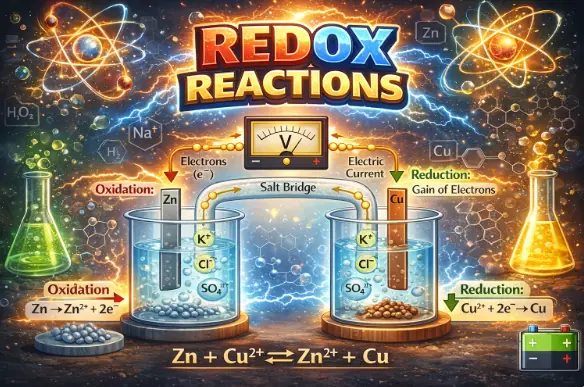
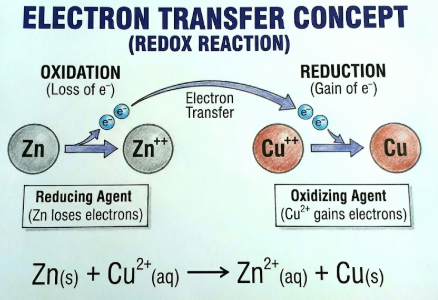
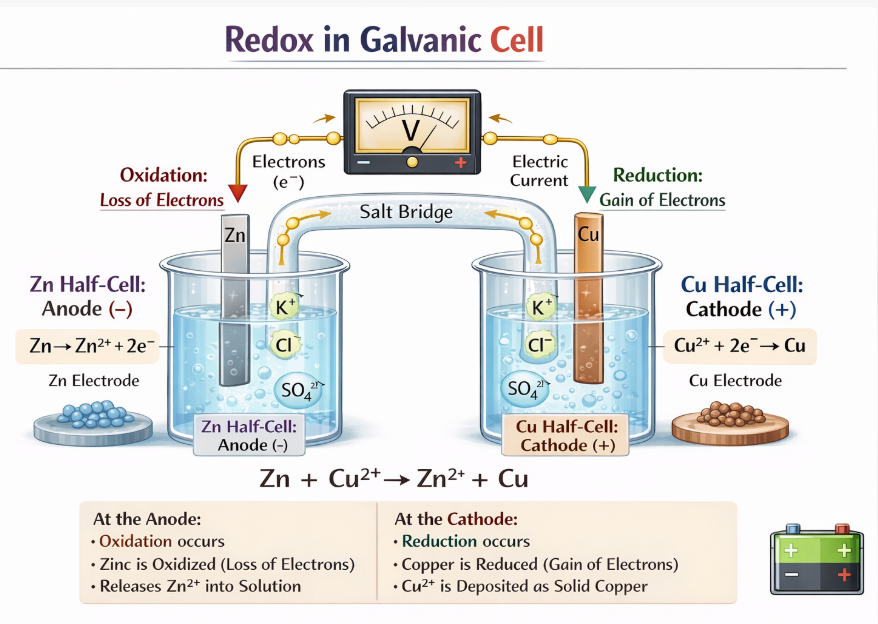
Metal Displacement: Zn + CuSO4 → ZnSO4 + Cu
Non-metal Displacement: Zn + 2HCl → ZnCl2 + H2
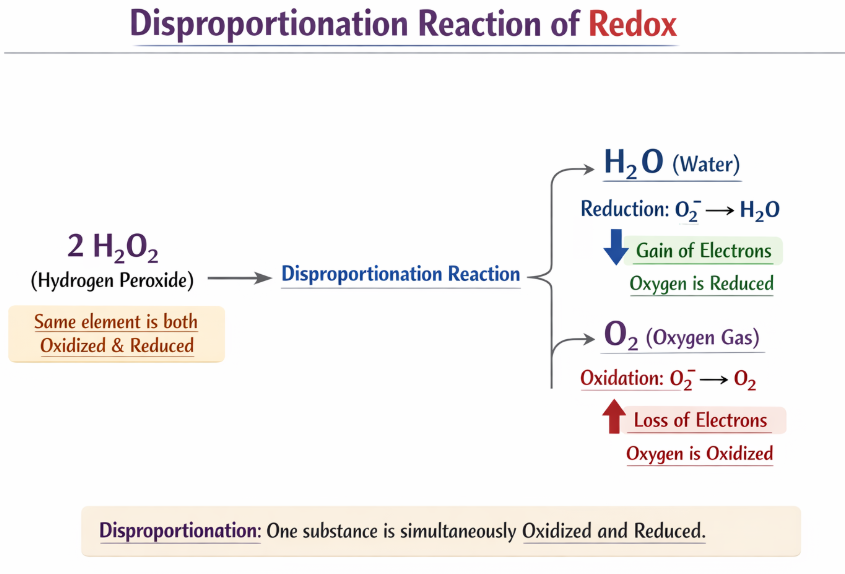
4. Disproportionation Reaction:
A single element undergoes both Oxidation and Reduction simultaneously.
2H2O2 → 2H2O + O2 (O changes from -1 to -2 and 0)
4. Balancing Methods
4.1 Ion-Electron Method (Half-Reaction)
Steps for Acidic Medium:
Separate into Oxidation and Reduction half-reactions.
Balance atoms other than O and H.
Balance O by adding H2O.
Balance H by adding H+.
Balance Charge by adding electrons (e-).
Equalize electrons in both halves and add them.
Steps for Basic Medium:
Follow acidic steps up to adding H+. Then, add OH- ions to BOTH sides equal to the number of H+ ions. (H+ + OH- → H2O).
5. Applications
1. Corrosion (Rusting):
Oxidation of metal surfaces by atmospheric oxygen and moisture.
Fe → Fe2+ + 2e- (Anode)
O2 + 4H+ + 4e- → 2H2O (Cathode)
Rust: Fe2O3.xH2O
2. Rancidity:
Oxidation of fats and oils in food causing unpleasant smell and taste. Prevented by antioxidants (BHA, BHT) or nitrogen packing.
[Image of electrochemical cell schematic]
Redox Titrations
Self Indicator: KMnO4 (Pink to colorless).
External Indicator: Starch in Iodometric titrations (Blue complex).
Numericals & HOTS
Q1. Structure Based O.N.
Calculate the oxidation number of Chromium in CrO5 (Chromium Pentoxide).
Solution:
Using the formula method: x + 5(-2) = 0 → x = +10. (Incorrect, max is +6). Structure Method (Butterfly Structure):
CrO5 has one double-bonded oxygen (Oxide, -2) and four oxygens in peroxy linkage (-1).
x + 1(-2) + 4(-1) = 0
x - 2 - 4 = 0
x - 6 = 0 x = +6
Q2. Balancing Redox
Balance the following reaction in acidic medium:
MnO4- + Fe2+ → Mn2+ + Fe3+
1. Terminal Br (Left): Bonded to 3 Oxygens. O.N. = +6.
2. Central Br: Bonded to 2 Oxygens. O.N. = +4.
3. Terminal Br (Right): Bonded to 3 Oxygens. O.N. = +6.
States: +6, +4, +6
Q8. Representing Compounds
Write the Stock Notation for:
(a) AuCl3
(b) MnO2
Solution:
Stock notation uses Roman numerals in brackets to indicate the oxidation state of the metal.
(a) AuCl3: x + 3(-1) = 0 → x = +3.
Notation: Aurum(III) chloride
(b) MnO2: x + 2(-2) = 0 → x = +4.
Notation: Manganese(IV) oxide
Q9. Balancing Coefficients
Determine the values of x, y, z in the reaction:
x K2Cr2O7 + y SO2 + z H2SO4 → K2SO4 + Cr2(SO4)3 + H2O
Solution:
Reduction: Cr(+6) → Cr(+3). Change = 3 per atom. Total = 6.
Oxidation: S(+4 in SO2) → S(+6 in sulphate). Change = 2.
Cross multiply factors: Cr (change 6) and S (change 2). Ratio 1:3.
So, 1 K2Cr2O7 reacts with 3 SO2.
Therefore, x=1, y=3.
Balance K: 1 K2SO4.
Balance SO4: Total 4 needed on RHS (1 in K salt + 3 in Cr salt).
3 come from SO2 (after oxidation), so 1 must come from H2SO4.
So, z=1.
x=1, y=3, z=1
Q10. Spontaneity Check
Can a solution of 1 M CuSO4 be stored in a Nickel vessel? Given E°(Ni2+/Ni) = -0.25V and E°(Cu2+/Cu) = +0.34V.
Solution:
For reaction to occur (dissolution of vessel):
Ni + Cu2+ → Ni2+ + Cu
Since E°cell is Positive, the reaction is spontaneous. No, it cannot be stored because Nickel will dissolve and displace Copper.
Important Formulae & Concepts
1. Calculation of Oxidation Number (O.N.)
General Sum Rule:
Σ (O.N. of all atoms) = Charge on species
Range of O.N.:
Max O.N. = Group Number
Min O.N. = Group Number - 8
(Valid for p-block elements)
2. Equivalent Weight (E)
E = Molar Mass / n-factor
n-factor for Redox:
n = Total change in O.N. per molecule
For Disproportionation:
E = Eoxidation + Ereduction
3. Balancing Principle
Total Decrease in O.N. = Total Increase in O.N.
n1 × M1 × V1 = n2 × M2 × V2
(Equivalents of Oxidant = Equivalents of Reductant)
4. Electrode Potential (E°)
Standard Reduction Potential (SRP):
High SRP = Strong Oxidizing Agent (e.g., F2)
Low SRP = Strong Reducing Agent (e.g., Li)
E°cell = E°cathode - E°anode
20 Golden Facts (NEET)
1. Fluorine's Rule: Fluorine is the most electronegative element. It ALWAYS exhibits an oxidation state of -1 in all its compounds. It cannot have a positive oxidation state.
2. Disproportionation Limit: Elements in their highest or lowest oxidation states CANNOT undergo disproportionation. Example: Cl in ClO4- (+7) cannot oxidize further.
3. Fractional O.N.: Oxidation number can be fractional (e.g., in Fe3O4, Fe is +8/3). This is an average value; individual atoms have integer states (+2 and +3).
4. Paradox of Structure: In CrO5 (Butterfly structure), Cr has O.N. of +6, not +10. This is because it has two peroxy linkages (-O-O-) where O is -1.
5. Bleaching Action: SO2 bleaches by Reduction (Temporary). Cl2 bleaches by Oxidation (Permanent).
7. K2Cr2O7 n-factor: In acidic medium, Dichromate acts as an oxidant with n=6. (Cr change from +6 to +3 per atom, 2 atoms = 6).
8. Spectator Ions: Ions present in the solution that do not undergo any change in oxidation state during the reaction are called spectator ions.
9. Nitric Acid (HNO3): It acts only as an Oxidizing Agent because N is in its max oxidation state (+5).
10. Nitrous Acid (HNO2): N is in +3 state (intermediate). It can act as both an Oxidizing and a Reducing agent.
11. Metal Hydrides: In compounds like LiH or CaH2, Hydrogen shows an oxidation state of -1 because metals are more electropositive than H.
12. Caro's Acid (H2SO5): Sulfur is in +6 state (not +8). It contains one peroxy linkage.
13. Marshell's Acid (H2S2O8): Sulfur is in +6 state. It also contains a peroxy linkage.
14. Electrochemical Series: Li is the strongest reducing agent (Lowest SRP), and F2 is the strongest oxidizing agent (Highest SRP).
15. Displacement Rule: A metal placed higher in the activity series (lower SRP) can displace a metal lower in the series (higher SRP) from its salt solution. (e.g., Zn displaces Cu).
16. Bleaching Powder: CaOCl2. The two Chlorine atoms have different oxidation states: -1 (as Chloride Cl-) and +1 (as Hypochlorite OCl-).
17. Brown Ring Test: The complex formed [Fe(H2O)5NO]2+ has Iron in +1 oxidation state, which is rare.
18. H2O2 Role: Hydrogen Peroxide acts as both an Oxidizing and Reducing agent in both acidic and basic media.
19. Equivalent Wt of Oxidant: Mol. Mass / No. of electrons gained by one molecule.
20. Neutrality: Redox reactions in solution must obey the principle of electroneutrality. The total charge of reactants must equal the total charge of products.