
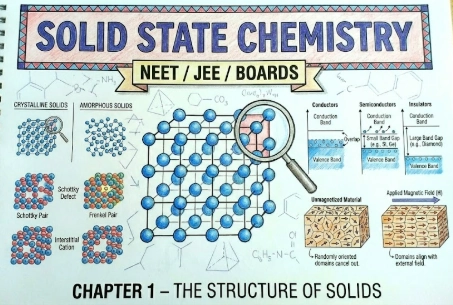
1. Classification of Solids
Solids are characterized by definite shape, volume, and mass due to strong intermolecular forces and short distances.
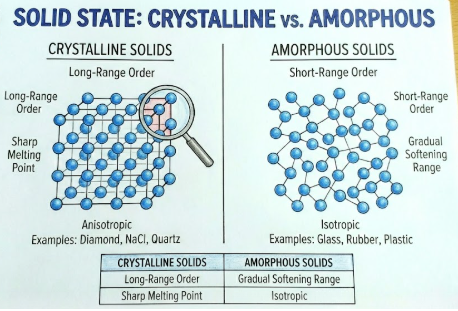
Crystalline vs Amorphous
| Property | Crystalline | Amorphous |
|---|---|---|
| Geometry | Regular, long range order | Irregular, short range |
| Melting Point | Sharp M.P. | Softens over a range |
| Nature | Anisotropic (properties vary with direction) | Isotropic (same in all directions) |
| Examples | NaCl, Quartz, Diamond | Glass, Rubber, Plastic |
Types of Crystalline Solids
- Ionic: Ions held by Coulombic forces. Hard, brittle, high MP. (e.g., NaCl).
- Covalent (Network): Atoms held by covalent bonds. Very hard. (e.g., Diamond, SiO2).
- Molecular: Molecules held by Van der Waals/H-bonds. Soft, low MP. (e.g., Ice, Solid CO2).
- Metallic: Positive ions in sea of electrons. Conductive, ductile. (e.g., Fe, Cu).
2. Unit Cells & Packing
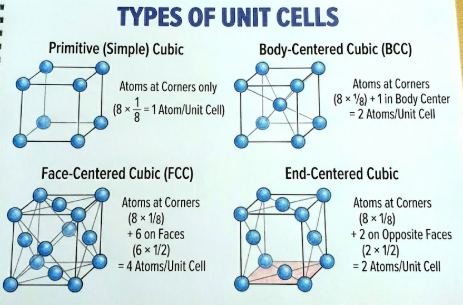
Unit Cell: The smallest repeating unit which, when repeated in 3D, generates the entire lattice.
- Simple Cubic (SC): Atoms at corners only. Z = 8 × (1/8) = 1.
- Body Centered (BCC): Corners + Body center. Z = 1 + 1 = 2.
- Face Centered (FCC/CCP): Corners + Face centers. Z = 1 + 3 = 4.
Packing Efficiency & Formulas
| Type | Radius (r) vs Edge (a) | Packing % | Coord. No. |
|---|---|---|---|
| SC | a = 2r | 52.4% | 6 |
| BCC | 4r = √3 a | 68% | 8 |
| FCC | 4r = √2 a | 74% | 12 |
d = (Z × M) / (a3 × NA)
(Ensure 'a' is in cm for density in g/cm3)
3. Voids in Crystals
Empty spaces inside the packing.
- Tetrahedral Void (Td): Surrounded by 4 spheres. Radius ratio = 0.225. (Count = 2N)
- Octahedral Void (Oh): Surrounded by 6 spheres. Radius ratio = 0.414. (Count = N)
4. Imperfections in Solids
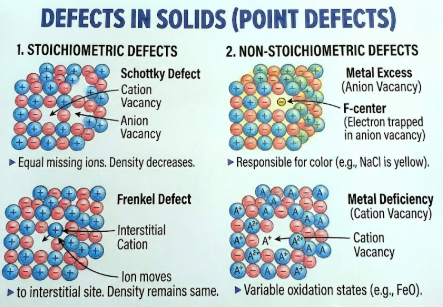
Stoichiometric Defects
Equal number of Cations and Anions missing.
- Density: Decreases.
- Condition: Similar size of ions (e.g., NaCl, KCl, CsCl).
Smaller ion (cation) dislocated to interstitial site.
- Density: Remains same.
- Condition: Large difference in ion size (e.g., AgCl, ZnS).
Non-Stoichiometric Defects
- Metal Excess (F-Center): Anion vacancy occupied by electron. Causes color (e.g., NaCl yellow, KCl violet).
- Metal Deficiency: Cation missing, charge balanced by higher valency cation (e.g., Fe0.95O).
5. Electrical Properties
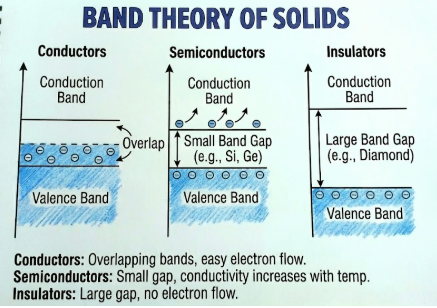
Band Theory
- Conductors: No gap between Valence Band (VB) and Conduction Band (CB).
- Insulators: Large energy gap (Eg > 3 eV). No electron jump.
- Semiconductors: Small gap. Electrons jump at high temp.
Doping (Semiconductors)
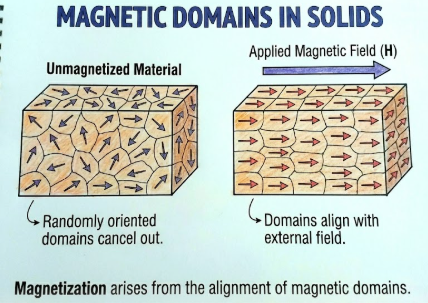
6. Magnetic Properties
Weakly attracted by magnetic field. Unpaired electrons present (e.g., O2, Cu2+).
Weakly repelled. No unpaired electrons (e.g., H2O, NaCl).
Strongly attracted. Domains align in same direction. Permanent magnet (e.g., Fe, Ni, Co, CrO2).
Domains align oppositely, cancelling magnetic moment (e.g., MnO).
Domains align unequally in parallel/anti-parallel. Weak attraction (e.g., Fe3O4).
Numericals & HOTS
Important Formulae
20 Golden Facts (NEET)
- 1. Supercooled Liquids: Amorphous solids (like Glass) have a tendency to flow very slowly, causing old window panes to become thicker at the bottom.
- 2. AgBr Exception: Silver Bromide (AgBr) is unique as it shows BOTH Schottky (vacancy) and Frenkel (dislocation) defects.
- 3. F-Centers: The anionic sites occupied by unpaired electrons are called F-centers (Farbenzenter). They impart color (e.g., NaCl turns yellow, KCl turns violet).
- 4. ZnO Heating: Zinc Oxide (white) turns Yellow on heating due to metal excess defect (loss of oxygen leaving Zn2+ and electrons in voids).
-
5. Coordination Number (CN):
NaCl structure (Rock Salt): Na+(6) : Cl-(6)
CsCl structure: Cs+(8) : Cl-(8)
ZnS structure: Zn2+(4) : S2-(4) - 6. Pressure Effect: High pressure increases Coordination Number. NaCl type (6:6) → CsCl type (8:8).
- 7. Temperature Effect: High temperature decreases Coordination Number. CsCl type (8:8) → NaCl type (6:6).
- 8. Ferrimagnetism: Magnetic moments are aligned in parallel and anti-parallel directions in unequal numbers. Example: Fe3O4 (Magnetite). Becomes paramagnetic on heating.
- 9. Quartz vs Glass: Quartz is crystalline SiO2 (ordered). Glass is amorphous SiO2 (random). Quartz can be converted to glass by melting and rapid cooling.
- 10. 12-16 Compounds: Semiconductors formed by Group 12 and 16 elements (e.g., ZnS, CdS, HgTe). They have average valency of 4.
- 11. Diamond: Covalent solid. Each Carbon is sp3 hybridized. Hardest substance. Insulator (no free electrons).
- 12. Graphite: Covalent solid but layered. Each Carbon is sp2 hybridized. Good conductor (free 4th electron between layers). Soft lubricant.
-
13. Distance of Nearest Neighbor (d):
SC: d = a
BCC: d = √3 a / 2
FCC: d = a / √2 -
14. Radius Ratio Rule:
0.155 - 0.225 → Triangular (CN 3)
0.225 - 0.414 → Tetrahedral (CN 4)
0.414 - 0.732 → Octahedral (CN 6)
0.732 - 1.000 → Cubic (CN 8) - 15. CrO2 Application: Chromium Dioxide (CrO2) is ferromagnetic and is used to make magnetic tapes for audio recording.
- 16. Rectifier: p-n junction allows current to flow only in one direction, acting as a rectifier.
-
17. HCP vs CCP: Both have 74% efficiency.
HCP (Mg, Zn): ABABAB pattern.
CCP/FCC (Cu, Ag, Au): ABCABC pattern. - 18. Cation Vacancy: FexO (where x ≈ 0.95) exists because some Fe2+ are missing and charge is balanced by Fe3+.
- 19. Pyroelectricity: Some polar crystals produce a small electric current when heated (e.g., Tourmaline).
-
20. Molecular Solid Types:
Non-polar: Ar, CCl4 (Dispersion forces).
Polar: HCl, SO2 (Dipole-dipole).
H-bonded: H2O (Hydrogen bonds).