1. Solutions & Concentration
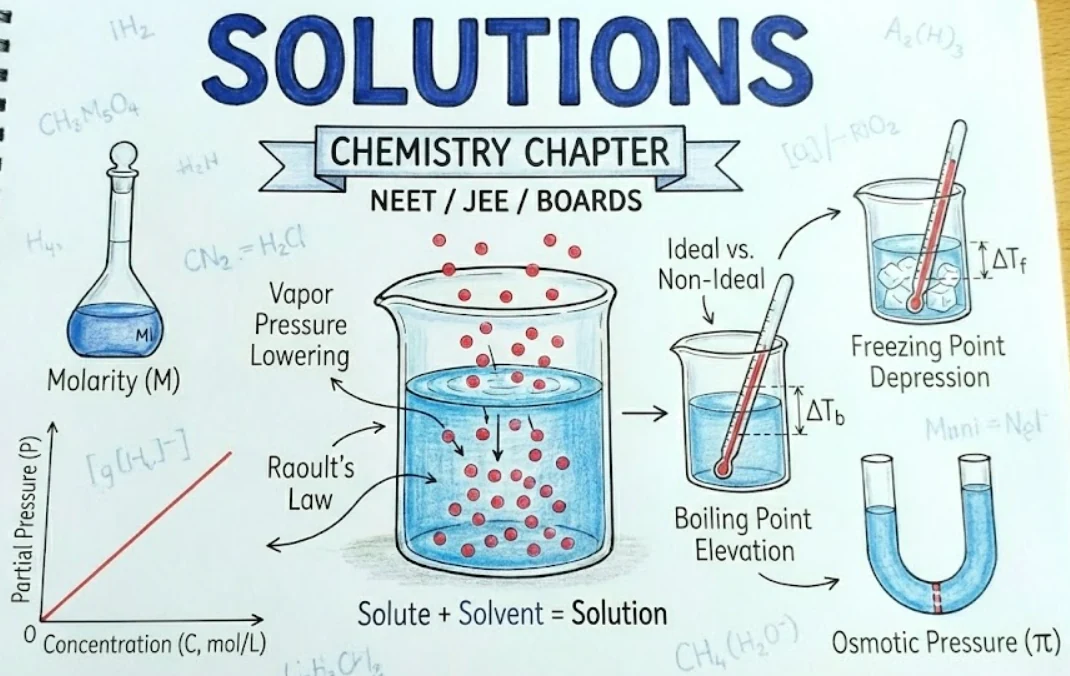
A solution is a homogeneous mixture of two or more substances.
- Solute: Component present in smaller quantity.
- Solvent: Component present in larger quantity (determines physical state).
Methods of Expressing Concentration
1. Molarity (M):Moles of solute per Litre of solution. (Temp Dependent)
M = nsolute / Vsol(L)
2. Molality (m):Moles of solute per kg of Solvent. (Temp Independent - Better for experiments)
m = nsolute / Wsolvent(kg)
3. Mole Fraction (x):Ratio of moles of one component to total moles.
xA = nA / (nA + nB)
Sum of mole fractions = 1
2. Solubility & Henry's Law
Solubility: Max amount of solute that can be dissolved in a specified amount of solvent.
Henry's Law (Gas in Liquid)
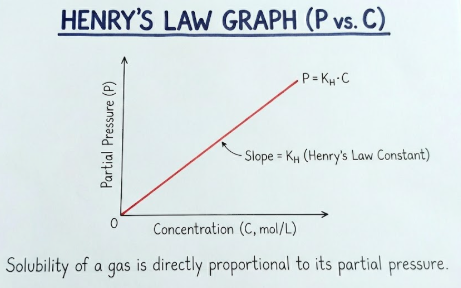
The partial pressure of the gas in vapor phase (p) is proportional to the mole fraction of the gas (x) in the solution.
p = KH · x
- KH (Henry's Constant): Depends on nature of gas and Temp.
- Higher KH → Lower Solubility.
- KH increases with Temperature (So, warm water holds less O2).
3. Vapour Pressure & Raoult's Law
Raoult's Law (Volatile Solute): Partial vapor pressure of each component is product of vapor pressure of pure component and its mole fraction.
pA = p°A xA
pB = p°B xB
Ptotal = pA + pB
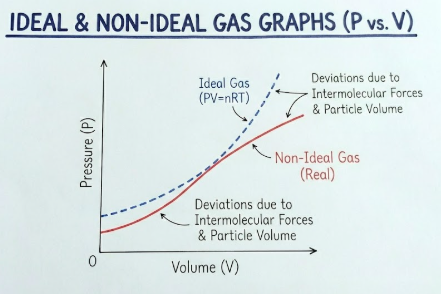
Ideal vs Non-Ideal Solutions
| Ideal | Positive Deviation | Negative Deviation |
|---|
| Obey Raoult's Law | Ptotal > Ideal | Ptotal < Ideal |
| ΔHmix = 0 | ΔHmix > 0 (Endo) | ΔHmix < 0 (Exo) |
| ΔVmix = 0 | ΔVmix > 0 (Expands) | ΔVmix < 0 (Shrinks) |
| A-B = A-A | A-B < A-A (Weaker) | A-B > A-A (Stronger) |
Azeotropes: Constant boiling mixtures.
• Min Boiling Azeotrope: +ve deviation (e.g., Ethanol + Water).
• Max Boiling Azeotrope: -ve deviation (e.g., HNO3 + Water).
4. Colligative Properties (CP)
Properties that depend ONLY on the number of solute particles, not their nature. (For non-volatile solute).
1. Relative Lowering of Vapor Pressure:
(p° - p) / p° = xsolute
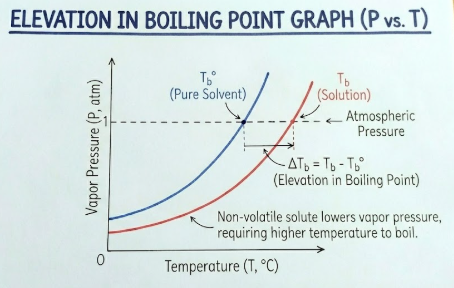
2. Elevation in Boiling Point (ΔTb):
ΔTb = Kb × m
(Kb = Ebullioscopic Constant)
3. Depression in Freezing Point (ΔTf):
ΔTf = Kf × m
(Kf = Cryoscopic Constant)
4. Osmotic Pressure (π):
π = CRT
(C = Molarity)
Osmotic Solutions Types
- Isotonic: Same π. No net flow.
- Hypertonic: Higher π (Cells shrink/plasmolysis).
- Hypotonic: Lower π (Cells swell/burst).
Reverse Osmosis (RO): If Pressure > π is applied on solution side, solvent flows from solution to pure solvent. Used for desalination.
5. Van't Hoff Factor (i)
Correction factor for Association or Dissociation of solute.
i = (Observed CP) / (Calculated CP)
i = (Total moles after) / (Total moles before)
- No Association/Dissociation (Urea, Glucose): i = 1
- Dissociation (NaCl → Na+ + Cl-): i > 1 (i = 1 + (n-1)α)
- Association (2CH3COOH → Dimer): i < 1 (i = 1 + (1/n - 1)α)
Modified Equations:
- RLVP: (p°-p)/p° = i · xsolute
- ΔTb = i · Kb · m
- ΔTf = i · Kf · m
- π = i · CRT
Numericals & HOTS
Q1. Molarity & Molality
Calculate the molality of 2.5 g of ethanoic acid (CH3COOH) in 75 g of benzene.
Solution:
1. Moles of solute (C2H4O2):
Molar Mass = 24 + 4 + 32 = 60 g/mol.
Moles = 2.5 / 60 = 0.0417 mol.
2. Mass of solvent (Benzene):
Mass = 75 g = 0.075 kg.
3. Molality (m):
m = Moles of solute / Mass of solvent (kg)
m = 0.0417 / 0.075
m = 0.556 mol/kg
Q2. Henry's Law Application
If N2 gas is bubbled through water at 293 K, how many millimoles of N2 would dissolve in 1 litre of water? Assume N2 exerts a partial pressure of 0.987 bar. (KH for N2 = 76.48 kbar).
Solution:
p = KH × x
Given p = 0.987 bar.
KH = 76.48 kbar = 76480 bar.
Mole fraction (x) = p / KH
x = 0.987 / 76480 = 1.29 × 10⁻⁵
Moles of water in 1L = 1000g / 18 = 55.5 mol.
Since x = n / (n + 55.5) ≈ n / 55.5 (as n is very small):
n = 1.29 × 10-5 × 55.5
n = 7.16 × 10⁻⁴ mol
n = 0.716 mmol
Q3. Vapor Pressure of Mixture
Vapor pressure of pure liquids A and B are 450 and 700 mm Hg respectively. Find the composition of the liquid mixture if total vapor pressure is 600 mm Hg.
Solution:
Ptotal = P°A + (P°B - P°A)xB
600 = 450 + (700 - 450)xB
600 = 450 + 250xB
150 = 250xB
xB = 150 / 250 = 0.6
Since xA + xB = 1:
xA = 1 - 0.6 = 0.4
Composition: xA = 0.4, xB = 0.6
Q4. Antifreeze Calculation
45g of ethylene glycol (C2H6O2) is mixed with 600g of water. Calculate the freezing point depression. (Kf for water = 1.86 K kg mol-1).
Solution:
1. Moles of solute:
Molar Mass = 24 + 6 + 32 = 62 g/mol.
n = 45 / 62 = 0.726 mol.
2. Molality (m):
m = 0.726 / 0.600 kg = 1.21 mol/kg.
3. ΔTf = Kf × m
ΔTf = 1.86 × 1.21
ΔTf = 2.25 K
Q5. Molar Mass of Protein
200 cm3 of an aqueous solution of a protein contains 1.26 g of the protein. The osmotic pressure of such a solution at 300 K is found to be 2.57 × 10⁻³ bar. Calculate the molar mass of the protein.
Solution:
Formula: π = CRT = (n/V)RT = (w/M) (RT/V)
M = (wRT) / (πV)
w = 1.26 g
R = 0.083 L bar K-1 mol-1
T = 300 K
π = 2.57 × 10⁻³ bar
V = 0.2 L
M = (1.26 × 0.083 × 300) / (2.57 × 10-3 × 0.2)
M = 31.374 / 0.000514
M = 61,039 g/mol
Q6. Isotonic Condition (HOTS)
A 5% solution (by mass) of cane sugar (M=342) is isotonic with a 0.877% solution of substance X. Find the molecular weight of X.
Solution:
For isotonic solutions at same Temp: C1 = C2 (assuming i=1 for both).
C1 (Sugar) = (5g / 342) / 100mL
C2 (X) = (0.877g / Mx) / 100mL
5 / 342 = 0.877 / Mx
Mx = (0.877 × 342) / 5
Mx = 299.9 / 5
Mx ≈ 60 g/mol (Likely Urea)
Q7. Calculating 'i'
The freezing point depression of a 0.1 molal solution of weak acid HA is 0.19 K. If Kf for water is 1.86 K kg mol-1, calculate the Van't Hoff factor (i).
Solution:
Calculated ΔTf = Kf × m = 1.86 × 0.1 = 0.186 K.
Observed ΔTf = 0.19 K.
i = Observed Value / Calculated Value
i = 0.19 / 0.186
i = 1.02
Q8. Dimerization (HOTS)
2g of Benzoic acid (C6H5COOH) dissolved in 25g of benzene shows a freezing point depression of 1.62 K. Kf for benzene is 4.9 K kg mol-1. What is the percentage association? (Molar mass = 122).
Solution:
1. Theoretical ΔTf:
m = (2/122) / 0.025 = 0.655 mol/kg.
ΔTtheo = 4.9 × 0.655 = 3.21 K.
2. Calculate i:
i = Observed / Theoretical = 1.62 / 3.21 = 0.504.
3. Association Formula (Dimer, n=2):
i = 1 + (1/n - 1)α
0.504 = 1 + (0.5 - 1)α
0.504 - 1 = -0.5α
-0.496 = -0.5α
α = 0.992
Percentage Association = 99.2%
Q9. Comparing Properties
Arrange the following 0.1 M aqueous solutions in increasing order of Boiling Point: Urea, NaCl, MgCl2, Al2(SO4)3.
Solution:
ΔTb ∝ i (since concentration is same).
1. Urea (i=1)
2. NaCl (i=2)
3. MgCl2 (i=3)
4. Al2(SO4)3 (i=5)
Boiling Point = 100 + ΔTb.
Order: Urea < NaCl < MgCl2 < Al2(SO4)3
Q10. Relative Lowering
The vapor pressure of water at 20°C is 17.5 mm Hg. A solution of sucrose (M=342) is prepared by dissolving 68.4 g in 1000 g of water. Calculate the vapor pressure of the solution.
Solution:
Moles solute (n2) = 68.4/342 = 0.2 mol.
Moles solvent (n1) = 1000/18 = 55.5 mol.
x2 = 0.2 / (55.5 + 0.2) ≈ 0.2 / 55.5 = 0.0036.
Formula: (p° - p) / p° = x2
(17.5 - p) / 17.5 = 0.0036
17.5 - p = 0.063
p = 17.5 - 0.063
p = 17.437 mm Hg
Important Formulae
1. Concentration Terms
Molarity (M):
M = nsolute / Vsol(L)
Molality (m):
m = nsolute / Wsolvent(kg)
Mole Fraction (x):
xA = nA / (nA + nB)
2. Gas Solubility & Vapor Pressure
Henry's Law:
p = KH · x
Raoult's Law (Volatile Solute):
Ptotal = p°AxA + p°BxB
Dalton's Law (Vapor Phase Composition):
pA = yA · Ptotal
(yA = mole fraction in vapor)
3. Colligative Properties (With 'i')
1. Rel. Lowering of VP:
(p° - p) / p° = i · xsolute
2. Elevation in BP:
ΔTb = i · Kb · m
3. Depression in FP:
ΔTf = i · Kf · m
4. Osmotic Pressure:
π = i · C R T
4. Van't Hoff Factor (i)
Degree of Dissociation (α):
α = (i - 1) / (n - 1)
Degree of Association (α):
α = (1 - i) / (1 - 1/n)
20 Golden Facts (NEET)
-
1. Temp Dependence: Molarity and Normality change with temperature (due to Volume). Molality and Mole Fraction are Independent of temperature (Mass does not change).
-
2. Henry's Constant (KH): KH increases with Temperature. Since Solubility ∝ 1/KH, solubility of gases decreases as temperature increases. (Aquatic life prefers cold water).
-
3. Scuba Diver's Bends: Caused by N2 bubbles blocking capillaries when a diver resurfaces quickly. Helium is added to tanks to reduce this effect (low solubility).
-
4. Positive Deviation: A-B interactions are WEAKER than A-A and B-B. Result: Vapor Pressure Increases, B.P. Decreases. (e.g., Ethanol + Acetone).
-
5. Negative Deviation: A-B interactions are STRONGER than A-A and B-B. Result: Vapor Pressure Decreases, B.P. Increases. (e.g., Chloroform + Acetone).
-
6. Azeotropes: Binary mixtures having the same composition in liquid and vapor phase and boil at a constant temperature. They cannot be separated by fractional distillation.
-
7. Min Boiling Azeotrope: Formed by solutions showing large Positive deviation (e.g., 95% Ethanol + 5% Water).
-
8. Max Boiling Azeotrope: Formed by solutions showing large Negative deviation (e.g., 68% HNO3 + 32% Water).
-
9. Ebullioscopic Constant (Kb): Depends ONLY on the nature of the Solvent. For water, Kb = 0.52 K kg mol-1.
-
10. Cryoscopic Constant (Kf): Also depends only on solvent. For water, Kf = 1.86 K kg mol-1. Note that Kf is usually greater than Kb.
-
11. Ethylene Glycol: Used as "Antifreeze" in car radiators because it lowers the freezing point of water, preventing the engine from freezing in winter.
-
12. Osmotic Pressure Advantage: It is the best method to determine molar mass of polymers/proteins because it can be measured at room temp and its magnitude is large even for dilute solutions.
-
13. Isotonic IV Fluids: Intravenous injections must be isotonic with blood plasma (π equivalent to 0.9% NaCl solution).
-
14. Edema: People taking a lot of salt experience water retention in tissues due to osmosis. This swelling is called edema.
-
15. Reverse Osmosis (RO): If pressure applied > Osmotic pressure, solvent flows from Solution → Solvent. Used for desalination of sea water.
-
16. Van't Hoff Factor (i):
• i = 1 (Non-electrolyte, e.g., Urea)
• i > 1 (Dissociation, e.g., NaCl, i=2)
• i < 1 (Association, e.g., Benzoic acid dimerizes, i=0.5) -
17. Order of CP: For same molarity: Al2(SO4)3 > BaCl2 > NaCl > Urea. (Depends on number of ions 'i').
-
18. Camphor: Used as a solvent in melting point determination (Rast method) because it has a very high Kf value (39.7), giving a large depression in freezing point.
-
19. Ideal Mixing: For ideal solutions, ΔHmix = 0 and ΔVmix = 0. However, ΔSmix > 0 (always) and ΔGmix < 0.
-
20. Salting of Roads: CaCl2 or NaCl is sprinkled on icy roads to lower the freezing point of water, melting the ice even at sub-zero temperatures.
📱 Practice MCQs for this topic inside our App
📱 Practice MCQs for this topic inside our App
📱 Practice MCQs for this topic inside our App
📱 Practice MCQs for this topic inside our App