

1. Introduction
Matter exists in three primary states: Solid, Liquid, and Gas. The state depends on the balance between:
- Intermolecular Forces: Tend to keep molecules together (Cohesive forces).
- Thermal Energy: Tends to keep molecules apart (Random motion).
Liquid: Intermediate forces.
Solid: Strongest forces, Lowest thermal energy.
2. The Gaseous State
2.1 Gas Laws
At constant T, Pressure is inversely proportional to Volume.
At constant P, Volume is directly proportional to Absolute Temperature.
At constant V, Pressure is directly proportional to Absolute Temperature.
Equal volumes of all gases at same T and P contain equal number of moles.
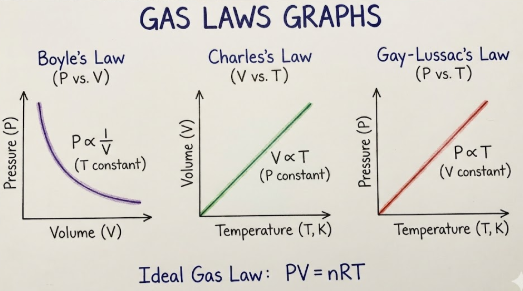
2.2 Ideal Gas Equation
R (Universal Gas Constant):
• 8.314 J K-1 mol-1 (SI Units)
• 0.0821 L atm K-1 mol-1 (Common for Pressure/Volume)
• 2 cal K-1 mol-1 (CGS)
3. Kinetic Theory of Gases (KTG)
Key Assumptions
- Gases consist of large number of identical particles (atoms/molecules).
- Volume of molecules is negligible compared to container volume.
- No force of attraction or repulsion between molecules.
- Collisions are perfectly elastic.
Pressure Equation
4. Molecular Speeds
Maxwell-Boltzmann distribution defines three types of speeds:
5. Real Gases
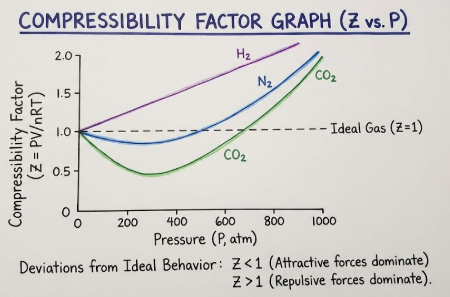
Real gases deviate from ideal behavior at High Pressure and Low Temperature.
Compressibility Factor (Z)
- Z = 1 (Ideal Gas)
- Z < 1 (Negative Deviation, Attractive forces dominate)
- Z > 1 (Positive Deviation, Repulsive forces dominate)
Van der Waals Equation
'a': Measure of intermolecular attraction (Unit: atm L2 mol-2).
'b': Measure of effective size of molecule (Unit: L mol-1).
6. Critical Constants
- Critical Temp (Tc): 8a / 27Rb (Gas cannot be liquefied above this T).
- Critical Pressure (Pc): a / 27b2.
- Critical Volume (Vc): 3b.
7. Liquid Properties
7.1 Surface Tension (γ)
Force acting per unit length perpendicular to the line drawn on the surface.
Causes drops to be spherical (Minimizing surface area).
Liquid Drop: Pex = 2γ / r
Soap Bubble: Pex = 4γ / r
7.2 Viscosity (η)
Internal resistance to flow.
Depends on temperature (Liquids: T↑ η↓; Gases: T↑ η↑).
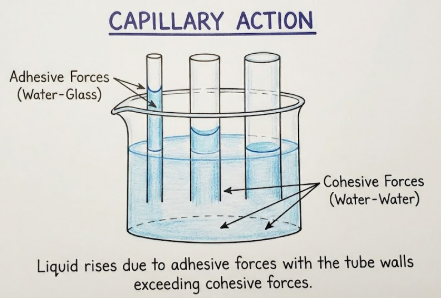
7.3 Capillarity
Rise or fall of liquid in a narrow tube.
(θ = Contact angle)
Numericals & HOTS
Important Formulae
20 Golden Facts (NEET)
- 1. Kinetic Energy: The average kinetic energy of gas molecules depends ONLY on absolute temperature. K.E. ∝ T. It is independent of the nature of the gas.
- 2. Unit of 'a': The Van der Waals constant 'a' represents attractive forces. Unit: atm L2 mol-2. Higher 'a' means easier liquefaction (e.g., NH3 > N2).
- 3. Unit of 'b': The constant 'b' represents excluded volume (size). Unit: L mol-1. Value is 4 times the actual volume of molecules ($b = 4 \times V_m$).
- 4. Z at Low Pressure: For real gases at low pressure, attractive forces dominate. Z < 1. Equation becomes: Z = 1 - a/(VRT).
- 5. Z at High Pressure: Repulsive forces dominate. Z > 1. Equation becomes: Z = 1 + Pb/RT.
- 6. H2 and He Exception: Hydrogen and Helium show Z > 1 at almost all conditions because their intermolecular attraction ('a') is negligible.
- 7. Dalton's Condition: Dalton's Law of Partial Pressure is applicable ONLY for non-reacting gases. (e.g., N2 + O2 is valid, but NH3 + HCl is invalid as they form solid NH4Cl).
- 8. Wet vs Dry Gas: Pdry gas = Ptotal - Aqueous Tension (Vapor pressure of water). Always subtract aq. tension in numericals.
- 9. Boiling Point vs Pressure: Boiling occurs when Vapor Pressure = External Pressure. On mountains (low P), B.P. decreases (cooking takes longer). In pressure cookers (high P), B.P. increases.
- 10. Mean Free Path (λ): Distance traveled between two collisions. $\lambda \propto T/P$. Decreases with high pressure.
- 11. Surface Tension vs Temp: Surface tension decreases as temperature increases (Hot soup tastes better because it spreads easily on the tongue).
- 12. Viscosity vs Temp: Viscosity of liquids decreases with Temp, but viscosity of GASES increases with Temp (due to increased collision randomness).
- 13. Absolute Zero: At -273.15°C (0 K), the volume of an ideal gas theoretically becomes zero, and molecular motion ceases.
- 14. Diffusion Rate: Lighter gases diffuse faster. Rate of diffusion of H2 is 4 times that of O2 (since Mass is 1/16th).
- 15. Falling Drops: Raindrops are spherical due to Surface Tension (minimizing surface area/energy).
- 16. Compressibility Factor Z: At the Critical Point, Z = 3/8 (approx 0.375) for a Van der Waals gas.
- 17. Laminar Flow: In streamline flow of liquids, the velocity is maximum at the center of the tube and minimum (zero) at the walls.
- 18. Units of R: In energy calculations (K.E., work), use R = 8.314 J. In Equation of State (PV=nRT), use R = 0.0821 L atm.
- 19. Avogadro's Hypothesis: The density of a gas is directly proportional to its molar mass at constant T and P ($d \propto M$).
- 20. Capillary Action: If cohesive forces (liquid-liquid) > adhesive forces (liquid-solid), the liquid will fall (convex meniscus, e.g., Mercury). If adhesive > cohesive, it rises (concave meniscus, e.g., Water).