

1. Introduction to Surface Chemistry
Surface chemistry deals with phenomena that occur at the surfaces or interfaces. The bulk phase is different from the surface phase.
2. Adsorption
- Adsorbate: The substance that gets accumulated (e.g., Gas).
- Adsorbent: The surface on which adsorption occurs (e.g., Charcoal).
Absorption: Bulk phenomenon (Uniform distribution, e.g., Sponge soaking water).
Adsorption: Surface phenomenon (Higher conc. at surface, e.g., Chalk dipped in ink).
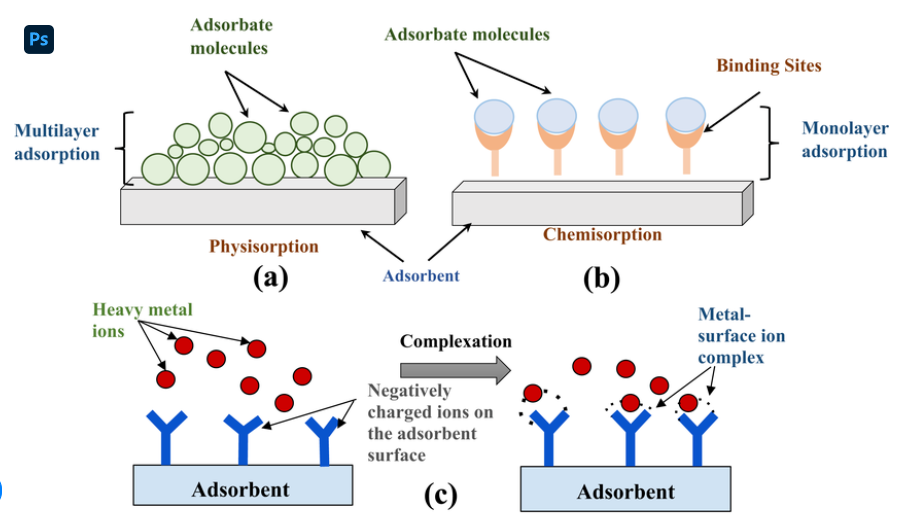
2.2 Physisorption vs Chemisorption
| Property | Physisorption | Chemisorption |
| Force | Weak Van der Waals | Strong Chemical Bond |
| Reversibility | Reversible | Irreversible |
| Heat (ΔH) | Low (20-40 kJ/mol) | High (80-240 kJ/mol) |
| Temp Effect | Decreases with high T | First increases, then decreases |
| Layers | Multi-molecular | Uni-molecular |
2.4 Freundlich Adsorption Isotherm
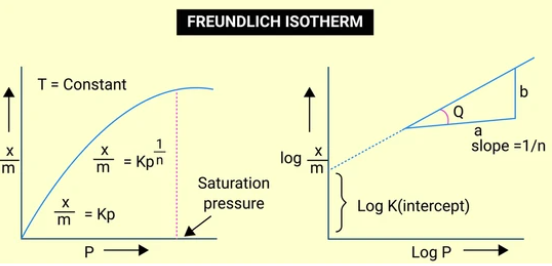
Relationship between extent of adsorption (x/m) and pressure (P) at constant T.
Where n > 1.
Log form: log(x/m) = log k + (1/n) log P
3. Catalysis
- Promoters: Enhance catalyst activity (e.g., Mo in Haber's process).
- Poisons: Decrease catalyst activity (e.g., CO in hydrogenation).
- Homogeneous: Catalyst and reactants in same phase.
- Heterogeneous: Catalyst and reactants in different phases.
Shape Selective Catalysis
Depends on pore structure of catalyst (Zeolites).
Example: ZSM-5 converts alcohols directly into gasoline (petrol).
4. Colloids
Heterogeneous system. Particle size: 1 nm to 1000 nm.
Consists of Dispersed Phase (DP) and Dispersion Medium (DM).
4.2 Classification (Nature of Interaction)
DP has great affinity for DM. Reversible, Stable. (e.g., Gum, Starch, Gelatin).
DP has little affinity for DM. Irreversible, Unstable, need stabilizing agents. (e.g., Metals, Metal sulphides).
Classification (Type of Particles)
- Multimolecular: Aggregation of many atoms (e.g., Gold sol, Sulphur sol).
- Macromolecular: Large molecules (e.g., Starch, Proteins, Plastics).
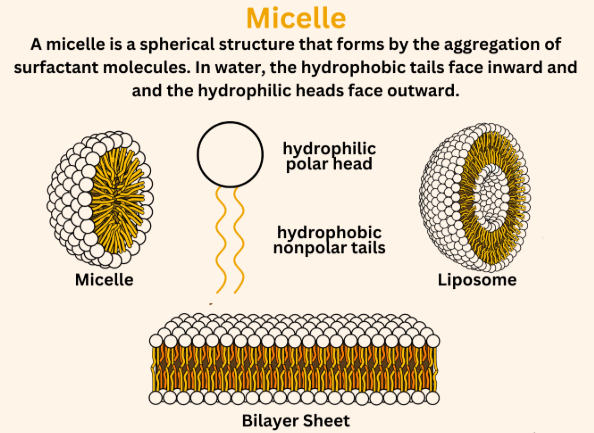
- Associated (Micelles): Behave as electrolytes at low conc, but form colloids at high conc.
Kraft Temperature (Tk): Temp above which micelles form.
CMC: Critical Micelle Concentration.
6. Properties of Colloids
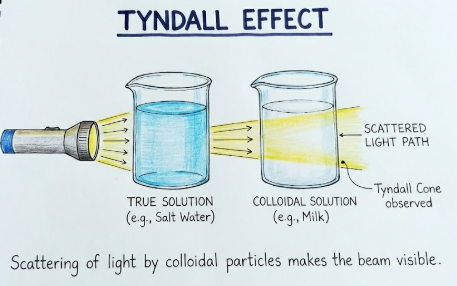
Scattering of light by colloidal particles. The path of light becomes visible.
Zig-zag motion of colloidal particles due to unbalanced bombardment by molecules of dispersion medium. Responsible for stability (prevents settling).
Movement of colloidal particles under an electric field towards oppositely charged electrodes.
8. Coagulation (Flocculation)
The process of settling of colloidal particles is called coagulation.
1. Ions carrying charge opposite to that of sol particles cause coagulation.
2. Greater the valency of the coagulating ion, greater is its power.
Order for Negative Sol (e.g., As2S3):
Order for Positive Sol (e.g., Fe(OH)3):
9. Emulsions
Liquid-Liquid colloidal systems.
- Oil in Water (O/W): Unstable. Example: Milk.
- Water in Oil (W/O): Example: Butter, Cold cream.
Emulsifying Agents: Stabilize emulsions (e.g., Proteins, Gums, Soaps).
10. Applications
- Medicines: Colloidal medicines are more effective due to large surface area (e.g., Argyrol for eyes).
- Delta Formation: River water (colloid of clay) meets Sea water (electrolyte) → Coagulation → Delta.
- Cottrell Precipitator: Removes smoke particles (carbon) from industrial exhaust via electrophoresis.
1. Introduction to Surface Chemistry
Surface chemistry deals with phenomena that occur at the surfaces or interfaces. The bulk phase is different from the surface phase.
2. Adsorption
- Adsorbate: The substance that gets accumulated (e.g., Gas).
- Adsorbent: The surface on which adsorption occurs (e.g., Charcoal).
Absorption: Bulk phenomenon (Uniform distribution, e.g., Sponge soaking water).
Adsorption: Surface phenomenon (Higher conc. at surface, e.g., Chalk dipped in ink).
2.2 Physisorption vs Chemisorption
| Property | Physisorption | Chemisorption |
| Force | Weak Van der Waals | Strong Chemical Bond |
| Reversibility | Reversible | Irreversible |
| Heat (ΔH) | Low (20-40 kJ/mol) | High (80-240 kJ/mol) |
| Temp Effect | Decreases with high T | First increases, then decreases |
| Layers | Multi-molecular | Uni-molecular |
2.4 Freundlich Adsorption Isotherm
Relationship between extent of adsorption (x/m) and pressure (P) at constant T.
Where n > 1.
Log form: log(x/m) = log k + (1/n) log P
3. Catalysis
- Promoters: Enhance catalyst activity (e.g., Mo in Haber's process).
- Poisons: Decrease catalyst activity (e.g., CO in hydrogenation).
- Homogeneous: Catalyst and reactants in same phase.
- Heterogeneous: Catalyst and reactants in different phases.
Shape Selective Catalysis
Depends on pore structure of catalyst (Zeolites).
Example: ZSM-5 converts alcohols directly into gasoline (petrol).
4. Colloids
Heterogeneous system. Particle size: 1 nm to 1000 nm.
Consists of Dispersed Phase (DP) and Dispersion Medium (DM).
4.2 Classification (Nature of Interaction)
DP has great affinity for DM. Reversible, Stable. (e.g., Gum, Starch, Gelatin).
DP has little affinity for DM. Irreversible, Unstable, need stabilizing agents. (e.g., Metals, Metal sulphides).
Classification (Type of Particles)
- Multimolecular: Aggregation of many atoms (e.g., Gold sol, Sulphur sol).
- Macromolecular: Large molecules (e.g., Starch, Proteins, Plastics).
- Associated (Micelles): Behave as electrolytes at low conc, but form colloids at high conc.
Kraft Temperature (Tk): Temp above which micelles form.
CMC: Critical Micelle Concentration.
6. Properties of Colloids
Scattering of light by colloidal particles. The path of light becomes visible.
Zig-zag motion of colloidal particles due to unbalanced bombardment by molecules of dispersion medium. Responsible for stability (prevents settling).
Movement of colloidal particles under an electric field towards oppositely charged electrodes.
8. Coagulation (Flocculation)
The process of settling of colloidal particles is called coagulation.
1. Ions carrying charge opposite to that of sol particles cause coagulation.
2. Greater the valency of the coagulating ion, greater is its power.
Order for Negative Sol (e.g., As2S3):
Order for Positive Sol (e.g., Fe(OH)3):
9. Emulsions
Liquid-Liquid colloidal systems.
- Oil in Water (O/W): Unstable. Example: Milk.
- Water in Oil (W/O): Example: Butter, Cold cream.
Emulsifying Agents: Stabilize emulsions (e.g., Proteins, Gums, Soaps).
10. Applications
- Medicines: Colloidal medicines are more effective due to large surface area (e.g., Argyrol for eyes).
- Delta Formation: River water (colloid of clay) meets Sea water (electrolyte) → Coagulation → Delta.
- Cottrell Precipitator: Removes smoke particles (carbon) from industrial exhaust via electrophoresis.
Important Formulae
20 Golden Facts (NEET)
- 1. Always Exothermic: Adsorption is always exothermic (ΔH < 0) because residual surface forces decrease, leading to a release of surface energy as heat.
- 2. Entropy Decrease: When gas is adsorbed on a solid, the freedom of movement of gas molecules is restricted. Thus, entropy decreases (ΔS < 0).
- 3. Critical Temperature: Easily liquefiable gases (high critical temp like SO2, NH3) are adsorbed more readily than permanent gases (H2, N2).
- 4. Activation Energy: Physisorption has very low activation energy. Chemisorption requires high activation energy (Activated Adsorption).
- 5. Particle Size: The range of colloidal particle size is 1 nm to 1000 nm. True solution < 1 nm; Suspension > 1000 nm.
- 6. Tyndall Conditions: It is observed only when: (a) Diameter of particle is comparable to wavelength of light, (b) Large difference in Refractive Indices of DP and DM.
- 7. Zeta Potential: The potential difference between the fixed layer and the diffused layer of charges around a colloidal particle. It determines stability.
- 8. Lyophilic Sol Stability: Due to two factors: (1) Charge on particles, (2) Extensive Solvation (Hydration). Lyophobic is stable ONLY due to charge.
- 9. Kraft Temperature: The formation of micelles takes place only above a particular temperature called Kraft Temperature (Tk).
- 10. Gold Number: Defined as the mg of protective colloid required to prevent coagulation of 10 mL of red gold sol by 1 mL of 10% NaCl solution.
- 11. Gelatin: Gelatin has a very low Gold Number (0.005–0.01), making it an excellent protective colloid (used in Ice Creams to prevent crystallization).
- 12. Electro-osmosis: If the movement of colloidal particles (electrophoresis) is prevented, the dispersion medium starts moving under electric field.
- 13. Blood Clotting: Blood is a negatively charged colloid. Ferric Chloride (FeCl3) provides Fe3+ ions which cause coagulation to stop bleeding.
- 14. Delta Formation: River water (Clay, -ve charge) meets Sea water (Electrolytes Na+, Mg2+). Coagulation occurs, depositing clay.
- 15. Peptization: The process of converting a precipitate into colloidal sol by shaking it with dispersion medium in the presence of a small amount of electrolyte.
- 16. Shape Selective: Zeolites are shape-selective catalysts due to their honeycomb-like structure. ZSM-5 converts alcohol to gasoline.
- 17. Enzyme Optimum: Enzymes are highly specific and work best at optimum temperature (298-310 K) and optimum pH (5-7).
- 18. Colloidal Rain: Artificial rain is caused by spraying oppositely charged dust or sand over clouds (which are colloidal aerosols of water).
- 19. Positive Sols: Hydrated metallic oxides (Al2O3.xH2O, Fe2O3.xH2O), Haemoglobin, Basic dyes (Methylene blue).
- 20. Negative Sols: Metals (Cu, Ag, Au), Metal Sulphides (As2S3), Starch, Gum, Clay, Charcoal, Acid dyes (Congo red).