
1. Basic Concepts & Systems
Thermodynamics is the study of energy transformations. For NEET, understanding the boundary between the system and the universe is step one.
Surroundings: Everything else (Universe - System).
1.1 Types of Systems
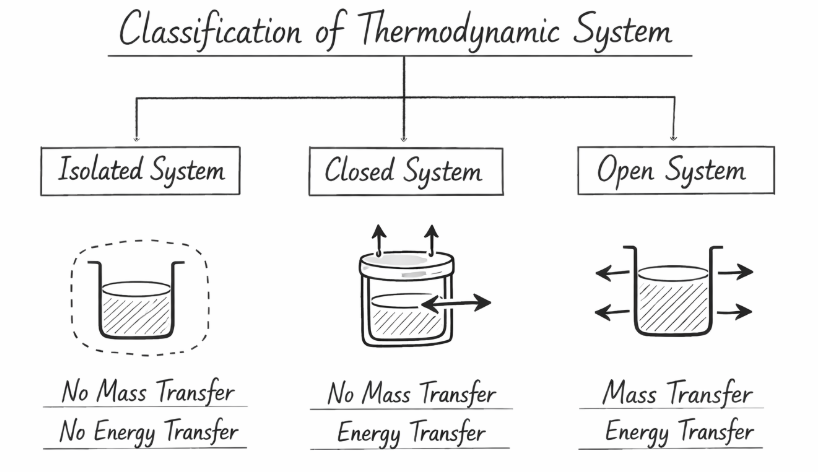
- Open System: Exchanges both matter and energy (e.g., Boiling water in an open pan).
- Closed System: Exchanges energy but NOT matter (e.g., Hot water in a sealed metallic flask).
- Isolated System: Exchanges neither energy nor matter (e.g., A perfectly insulated thermos).
The measurement of temperature (Thermometry) is based on the Zeroth Law of Thermodynamics, which was actually formulated after the First Law but is so fundamental it was given the number zero.
1.2 Thermodynamic Properties
1. Extensive Properties: Depend on quantity of matter.
2. Intensive Properties: Independent of quantity.
Ratio of two Extensive properties is always Intensive.
Example: Mass / Volume = Density (Intensive).
2. First Law & Internal Energy
Statement: Energy can neither be created nor destroyed. The energy of an isolated system is constant.
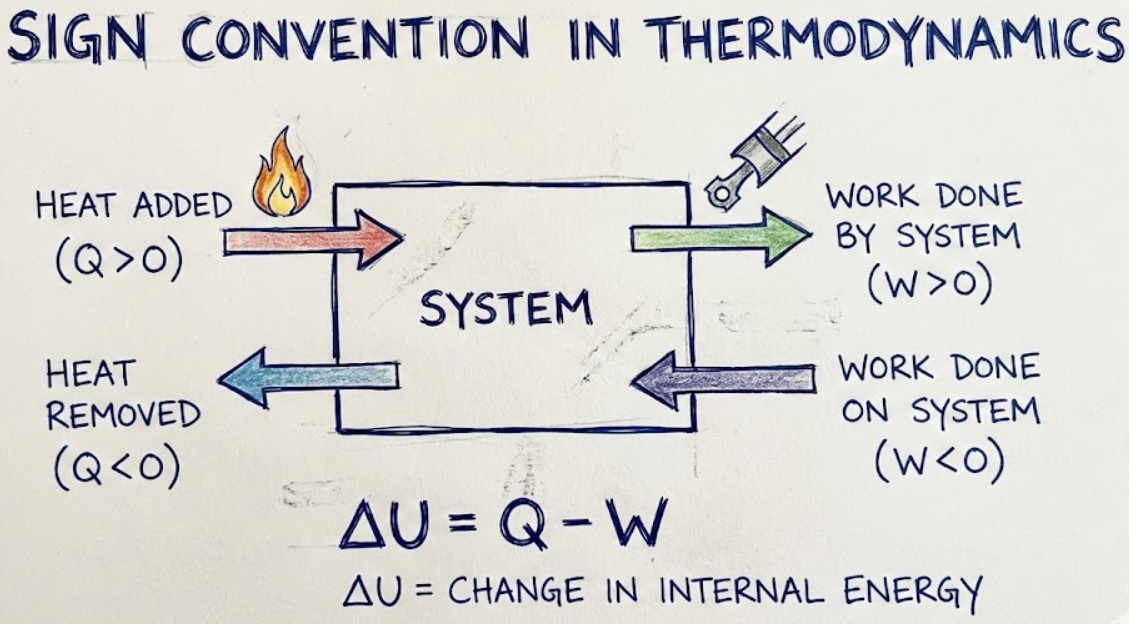
IUPAC Sign Convention
| Process | Sign |
| Heat absorbed by system | +ve (q > 0) |
| Heat released by system | -ve (q < 0) |
| Work done ON system (Compression) | +ve (w > 0) |
| Work done BY system (Expansion) | -ve (w < 0) |
Work Done (w) Formulas
- Irreversible Process: w = -Pext ΔV
- Reversible Isothermal: w = -2.303 nRT log(V2/V1)
- Free Expansion (Vacuum): Pext = 0, so w = 0.
3. Enthalpy (H)
Enthalpy is the total heat content of a system at constant pressure.
For Gaseous reactions:
ΔH = ΔU + ΔngRT
Where Δng = (Moles of gaseous products) - (Moles of gaseous reactants).
Heat Capacity (C)
Relationship between constant pressure (Cp) and constant volume (Cv) heat capacities for 1 mole of ideal gas:
4. Entropy & Second Law
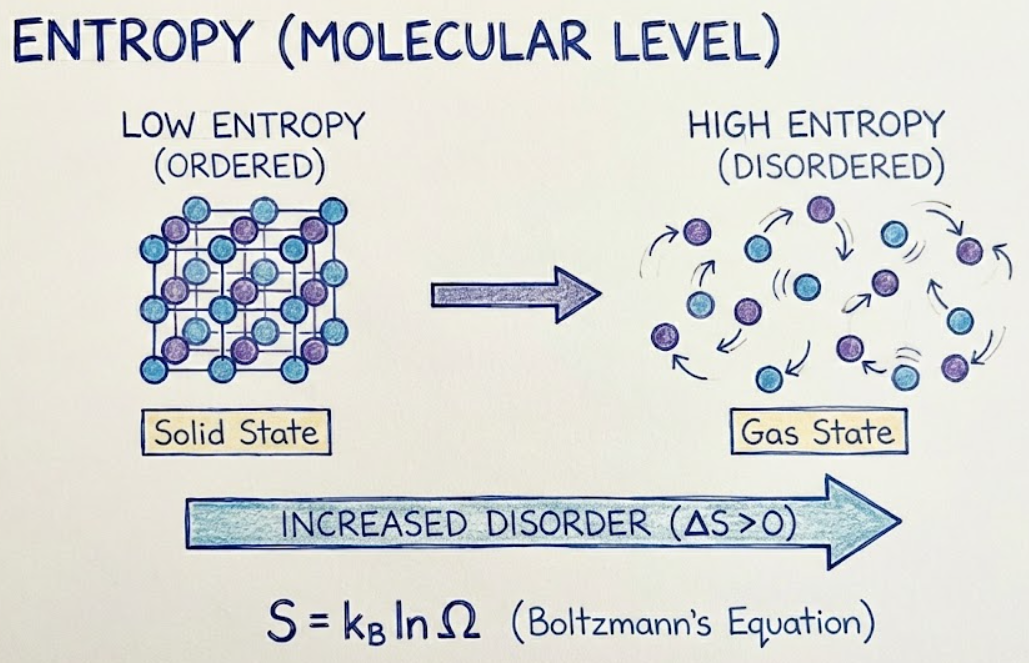
Entropy (S): Measure of randomness or disorder.
Order: Gas (Max) > Liquid > Solid (Min).
For any spontaneous process, the total entropy of the universe (System + Surroundings) must increase.
ΔStotal > 0
5. Gibbs Free Energy (G)
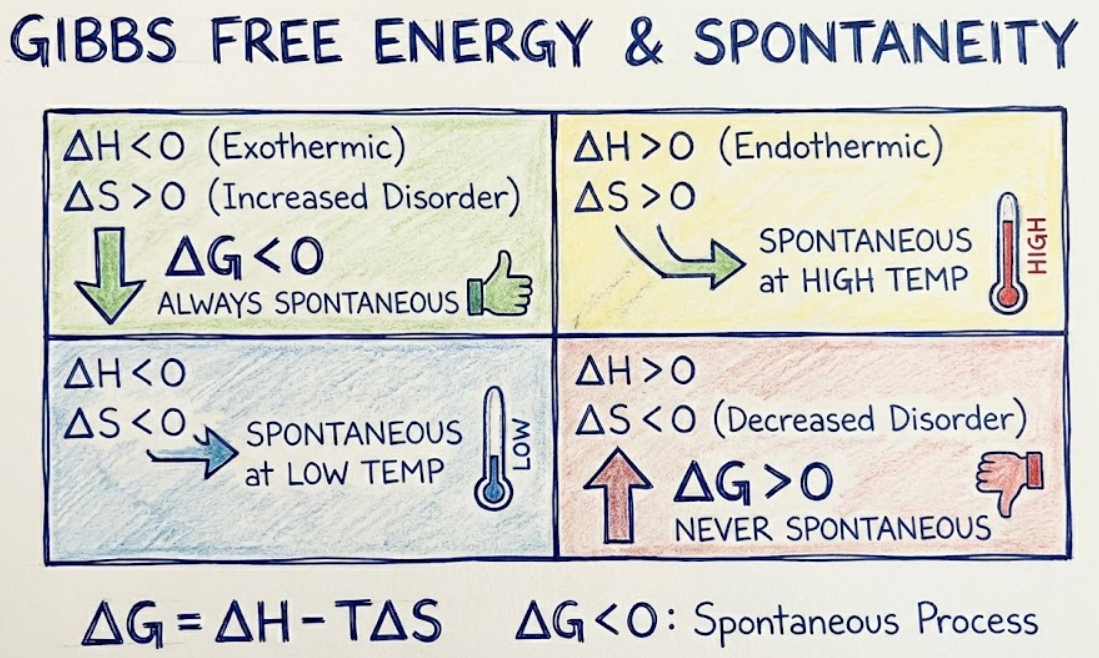
The single parameter to decide spontaneity at constant T and P.
Criteria for Spontaneity
| ΔG Value | Result |
| Negative (ΔG < 0) | Process is Spontaneous |
| Positive (ΔG > 0) | Non-Spontaneous |
| Zero (ΔG = 0) | System at Equilibrium |
ΔG° = -2.303 RT log K
Thermodynamics: Numericals & HOTS
Thermodynamics Formulas
1. First Law of Thermodynamics
2. Work Done (w)
Irreversible (Constant Ext. Pressure):
Reversible Isothermal (Ideal Gas):
3. Enthalpy & Internal Energy
4. Mayer's Relation
5. Entropy Change (ΔS)
6. Gibbs Free Energy (ΔG)
Relation with Equilibrium Constant:
20 Golden Facts for NEET
- 1. Free Expansion: Expansion of a gas into a vacuum (Pext = 0) involves Zero Work (w = 0). If the gas is ideal, ΔT = 0 and ΔU = 0 as well.
- 2. Intensive Ratio: The ratio of two extensive properties is always an Intensive Property. (e.g., Mass/Volume = Density, Enthalpy/Mole = Molar Enthalpy).
- 3. Adiabatic Cooling: When a gas expands adiabatically, it does work at the cost of its internal energy. This causes the temperature to FALL.
- 4. Standard Enthalpy: By convention, the standard enthalpy of formation (ΔfH°) of an element in its standard reference state (e.g., O2, Cl2, C-graphite, S-rhombic) is taken as ZERO.
- 5. Bomb Calorimeter: This device operates at constant volume. Therefore, the heat measured (qv) corresponds directly to the change in Internal Energy (ΔU), not Enthalpy.
- 6. Cyclic Process: For a cyclic process, the system returns to its initial state. Hence, change in all state functions is zero: ΔU = 0, ΔH = 0.
- 7. Third Law: The entropy of a perfectly crystalline solid at Absolute Zero (0 K) is ZERO. This is the reference point for calculating absolute entropies.
- 8. Mayer's Relation: For 1 mole of an ideal gas, Cp - Cv = R. This means Cp is always greater than Cv because work is done during expansion at constant pressure.
- 9. Bond Energy Trick: Unlike formation enthalpies, when calculating reaction enthalpy using Bond Energies: ΔH = ΣB.E.(Reactants) - ΣB.E.(Products).
- 10. Strong Acid-Base: The enthalpy of neutralization of a strong acid and strong base is constant: -57.1 kJ/mol (or -13.7 kcal/mol).
- 11. Path Functions: Heat (q) and Work (w) are path functions. Their value depends on the route taken. All other thermodynamic properties (P, V, T, U, H, S, G) are State Functions.
- 12. Equilibrium Condition: At thermodynamic equilibrium, Gibbs Free Energy change is minimum and constant, so ΔG = 0.
- 13. Solids & Liquids: For reactions involving only solids and liquids, volume change is negligible. Thus, ΔH ≈ ΔU.
- 14. Spontaneity Check: If ΔH is negative (Exothermic) and ΔS is positive (Disorder increases), the reaction is Spontaneous at ALL temperatures.
- 15. Zeroth Law: This law defines Temperature. If A is in thermal equilibrium with B, and B with C, then A is in equilibrium with C.
- 16. Reversible Work: The maximum amount of work can only be obtained from a Reversible process. Irreversible processes yield less work.
- 17. Combustion: Enthalpy of combustion (ΔcH) is always Negative (Exothermic), as burning releases heat.
- 18. Boiling Point: At the boiling point, the liquid and vapor are in equilibrium. Therefore, ΔG = 0, which implies ΔH = TΔS.
- 19. Atomization: Enthalpy of atomization is always Positive (Endothermic) because bonds must be broken to separate atoms.
- 20. Poisson's Ratio: The ratio γ = Cp/Cv determines the curve steepness in P-V graphs. Adiabatic curves are steeper than Isothermal curves by a factor of γ.