
Magnetic Effects of Current & Magnetism
Biot-Savart • Ampere's Law • Lorentz Force • Galvanometer • Earth's Magnetism • Matter
1. Oersted's Discovery & Biot-Savart Law
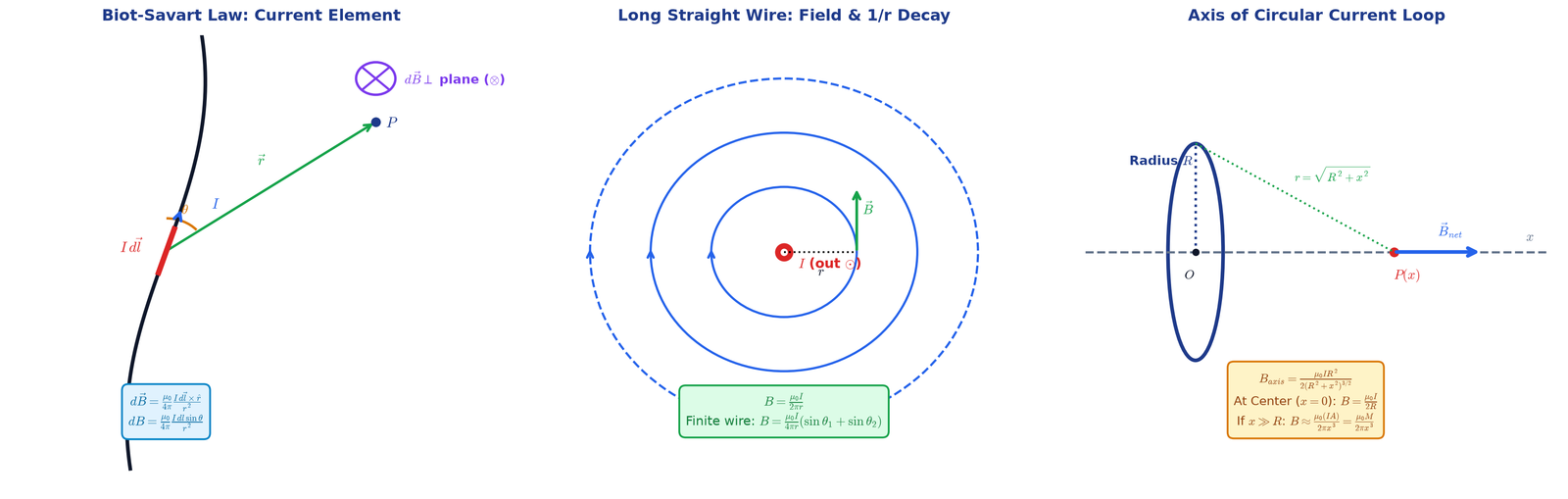
Hans Christian Oersted (1820) established that a steady electric current produces a magnetic field in the surrounding space. Magnetic field lines around a long straight current form concentric circles whose direction is governed by the Right-Hand Thumb Rule.
The magnetic field dB produced at a position vector r by an infinitesimally small current element I dl is:
• μ04π = 10-7 T·m/A.
• dB is perpendicular to both current element dl and radius vector r.
High-Yield Applications for NEET
• Semi-Infinite Wire (At one end): θ1 = 90°, θ2 = 0° &implies; B = μ0 I4π r.
• Circular Arc Subtending Angle φ (in radians): B = μ0 I4π R · φ.
• When x = √3 R &implies; Baxis = 18 Bcenter (Classic NEET PYQ).
• Far away along axis (x ≫ R): B ≈ μ0 M2π x3 where M = N I A.
2. Ampere's Circuital Law, Solenoid & Toroid
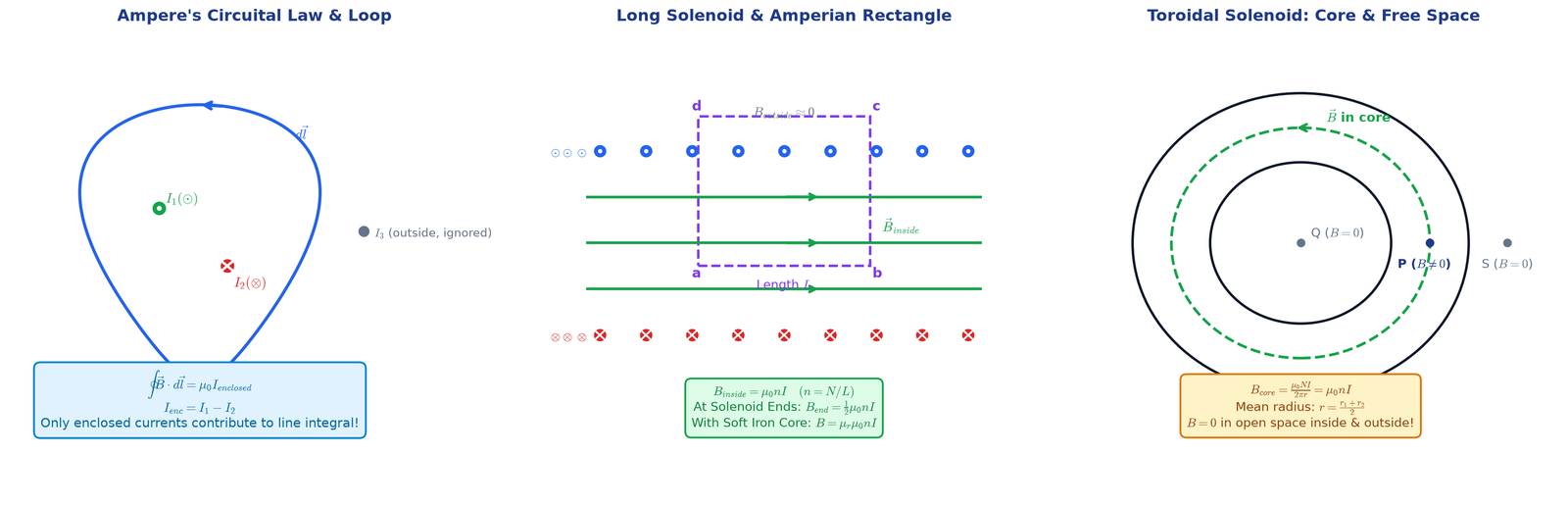
Ampere's Circuital Law plays the same role in magnetostatics as Gauss's law does in electrostatics: it enables swift calculation of magnetic fields when high geometrical symmetry exists.
The line integral of magnetic field B around any closed closed Amperian loop equals μ0 times the net algebraic current enclosed by that loop:
Solenoid & Toroid Summary
- Inside Central Region: B = μ0 n I (Uniform & parallel to axis)
- Near the Ends of Solenoid: Bend = 12 μ0 n I
- Outside Solenoid: Boutside ≈ 0
• Toroid (Endless Solenoid bent into a circle of mean radius r):
- Inside Core (Mean circumference 2πr): B = μ0 N I2π r = μ0 n I
- In the open space interior (hollow region) and exterior: B = 0 because Ienc = 0.
3. Lorentz Force & Charged Particle Motion
When a charge q moves with velocity v in combined electric E and magnetic B fields, the total Lorentz force is: F = q (E + v × B).
• Magnitude: F = q v B sinθ (where θ is angle between v and B).
• Zero Work Done: Since Fm is strictly perpendicular to v at every instant:
Trajectory Regimes Depending on Angle θ
2. θ = 90° (Perpendicular): F = qvB provides required centripetal force m v2r &implies; Circular Orbit.
• Orbital Radius:
3. 0° < θ < 90° (Oblique Angle): Velocity splits into:
• v⊥ = v sinθ produces circular rotation with radius r = m v sinθq B.
• v∥ = v cosθ pulls particle along field &implies; Helical Trajectory.
• Pitch of Helix: Linear distance traveled during one time period:
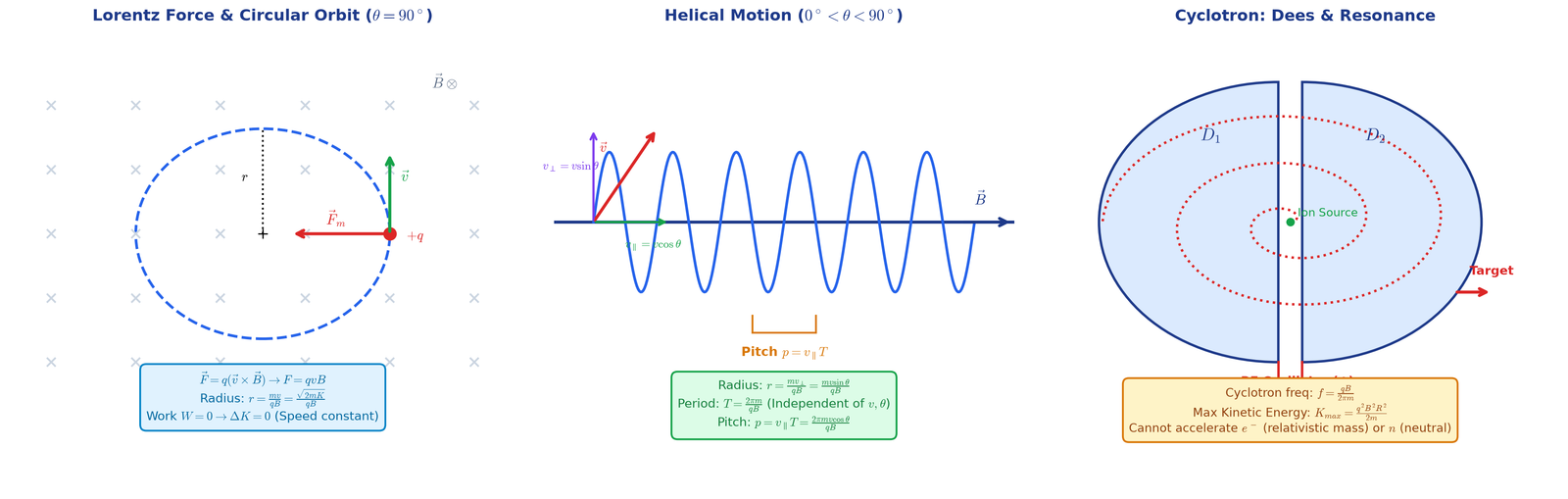
• Principle: Electric field between Dees accelerates ions; magnetic field bends them in semicircular arcs of increasing radius.
• Resonance Condition: Frequency of RF oscillator must match cyclotron frequency: fa = q B2π m.
• Maximum Kinetic Energy (At Dee exit radius R):
4. Force on Conductors & Moving Coil Galvanometer
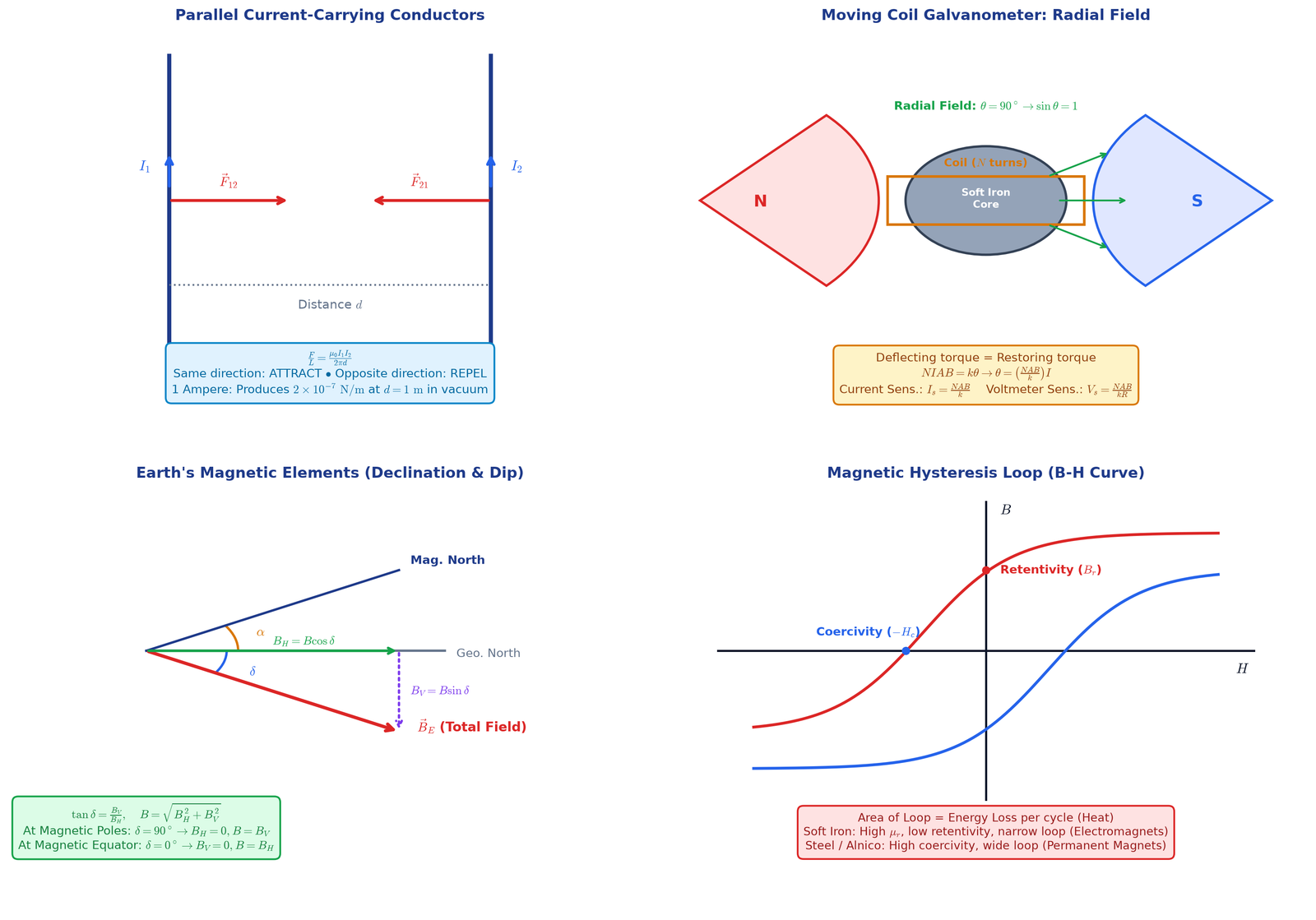
Force Between Two Parallel Current-Carrying Conductors:
• Current in OPPOSITE direction → REPEL each other.
• Definition of 1 Ampere: Current which, flowing in two infinitely long parallel wires separated by 1 meter in vacuum, produces an attractive/repulsive force of 2 × 10⁻⁷ N/m.
Torque on Coil & Moving Coil Galvanometer
• Radial Field Construction: Concave magnetic poles and a soft iron core make field lines radial, ensuring plane of the coil is always parallel to B (θ = 90° &implies; sinθ = 1).
• Equilibrium Condition: Deflecting torque = Restoring torque &implies; N I A B = k θ &implies;
• Voltage Sensitivity: Vs = θV = θI R = N A Bk R.
NEET Trap: Increasing N doubles Is, but wire length doubles so resistance R also doubles, leaving Vs unchanged!
5. Magnetism & Matter
Earth acts as a giant magnetic dipole tilted at ≈ 11.3° to its geographic rotation axis.
1. Magnetic Declination (α): Angle between Geographic Meridian and Magnetic Meridian.
2. Angle of Dip or Inclination (δ): Angle made by total magnetic field B with the horizontal.
• Horizontal Component: BH = B cosδ
• Vertical Component: BV = B sinδ
• Relation: BVBH = tanδ, B = √BH2 + BV2.
• At Magnetic Poles: δ = 90° &implies; BH = 0, B = BV.
• At Magnetic Equator: δ = 0° &implies; BV = 0, B = BH.
• Apparent Dip in two mutually perpendicular planes:
Comparison of Magnetic Materials
• Paramagnetic: Attracted feebly (moves weaker to stronger field). Atoms possess permanent dipole moments. Susceptibility χ is small and positive, inversely proportional to absolute temperature (Curie's Law: χ = C / T). μr > 1. Examples: Al, Na, O2, Pt, CuCl2.
• Ferromagnetic: Strongly attracted by magnets. Has domain structure. Susceptibility χ is very large and positive (χ ∼ 103 - 105), μr ≫ 1. Above Curie Temperature TC, domains break down and it transforms into a paramagnetic material (Curie-Weiss Law: χ = CT - TC). Examples: Fe, Co, Ni, Alnico, Gadolinium.
• Retentivity: Value of magnetic field B remaining when magnetizing field H is reduced to zero.
• Coercivity: Reverse magnetizing field -H required to wipe out residual magnetism.
• Area of Hysteresis Loop: Represents energy lost as heat per unit volume per magnetization cycle.
• Electromagnets & Transformer Cores: Require Soft Iron — High permeability μr, low retentivity, low coercivity, and very narrow loop (minimum heat loss).
• Permanent Magnets: Require Steel / Alnico — High retentivity, high coercivity, and broad hysteresis loop (resists demagnetization from stray fields).
Master Formula Matrix & 20 Golden Facts
Magnetic Effects of Current • Moving Charges • Magnetism and Matter
⚡ Master Formula Matrix
🎯 20 Golden NEET Must-Know Facts & Traps
Solved Numericals: Magnetic Effects
8 High-Yield NEET Problems Solved with Strict 3-Box Pedagogy
• Bcenter = μ0 I2 R
• Baxis = μ0 I R22 (R2 + x2)3/2
• Condition given: Baxis = 18 Bcenter
Equate the two formulas:
R2 + x2 = 4 R2 &implies; x2 = 3 R2 &implies; x = √3 R.
Whenever Baxis = 1n Bcenter, the distance is:
• Current I = 10 A, Radius R = 5 cm = 0.05 m.
• Straight segment 1: Line of current passes through O &implies; B1 = 0.
• Semicircular arc: Barc = μ0 I4 R (Directed into the page ⊗).
• Straight segment 2: Semi-infinite wire at perpendicular distance R &implies; B2 = μ0 I4π R (Directed into the page ⊗).
Both non-zero fields point into the page (⊗), so they add directly:
Whenever any straight section of wire has its line of action passing through the point of observation, its magnetic field contribution is strictly ZERO because the angle between dl and r is 0° or 180° (sinθ = 0)! Ignore it instantly.
• Proton: mass m, charge e.
• Deuteron: mass 2m, charge e.
• Alpha particle (α): mass 4m, charge 2e.
• Kinetic energy gained: K = q V.
• Circular radius: r = √2 m Kq B = 1B √2 V mq &implies; r ∝ √mq
Apply the proportionality r ∝ √m√q:
1. For Proton:
Ratio = rp : rd : rα = 1 : √2 : √2.
If particles have the SAME MOMENTUM: r ∝ 1q &implies; rp : rd : rα = 2 : 2 : 1.
If particles have the SAME KINETIC ENERGY: r ∝ √mq &implies; 1 : √2 : 1.
If accelerated through the SAME POTENTIAL: r ∝ √mq &implies; 1 : √2 : √2. Read question carefully!
• v⊥ = v sin 30° = 4 × 106 × 0.5 = 2 × 10⁶ m/s.
• v∥ = v cos 30° = 4 × 10⁶ × √32 = 2√3 × 10⁶ ≈ 3.46 × 10⁶ m/s.
• Radius r = m v⊥q B, Pitch p = v∥ · T = 2π m v∥q B.
(a) Radius of the Helix:
(b) Pitch of the Helix:
First, time period:
Notice that PitchRadius = 2π v∥v⊥ = 2π cotθ! For θ = 30°, pr = 2π √3 ≈ 10.88. Checking: 619 μm / 56.9 μm = 10.88. Instant verification!
• IA = 10 A, IB = 20 A, IC = 30 A.
• Distance between A and B = d = 0.1 m; between B and C = d = 0.1 m.
• Since all currents flow in the same direction, both A and C exert attractive forces on B in opposite directions.
1. Force on wire B due to wire A (towards left, towards A):
2. Force on wire B due to wire C (towards right, towards C):
3. Net force per unit length on wire B:
Since distances are equal, directly factor out common terms:
FnetL = μ0 IB2π d (IC - IA) = 2 × 10-7 × 200.1 × (30 - 10) = 4 × 10-5 × 20 = 8 × 10⁻⁴ N/m!
• Galvanometer resistance G = 25 Ω.
• Full-scale deflection current Ig = 4 mA = 0.004 A.
• Desired ammeter range I = 5 A; desired voltmeter range V = 10 V.
• Ammeter: Shunt in parallel, S = Ig GI - Ig.
• Voltmeter: Multiplier in series, R = VIg - G.
(a) Shunt for Ammeter (0 - 5 A):
(b) Series Resistance for Voltmeter (0 - 10 V):
For Ammeter: n = IIg = 50.004 = 1250 &implies; S = Gn - 1 ≈ 251250 = 0.02 Ω.
For Voltmeter: n = VIg G = 100.1 = 100 &implies; R = (n - 1) G = 99 × 25 = 2475 Ω.
• N = 100, I = 0.5 A, R = 0.1 m &implies; Area A = π R2 = π (0.1)2 = 0.01π m2.
• B = 0.4 T.
• Magnetic moment: M = N I A.
• Angle of dipole normal with field: θ = 90° - 30° = 60°.
• Work done: W = M B (cos 0° - cos 180°) = 2 M B.
(a) Magnetic Moment:
(b) Torque on Coil:
(c) Work Done (Stable to Unstable Equilibrium):
W = 2 × 1.57 × 0.4 = 1.256 J.
Watch the phrasing! "Plane of coil makes 30° with B" means the dipole vector (normal to plane) makes θ = 90° - 30° = 60° with B! If you plug in 30° directly, you will pick the distractor option and lose 5 marks!
• BH = 0.35 G, δ = 45° &implies; BV = BH tan 45° = 0.35 G.
• Total field: B = BHcosδ.
• Apparent Dip in plane rotated by angle α = 60° from meridian:
(a) Total Magnetic Field:
(b) Apparent Dip Angle δ':
δ' = tan-1(2) ≈ 63.4°.
Because cosα ≤ 1 for all real angles, tanδ' ≥ tanδ! Thus, apparent dip is ALWAYS greater than or equal to true dip (δ' ≥ δ). If any exam option gives an apparent dip smaller than the true dip, eliminate it instantly!