
NEET Physics: Atoms & Bohr Model Master Notes
Unit: Modern Physics | Weightage: 2 - 3 Questions (8 - 12 Marks) | Target Exam: NEET UG
1. Rutherford Alpha Particle Scattering Experiment
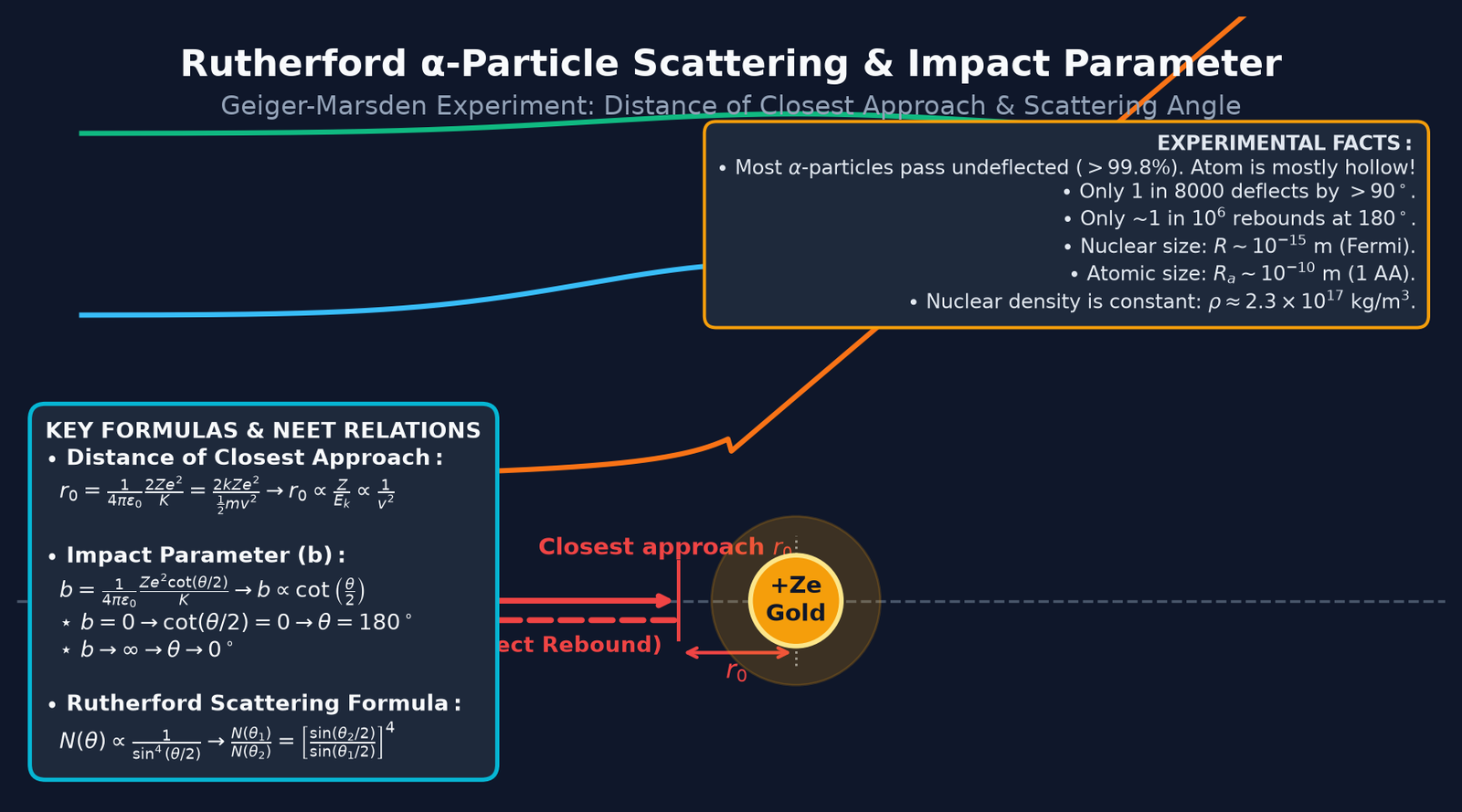
In 1911, Hans Geiger and Ernest Marsden, under the guidance of Ernest Rutherford, conducted the landmark alpha particle scattering experiment using a thin gold foil of thickness 2.1 × 10⁻⁷ m (about 400 atoms thick).
Key Experimental Observations
- > 99.86% of α-particles passed straight through the foil with virtually zero deflection (θ < 1°).
- Only ~ 1 in 8,000 α-particles suffered a deflection of more than 90°.
- Very rare (~ 1 in 106) was deflected by nearly 180° (head-on collision rebound).
- Most of an atom is empty space (hollow).
- The entire positive charge and almost 99.9% of the mass of an atom is concentrated in a tiny core called the Nucleus.
- Nuclear radius (r0 ∼ 10−15 m = 1 fm) is roughly 10−5 times smaller than the atomic radius (Ra ∼ 10−10 m = 1 Å).
- Volume ratio of atom to nucleus: VatomVnucleus ∼ (10−10)3(10−15)3 = 1015.
Distance of Closest Approach (r0)
For an α-particle fired directly towards a gold nucleus (head-on collision, impact parameter b = 0), all its initial kinetic energy Ek is converted into electrostatic potential energy U at the turning point:
Impact Parameter (b)
The impact parameter b is defined as the perpendicular distance of the initial velocity vector of the α-particle from the center of the target nucleus:
- When b = 0 (head-on collision): cot(θ / 2) = 0 ⇒ θ = 180° (rebound).
- When b is very large: cot(θ / 2) → ∞ ⇒ θ → 0° (undeflected).
Rutherford Scattering Formula
The number of α-particles N(θ) scattered at an angle θ per unit area onto the detector is:
2. Rutherford's Model Limitations & The Need for Bohr's Model
- Atomic Instability: An electron in a circular planetary orbit is constantly accelerated towards the center (a = v2 / r). According to classical Maxwellian electrodynamics, an accelerated charged particle must continuously radiate electromagnetic energy. Hence, the electron should lose energy, spiral inward, and crash into the nucleus in ~ 10−8 seconds. Real atoms are remarkably stable!
- Line Spectra Failure: As the electron spirals inward with continuously varying frequency, it should emit a continuous spectrum of light. In reality, atoms emit sharp, discrete line spectra.
3. Bohr's Postulates for Hydrogen-like Species
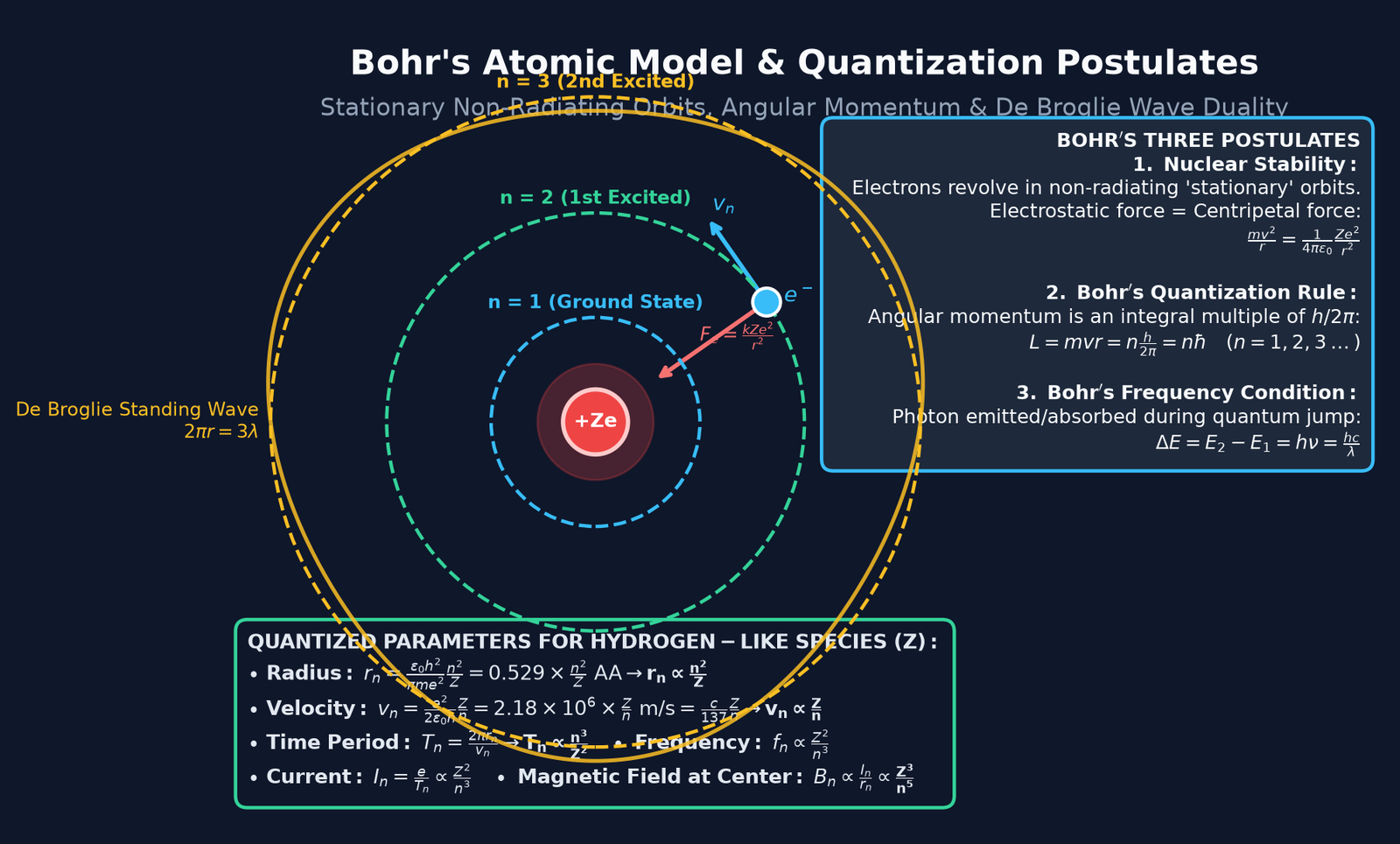
In 1913, Niels Bohr combined classical mechanics with Planck's quantum hypothesis to formulate three fundamental postulates for single-electron (hydrogenic) systems (H, He+, Li2+, Be3+):
Postulate 1 (Stationary Non-Radiating Orbits):
Electrons revolve only in certain non-radiating orbits called stationary orbits. In these stable states, the electrostatic Coulomb attraction provides the necessary centripetal force:
Postulate 2 (Quantization of Orbital Angular Momentum):
An electron can only orbit in states where its orbital angular momentum L is an integral multiple of
h2π:
Postulate 3 (Bohr's Quantum Transition Frequency Condition):
Radiation is emitted or absorbed only when an electron jumps from one stationary state (E2) to another (E1):
4. Quantitative Derivations of Bohr's Model
A. Orbital Radius (rn)
Eliminating v between Postulate 1 and Postulate 2 yields:
B. Orbital Speed (vn)
C. Time Period (Tn), Frequency (fn), Current (In) & Magnetic Field (Bn)
| Physical Parameter | Mathematical Expression | NEET Scaling Proportionality |
|---|---|---|
| Time Period (Tn) | Tn = 2π rnvn ∝ n2/ZZ/n | Tn ∝ n3Z2 |
| Orbital Frequency (fn) | fn = 1Tn = ω2π | fn ∝ Z2n3 |
| Equivalent Current (In) | In = eTn = e × fn | In ∝ Z2n3 |
| Magnetic Field at Center (Bn) | Bn = μ0 In2 rn ∝ Z2/n3n2/Z | Bn ∝ Z3n5 |
| Magnetic Dipole Moment (μL) | Mn = In × A = In × (π rn2) = n μB | Mn ∝ n (Bohr Magneton μB = e ℏ2 m) |
D. Energy Relations & The Virial Theorem
The total energy of an electron in a stable orbit is the sum of its Kinetic Energy (KE) and Electrostatic Potential Energy (PE):
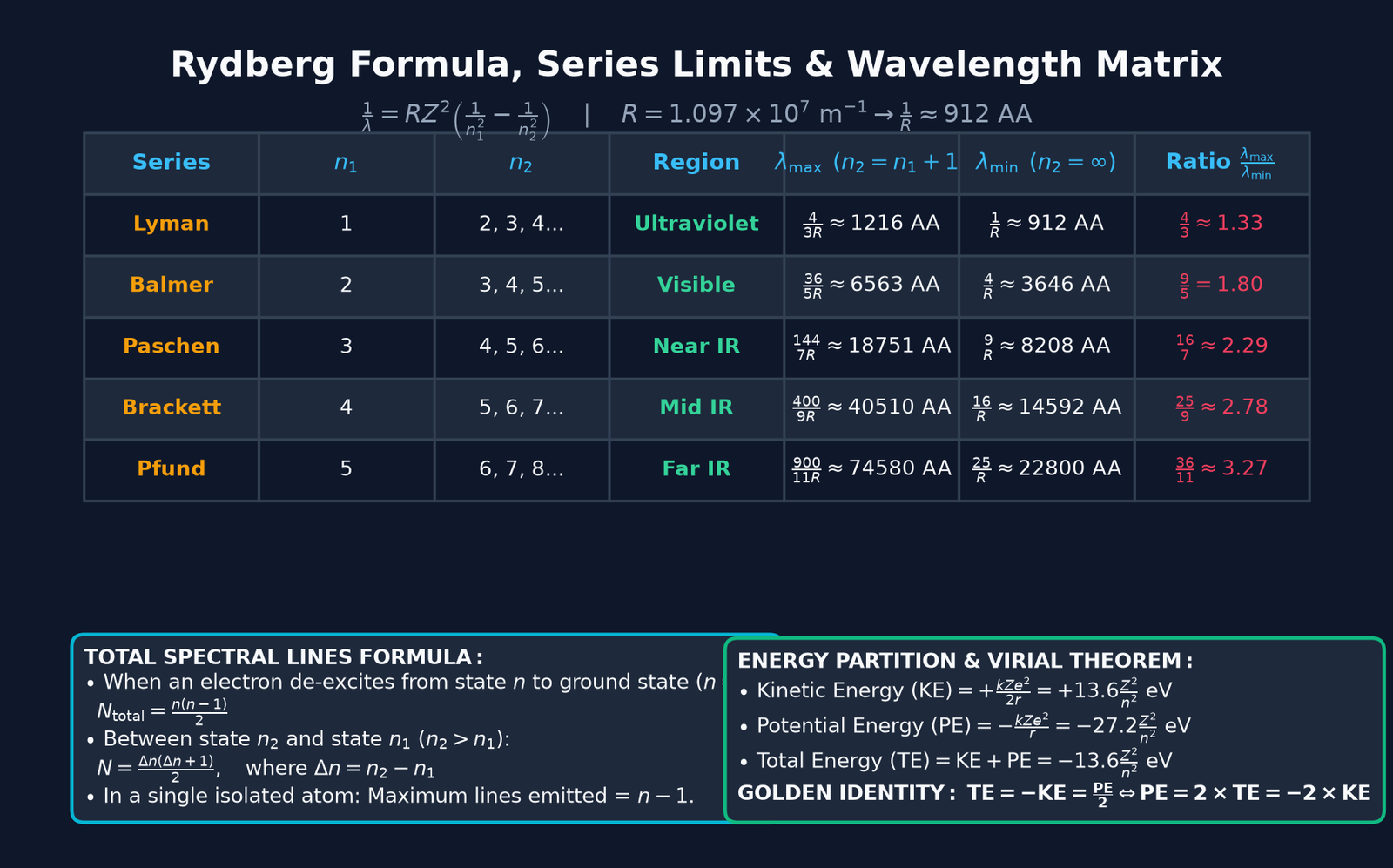
- Kinetic Energy (KE): KE = 12 m v2 = k Z e22 r = + 13.6 Z2n2 eV (always positive)
- Potential Energy (PE): PE = − k Z e2r = − 27.2 Z2n2 eV (negative due to attraction)
- Total Energy (TE or En): En = KE + PE = − 13.6 Z2n2 eV
5. Hydrogen Spectrum & Spectral Series
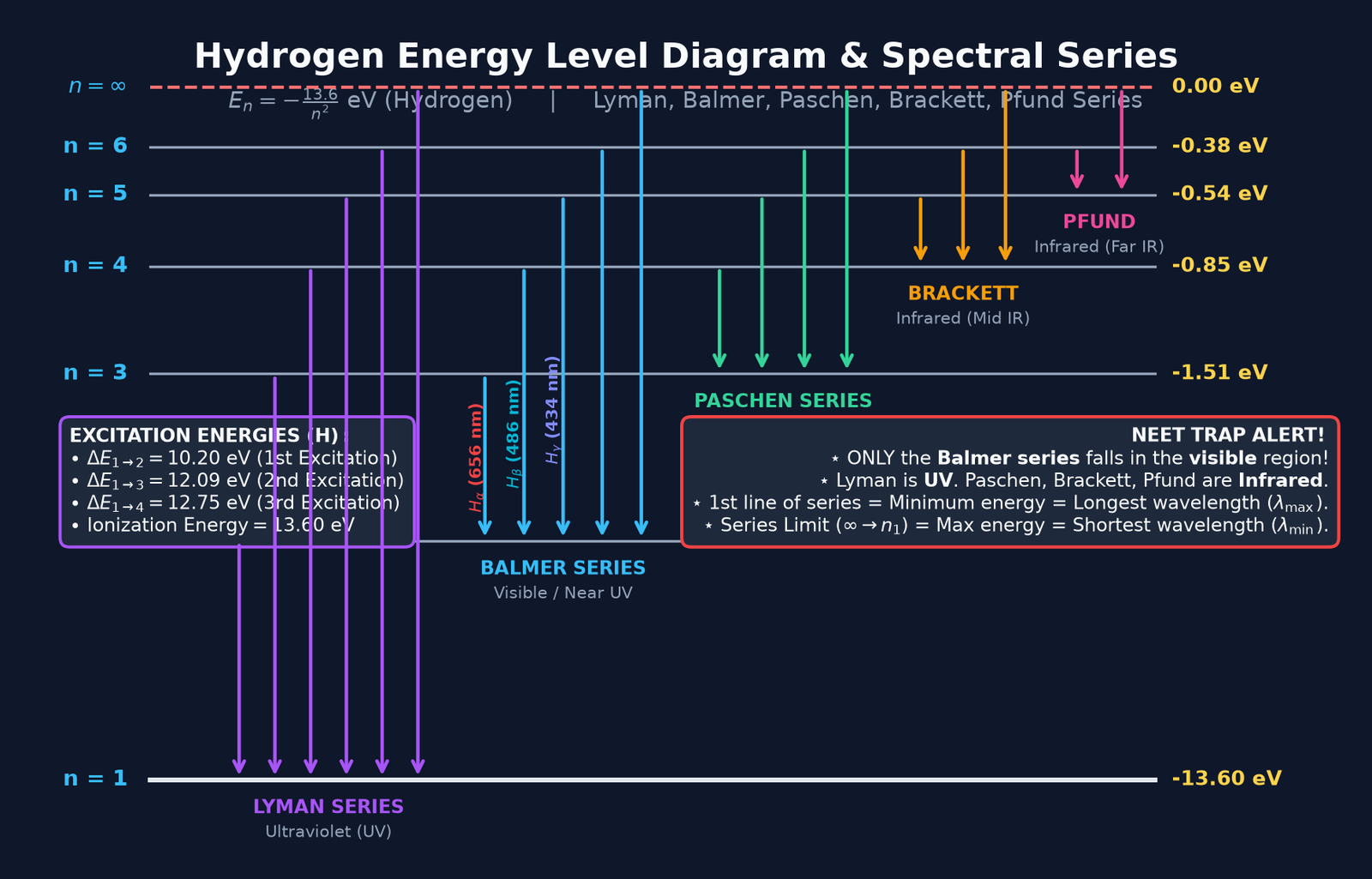
When an electron in an excited state n2 drops to a lower state n1, a single photon is emitted with energy:
Comprehensive Master Table of Spectral Series
| Series | n1 | n2 | Spectral Region | Shortest λ (Series Limit n2 = ∞) | Longest λ (First Line n2 = n1 + 1) | Ratio λmaxλmin |
|---|---|---|---|---|---|---|
| Lyman | 1 | 2, 3, 4... | Ultraviolet (UV) | 1R ≈ 912 Å | 43R ≈ 1216 Å | 43 ≈ 1.33 |
| Balmer | 2 | 3, 4, 5... | Visible / Near UV | 4R ≈ 3646 Å | 365R ≈ 6563 Å | 95 = 1.80 |
| Paschen | 3 | 4, 5, 6... | Near Infrared | 9R ≈ 8208 Å | 1447R ≈ 18751 Å | 167 ≈ 2.29 |
| Brackett | 4 | 5, 6, 7... | Mid Infrared | 16R ≈ 14592 Å | 4009R ≈ 40510 Å | 259 ≈ 2.78 |
| Pfund | 5 | 6, 7, 8... | Far Infrared | 25R ≈ 22800 Å | 90011R ≈ 74580 Å | 3611 ≈ 3.27 |
Calculation of Number of Spectral Lines
- For a sample of gas containing many atoms with electrons excited to state n:Total Emitted Spectral Lines from State n to GroundNtotal = nC2 = n (n − 1)2
- Between two specified states n2 and n1 (where n2 > n1):Spectral Lines between Level n2 and n1N = Δn (Δn + 1)2 (where Δn = n2 − n1)
- CRITICAL NEET DISTINCTION (Single Isolated Atom): In a single isolated atom containing one electron excited to state n, the electron can take only one cascade path downwards. Thus, the maximum number of lines emitted is (n − 1), not n(n−1)2!
6. De Broglie's Explanation of Bohr's 2nd Postulate
In 1923, Louis de Broglie showed that an electron revolving in a stable Bohr orbit behaves as a circular stationary (standing) matter wave.
- For constructive interference of the matter wave around a circular orbit of circumference 2πr, the circumference must contain an integral number of de Broglie wavelengths:Standing Wave Condition2 π rn = n λ
- Substituting de Broglie's wavelength λ = hp = hm v:2 π rn = n hm v ⇒ m v rn = n h2π
- Conclusion: Bohr's arbitrary quantization assumption is a direct, natural consequence of electron wave-particle duality!
7. Atomic Excitation, Ionization & Recoil Dynamics
Definitions & Key Benchmarks for Hydrogen
- Ground State: n = 1, E1 = − 13.60 eV.
- First Excited State: n = 2, E2 = − 3.40 eV. Excitation energy ΔE = 10.20 eV.
- Second Excited State: n = 3, E3 = − 1.51 eV. Excitation energy ΔE = 12.09 eV.
- Third Excited State: n = 4, E4 = − 0.85 eV. Excitation energy ΔE = 12.75 eV.
- Ionization Energy (IE): The minimum energy required to liberate an electron from ground state to infinity: IE = E∞ − E1 = 0 − (− 13.6) = + 13.60 eV (for H). For hydrogen-like ion: 13.6 Z2 eV.
- Ionization Potential (IP): IP = 13.6 Z2 Volts.
Recoil of Emitting Atom
When an isolated stationary atom of mass M emits a photon of frequency ν and wavelength λ, linear momentum is strictly conserved:
8. Limitations of Bohr's Atomic Model
- Applies Only to Single-Electron Systems: Accurately predicts spectra for H, He+, Li2+, Be3+, but completely fails for multi-electron atoms (even neutral Helium with 2 electrons) due to electron-electron Coulomb repulsion.
- Unable to Explain Fine Structure: High-resolution spectroscopy reveals that individual spectral lines are actually doublets or multiplets. Bohr model cannot account for this (explained later by spin-orbit coupling and relativistic corrections).
- Zeeman & Stark Effects: Fails to explain the splitting of spectral lines in external magnetic fields (Zeeman effect) or external electric fields (Stark effect).
- Relative Intensities: Cannot predict why certain spectral transitions are much brighter (higher transition probability) than others.
- Heisenberg Uncertainty Principle Violation: Bohr's model assumes a well-defined circular orbit where both the position and momentum of the electron are known simultaneously with 100% precision, directly violating Δx · Δp ≥ ℏ2.
NEET Master Formula Matrix & 20 Golden Facts
Chapter: Atoms (Modern Physics) • Complete Revision Sheet for Instant Speed & Precision
Master Formula Matrix: Bohr Model & Atomic Physics
| Category | Formula Name | Mathematical Expression | NEET Scaling Proportionality |
|---|---|---|---|
| Rutherford Scattering | Distance of Closest Approach | r0 = 14πε0 2 Z e2Ek = 4 k Z e2m v2 | r0 ∝ ZEk ∝ 1v2 |
| Rutherford Scattering | Impact Parameter | b = 14πε0 Z e2 cot(θ2)Ek | b ∝ cot(θ2) |
| Rutherford Scattering | Angular Distribution | N(θ) ∝ 1sin4(θ2) | N(θ1)N(θ2) = sin4(θ2/2)sin4(θ1/2) |
| Bohr Postulates | Angular Momentum Quantization | L = m v r = n h2π = n ℏ | L ∝ n (Independent of Z) |
| Bohr Orbit | Orbital Radius | rn = ε0 h2π m e2 n2Z = 0.529 n2Z Å | rn ∝ n2Z |
| Bohr Orbit | Orbital Speed | vn = e22ε0 h Zn = 2.18 × 10⁶ Zn m/s = c137 Zn | vn ∝ Zn |
| Bohr Dynamics | Orbital Time Period | Tn = 2π rnvn | Tn ∝ n3Z2 |
| Bohr Dynamics | Orbital Frequency | fn = 1Tn = vn2π rn | fn ∝ Z2n3 |
| Electrodynamics | Equivalent Circular Current | In = eTn = e × fn | In ∝ Z2n3 |
| Electrodynamics | Magnetic Field at Nucleus | Bn = μ0 In2 rn | Bn ∝ Z3n5 |
| Energy Partition | Kinetic Energy | KE = 12 m v2 = + 13.6 Z2n2 eV | KE > 0 (always positive) |
| Energy Partition | Potential Energy | PE = − k Z e2r = − 27.2 Z2n2 eV | PE = − 2 × KE |
| Energy Partition | Total Energy | En = KE + PE = − 13.6 Z2n2 eV | En = − KE = PE2 |
| Spectroscopy | Rydberg Transition Formula | 1λ = R Z2 [1n12 − 1n22] | R ≈ 1.097 × 10⁷ m−1, 1R ≈ 912 Å |
| Spectral Lines | Total Lines from State n to Ground | Ntotal = n (n − 1)2 | Gas sample containing many atoms |
| Spectral Lines | Transitions between n2 and n1 | N = Δn (Δn + 1)2 | where Δn = n2 − n1 |
| De Broglie Waves | Standing Wave Condition | 2π rn = n λ | n-th orbit has exactly n de Broglie waves |
| Recoil Mechanics | Recoil Speed of Emitting Atom | vrecoil = hλ M = ΔEM c | Conservation of Linear Momentum |
20 Golden NEET Must-Know Facts & Traps
Second excitation energy (1 → 3): 12.09 eV.
Third excitation energy (1 → 4): 12.75 eV.
If an incident electron has 11.5 eV, it can only excite H to n = 2 and leaves with 1.3 eV residual KE!
Ionization potential is measured in Volts (V): IP = 13.6 Z2 V.
For He+ (Z = 2): IE = 54.4 eV, IP = 54.4 V. For Li2+ (Z = 3): IE = 122.4 eV, IP = 122.4 V.
This represents the maximum energy photon, maximum frequency, and minimum wavelength (λmin) in that series!
This represents the minimum energy photon, minimum frequency, and longest wavelength (λmax) in that series!
The ratio is: λmaxλmin = 36/5R4/R = 95 = 1.80.
In a single isolated atom, the electron takes a single path down: Maximum lines = (n − 1)! NEET loves this trap.
NEET Physics: Atoms — 8 Solved Numericals
Master Problem Solving with Strict 3-Box Pedagogy: Given & Concept • Step-by-Step Calculation • NEET Speed Shortcut
• Given: Kinetic energy Ek = 5.0 MeV = 5.0 × 106 × 1.6 × 10−19 J = 8.0 × 10⁻¹³ J.
• Target nucleus: Gold (Z = 79), α-particle charge q1 = 2e, target nucleus charge q2 = Ze = 79e.
• Core Concept: At the distance of closest approach r0 (turning point), entire KE is converted into electrostatic potential energy U:
Ek = 14πε0 (2e)(Ze)r0 ⇒ r0 = 14πε0 2 Z e2Ek.
NEET Mental Shortcut: r0 ∝ ZEk ∝ 1v2.
• If KE is multiplied by factor k, r0 becomes r0 / k.
• If speed v is doubled, r0 becomes r0 / 4!
• For gold (Z = 79) and 5 MeV: r0 ≈ 4.5 × 10⁻¹⁴ m. Always verify order of magnitude is ∼ 10−14 m (10 to 50 fm).
• Given: Li2+ is a hydrogen-like species with Z = 3.
• "Third excited state" means principal quantum number n = 3 + 1 = 4.
• Core Concepts:
1. Orbital Radius: rn = r1,H × n2Z.
2. Orbital Speed: vn = v1,H × Zn.
NEET Vocabulary Warning:
• "1st excited state" ⇒ n = 2
• "2nd excited state" ⇒ n = 3
• "m-th excited state" ⇒ n = m + 1!
Students commonly plug n = 3 instead of n = 4 and get negative marks. Always write n = excited state + 1 first!
• Given: Transition n2 = 3 → n1 = 1 (Lyman series, β-line). Hydrogen atom (Z = 1).
• Core Concept: Rydberg Transition Formula:
1λ = R Z2
[
1n12 −
1n22
]
and ν = cλ.
Energy Difference Shortcut:
E1 = − 13.60 eV, E3 = − 1.51 eV.
Photon energy: ΔE = 13.60 − 1.51 = 12.09 eV.
Using the ultra-fast formula: λ (Å) = 12400ΔE (eV) = 1240012.09 ≈ 1026 Å! Solved in 5 seconds flat!
• Balmer Series: Lower state n1 = 2.
• Longest wavelength (λmax): Minimum energy transition, i.e., from adjacent upper level n2 = n1 + 1 = 3 (Hα line).
• Shortest wavelength (λmin): Maximum energy transition (series limit), i.e., from n2 = ∞.
Universal Series Ratio Formula:
For any spectral series with base level n1:
λmaxλmin =
(n1 + 1)22 n1 + 1.
• Lyman (n1 = 1): (2)2 / 3 = 4 / 3.
• Balmer (n1 = 2): (3)2 / 5 = 9 / 5.
• Paschen (n1 = 3): (4)2 / 7 = 16 / 7. Never recalculate in NEET!
• Given: Initial state n = 1 (field B1); Final state: 2nd excited state ⇒ n = 3.
• Core Concept: Revolving electron constitutes an electric current loop:
I = eT ∝ Z2n3.
Orbital radius r ∝ n2Z.
Magnetic field at center: B = μ0 I2 r ∝
Z2/n3n2/Z =
Z3n5.
Power of n Trap:
• Radius: r ∝ n2
• Velocity: v ∝ 1/n
• Time Period: T ∝ n3
• Current: I ∝ 1/n3
• Magnetic Field: B ∝ 1/n5 (NEET examiners test this 5th power frequently!).
• Given: Incident photon energy Ephoton = 12.75 eV. Initial state n = 1 (E1 = − 13.60 eV).
• Energy of excited state: En = E1 + Ephoton = − 13.60 + 12.75 = − 0.85 eV.
• Total lines in gas sample: Ntotal = n(n − 1)2.
• Visible lines belong strictly to the Balmer series (transitions ending at n = 2).
• Lyman (transitions to n = 1): (4 → 1, 3 → 1, 2 → 1) = 3 lines (UV)
• Balmer (transitions to n = 2): (4 → 2, 3 → 2) = 2 lines (Visible)
• Paschen (transitions to n = 3): (4 → 3) = 1 line (IR)
Total = 3 + 2 + 1 = 6 lines.
Instant Breakdown Formula:
When de-exciting from level n to ground state:
• Number of Lyman lines = n − 1
• Number of Balmer lines = n − 2
• Number of Paschen lines = n − 3
For n = 4: Lyman = 3, Balmer = 2, Paschen = 1. Immediate answer without drawing!
• Given: Transition 2 → 1. ΔE = 10.20 eV = 10.20 × 1.6 × 10−19 J = 1.632 × 10⁻¹⁸ J.
• Mass M = 1.67 × 10⁻²⁷ kg.
• Core Concept: Linear momentum conservation: Initial momentum = 0 ⇒ precoil = pphoton = ΔEc.
• Recoil speed: vrecoil = precoilM = ΔEM c.
• Recoil kinetic energy: Krecoil = p22 M.
Conceptual Takeaway:
The recoil kinetic energy is only ~ 10−8 eV, which is less than 1 part in 100 million of the photon's energy! That is why in NEET calculations, we can safely treat the emitted photon energy as virtually identical to the atomic transition energy (ΔE).
• Lyman-α line: Transition 2 → 1. Requires excitation from n = 1 to n = 2 (ΔE1→2 = 10.20 eV).
• Balmer-α line: Transition 3 → 2. Requires excitation from n = 1 to at least n = 3 (ΔE1→3 = 12.09 eV).
• Collision Rules for Electrons: Because the electron's mass is tiny compared to the nucleus, the electron can transfer almost any required quantized excitation energy ΔE to the bound electron. If Eincident < ΔE1→2 (10.2 eV), collision is purely elastic. If Eincident ≥ 10.2 eV, inelastic collision can occur.
Photon vs Electron Collision Trap:
• A photon must match ΔE EXACTLY (resonant absorption). A photon of 11.0 eV CANNOT be absorbed by ground state hydrogen because no energy level exists at −2.6 eV!
• An electron does NOT need exact match; it can impart 10.2 eV and keep the remaining 0.8 eV as kinetic energy!