The atomic nucleus contains positive protons and neutral neutrons (collectively nucleons). Nuclear properties are determined by short-range, spin-dependent strong nuclear forces.
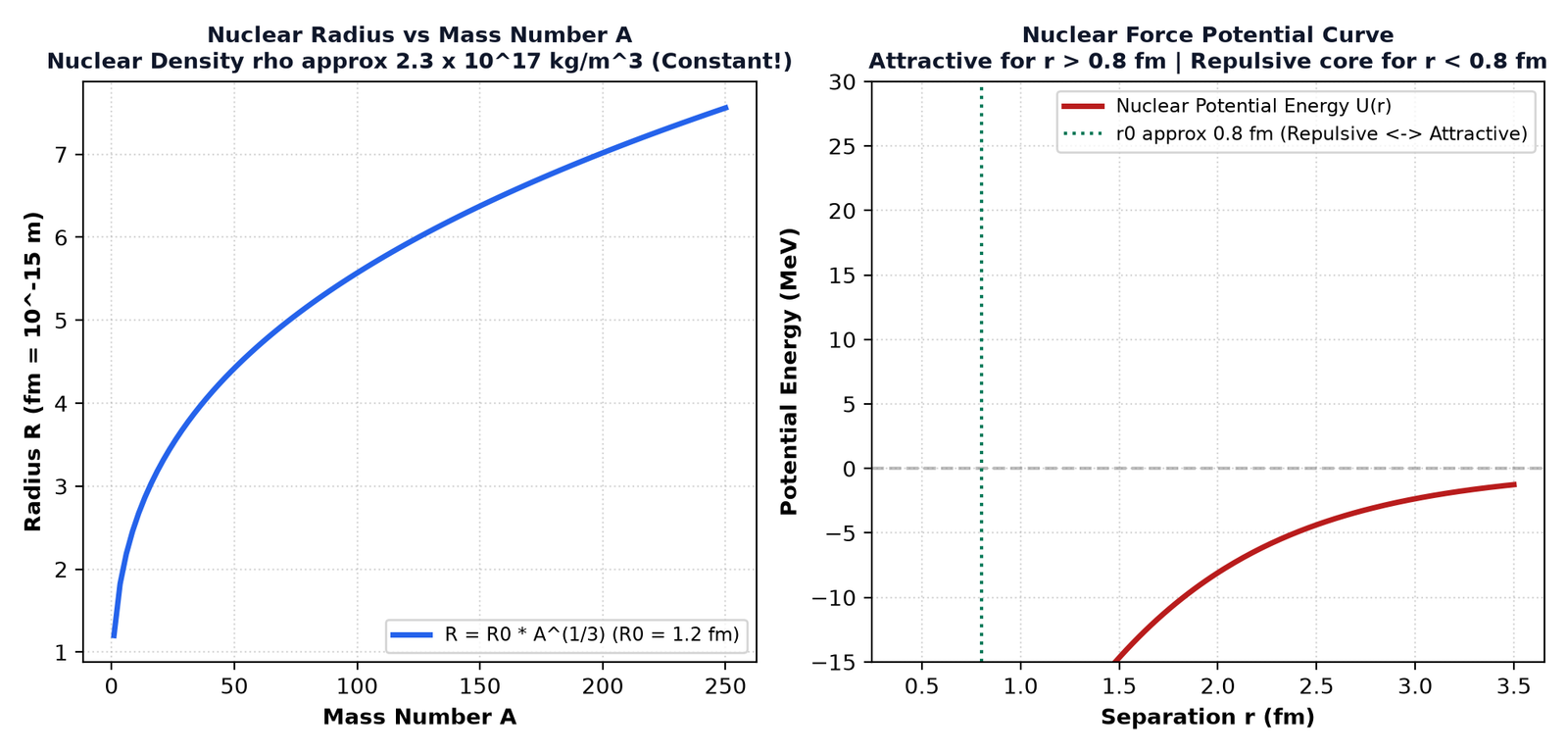
1. Nuclear Size & Density Invariance
Nuclear radius R is related to mass number A by the empirical relation:
R = R0 ⋅ A1/3 (where R0 ≈ 1.2 × 10⁻¹⁵ m = 1.2 fm)
Since nuclear volume V ∝ R3 ∝ A, and nuclear mass M ∝ A, the nuclear density is independent of mass number A:
ρnuclear = MassVolume ≈ 2.3 × 10¹⁷ kg/m3 (Constant for all nuclei!)
Fig 1: Nuclear Radius Scaling & Strong Force Potential Well (Minimum at r0 = 0.8 fm)
2. Mass Defect & Binding Energy Curve
The rest mass of a nucleus is always strictly less than the sum of masses of its constituent free nucleons. This difference is the Mass Defect (Δm):
Δm = [Z ⋅ mp + (A - Z) ⋅ mn] - Mnucleus
By Einstein's mass-energy equivalence, the Binding Energy is:
Eb = Δm ⋅ c2 = Δm (in amu) × 931.5 MeV
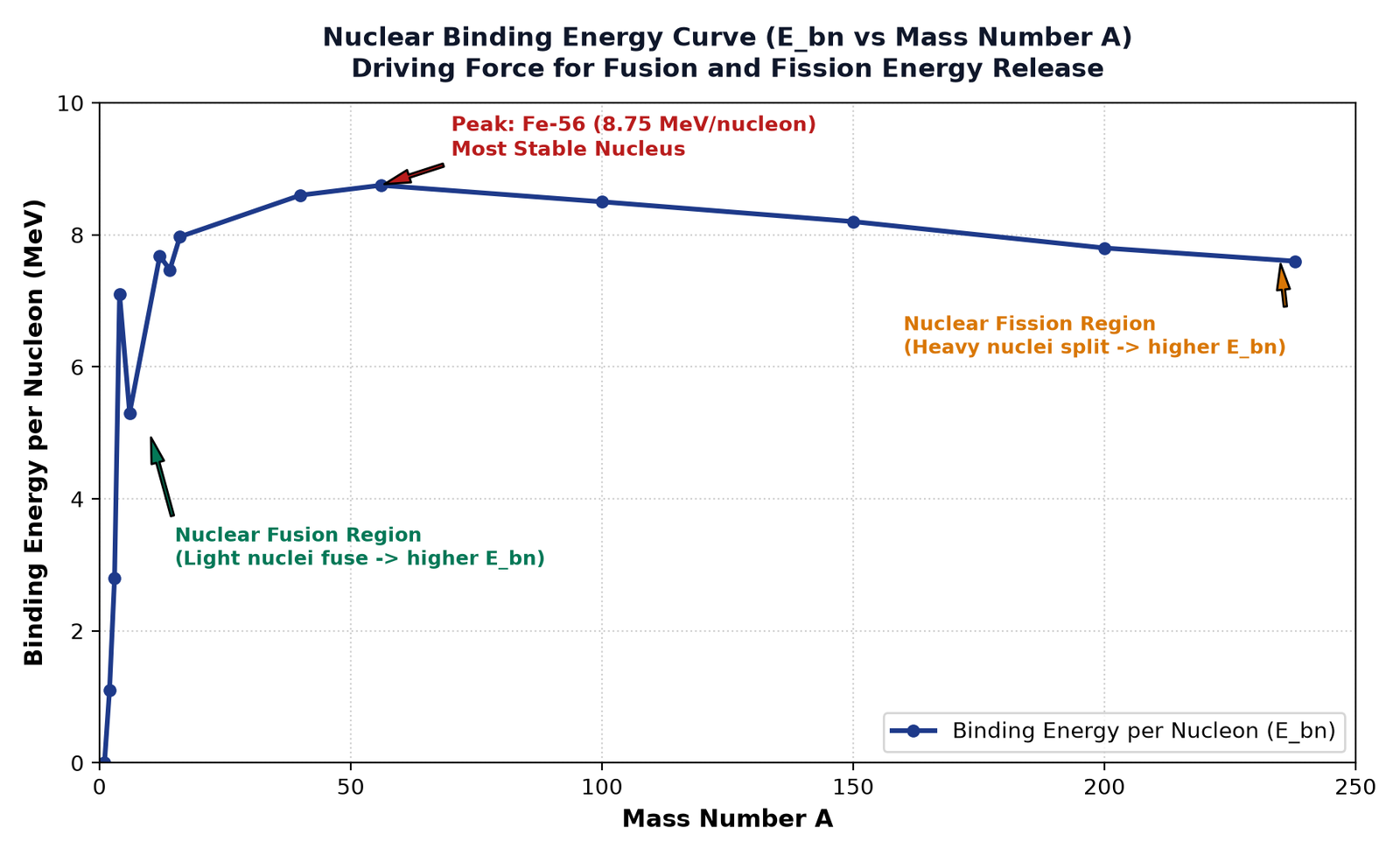
Binding energy per nucleon: Ebn = EbA measures nuclear stability.
Fig 2: Binding Energy per Nucleon Curve showing Peak Stability at Fe-56 (8.75 MeV)
NEET Invariant Facts:
Ebn is maximum for 56Fe (≈ 8.75 MeV/nucleon).
For intermediate nuclei (30 ≤ A ≤ 170), Ebn is practically constant (≈ 8.5 MeV/nucleon) due to nuclear force saturation.
Light nuclei (A < 20) fuse together (Nuclear Fusion) to increase Ebn, releasing immense energy (powers stars).
Heavy nuclei (A > 200) split (Nuclear Fission) into lighter fragments to increase Ebn, releasing energy (≈ 200 MeV per fission of U-235).
3. Radioactive Decay Law
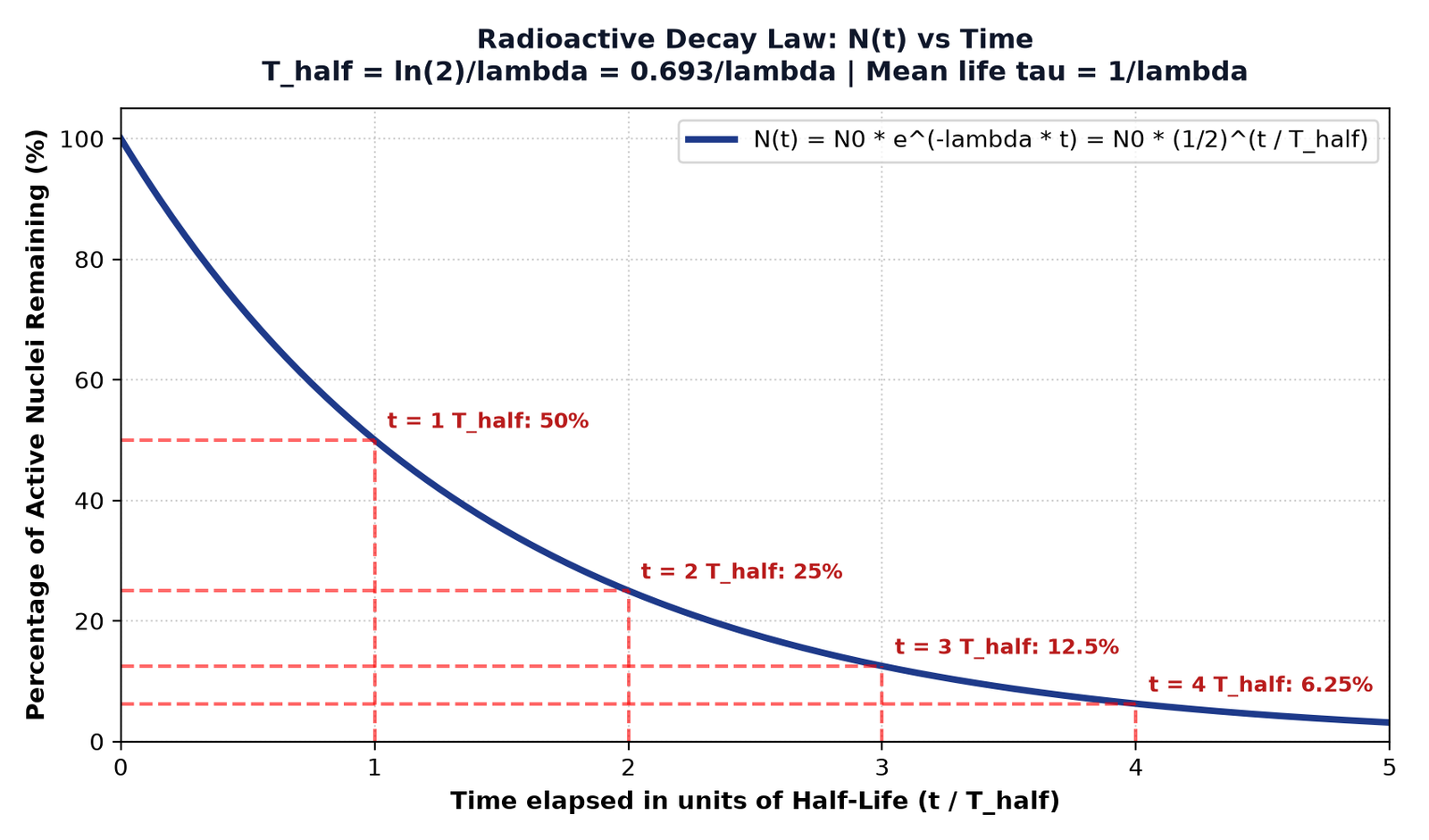
The rate of radioactive disintegration is directly proportional to the number of active nuclei present:
-dNdt = λ N → N(t) = N0 e-λt
where λ is the decay constant.
Fig 3: Exponential Decay Law and Half-Life Reductions
Key Decay Parameters
Half-Life (T1/2): Time in which active nuclei reduce to half:
T1/2 = ln(2)λ = 0.693λ
Fraction remaining after n half-lives:NN0 = (12)n = (12)t / T1/2
Mean (Average) Life (τ): Average lifetime of all nuclei: τ = 1λ ≈ 1.44 T1/2.
Activity (A): Rate of decay A = λN = A0 e-λt. SI unit is Becquerel (1 Bq = 1 decay/s); 1 Curie (Ci) = 3.7 × 10¹⁰ Bq.
4. Alpha, Beta, Gamma Decay & Fission Energetics
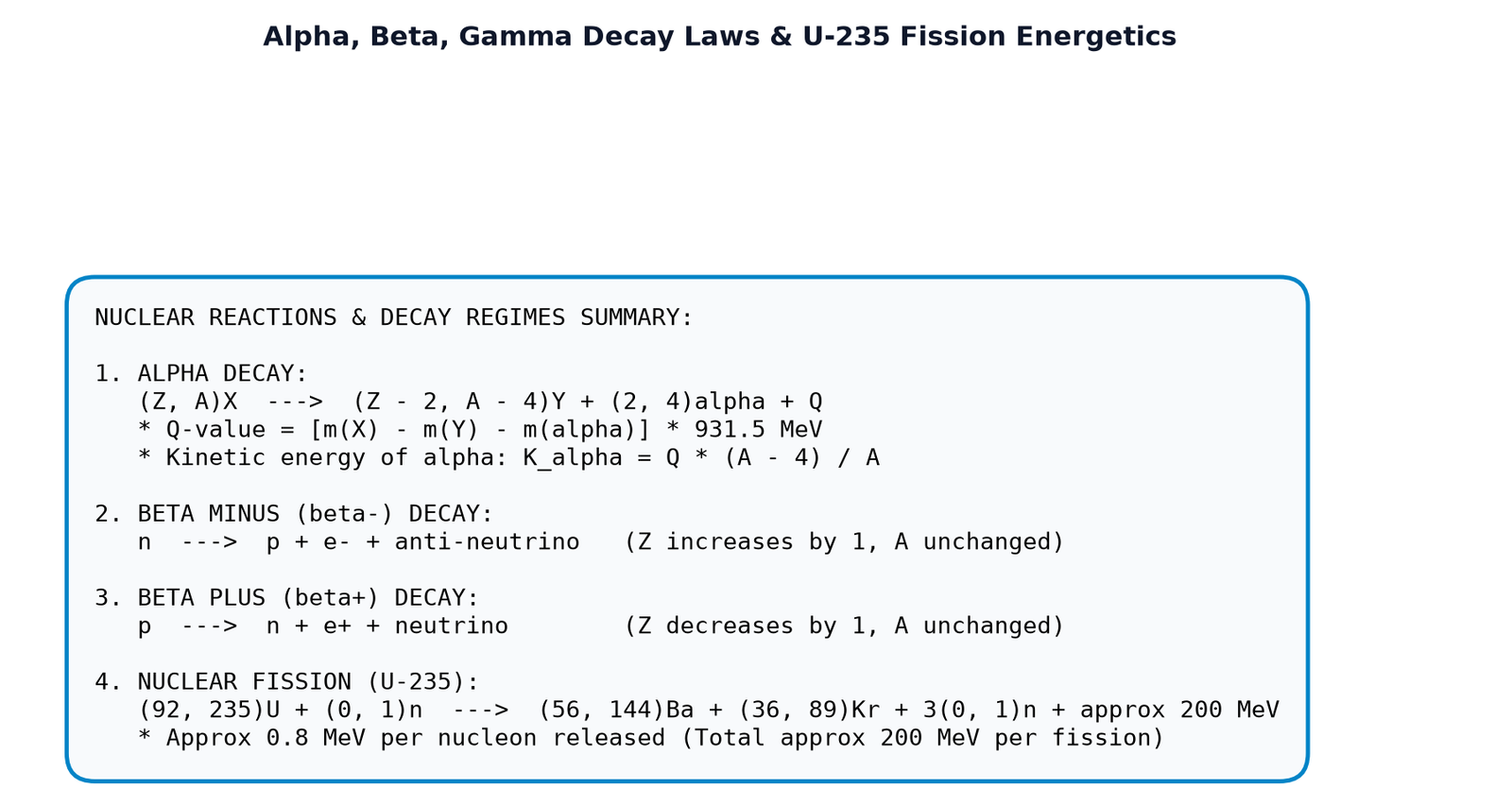
Fig 4: Summary of Alpha, Beta, Gamma Transmutations and Fission Mechanism
Alpha (α) Decay: Ejection of 42He nucleus. Parent (Z, A) → Daughter (Z - 2, A - 4) + α. Kinetic energy of alpha: Kα = Q ⋅ A - 4A.
Beta (β-) Decay: Neutron converts to proton: n → p + e- + ν̅ (antineutrino). Mass number A unchanged, Z increases by 1. Continuous energy spectrum explained by neutrino emission.
Beta (β+) Decay: Proton converts to neutron: p → n + e+ + ν (neutrino). Z decreases by 1.
Gamma (γ) Decay: Nuclear de-excitation emitting high-energy photons. Neither Z nor A changes.
Nuclei - Master Formula Matrix & 20 Golden Facts
Nuclei — Formula Matrix & 20 Golden Facts
Master Formula Matrix
Quantity
Formula
Key NEET Exam Point
Nuclear Radius
R = R0 A1/3
R0 ≈ 1.2 fm
Nuclear Density
ρ ≈ 2.3 × 10¹⁷ kg/m3
Independent of mass number A!
Mass Defect
Δm = [Z mp + (A - Z) mn] - M
1 amu = 931.5 MeV
Binding Energy
Eb = Δm × 931.5 MeV
Ebn = Eb / A
Decay Law
N(t) = N0 e-λt
N/N0 = (1/2)t/T1/2
Half-Life
T1/2 = 0.693λ
T1/2 = τ × ln(2)
Mean Life
τ = 1λ
τ ≈ 1.44 T1/2
Activity
A = λ N
1 Ci = 3.7 × 10¹⁰ Bq
Alpha KE
Kα = Q A - 4A
Alpha takes most of Q-value
20 Golden NEET Must-Know Facts & Traps
1. Nuclear density is strictly independent of mass number A. A uranium nucleus has essentially the same density as a carbon nucleus.
2. Peak of the binding energy curve is 56Fe at 8.75 MeV/nucleon, making it the most stable nucleus in the universe.
3. Heavy nuclei (A > 200) have lower binding energy per nucleon (≈ 7.6 MeV) due to electrostatic Coulomb repulsion between many protons.
4. Energy released in 1 fission event of 235U is approximately 200 MeV (≈ 0.85 MeV/nucleon).
5. Nuclear fusion releases more energy per unit mass (energy per nucleon ≈ 6.7 MeV for D-T fusion) than fission (≈ 0.85 MeV/nucleon).
6. Strong nuclear force is charge-independent: F(p-p) = F(n-n) = F(p-n) at equal separations.
7. Nuclear force is short-range (falls to zero beyond 2-3 fm) and exhibits saturation (interacts only with nearest neighbors).
8. At separations r < 0.8 fm, nuclear force becomes strongly repulsive, preventing nuclear collapse.
9. In beta-minus decay, a neutron converts into a proton, electron, and anti-neutrino: n → p + e- + ν̅.
10. In beta-plus decay, a proton converts into a neutron, positron, and neutrino: p → n + e+ + ν.
11. Free neutron is unstable and decays with half-life ≈ 14 minutes into proton, electron, and antineutrino. Inside stable nuclei, neutrons are stable.
12. Neutrinos are chargeless, have nearly zero mass, spin 1/2, and interact exclusively via the weak nuclear force.
13. Half-life T1/2 depends only on the radioactive substance, completely independent of external pressure, temperature, chemical state, or electric/magnetic fields.
14. After 1 half-life, 50% decayed; after 2 half-lives, 75% decayed; after 3 half-lives, 87.5% decayed; after n half-lives, fraction decayed = 1 - (1/2)n.
15. Fraction remaining after 1 mean life (τ = 1/λ) is 1/e ≈ 0.368 (36.8%); fraction decayed is 63.2%.
16. If a sample contains two independent decay channels with constants λ1 and λ2, effective constant is λeff = λ1 + λ2 → 1/Teff = 1/T1 + 1/T2.
17. In alpha decay, kinetic energy of alpha is Kα = Q(A - 4)/A. The daughter nucleus recoils with energy KD = 4Q/A.
18. Moderator in nuclear reactors (heavy water D2O, graphite) slows down fast neutrons (≈ 2 MeV) to thermal energies (≈ 0.025 eV) to maximize fission cross-section.
19. Control rods are made of Cadmium or Boron because of their very high neutron absorption cross-section.
20. Radiation penetrating power order: γ > β > α (Gamma penetrates lead; alpha stopped by paper). Ionizing power order is the exact reverse: α > β > γ (Alpha has 10,000x ionizing power of gamma).
Nuclei - 8 Solved NEET Numericals
Nuclei — 8 Solved NEET Numericals (3-Box Layout)
Problem 1: Ratio of Nuclear Radii
Given: Find the ratio of nuclear radii of 27Al to 64Cu.
NEET Shortcut: Direct cube root of mass numbers: 271/3 = 3, 641/3 = 4. Ratio is 3 : 4.
Problem 2: Ratio of Nuclear Densities
Given: What is the ratio of nuclear density of 12C to 238U?
Step-by-Step Calculation:
Mass M = m ⋅ A. Volume V = 43 π R3 = 43 π R03 A.
Density ρ = MV = m ⋅ A(4/3)π R03 A = 3m4π R03.
Notice mass number A cancels out completely!
Ratio ρC : ρU = 1 : 1.
NEET Shortcut: Nuclear density is a universal constant (≈ 2.3 × 10¹⁷ kg/m3). For ANY two nuclei, the ratio is ALWAYS 1 : 1!
Problem 3: Half-Life and Percentage Disintegration
Given: A radioactive element has a half-life of 20 days. What fraction and percentage will remain undecayed after 60 days?
Problem 5: Kinetic Energy of Alpha Particle in Alpha Decay
Given: A stationary 238U nucleus decays by alpha emission: 238U → 234Th + 4He. Total energy released Q = 4.28 MeV. Find kinetic energy of the alpha particle.
NEET Shortcut: Kα = Q(A - 4)/A. The lighter alpha particle carries away ≈ 98% of the total energy!
Problem 6: Energy Released in Fission of 1 kg of U-235
Given: In 1 fission of 235U, 200 MeV energy is released. Find total energy released by complete fission of 1 kg of 235U (Avogadro number NA = 6.02 × 10²³).
Step-by-Step Calculation:
Number of nuclei in 1 kg = 1000 g235 g/mol × 6.02 × 1023 = 2.56 × 1024 nuclei.
Total energy = (2.56 × 1024) × (200 MeV) = 5.12 × 1026 MeV.
Convert to Joules: 5.12 × 1026 × 1.6 × 10-13 J = 8.2 × 10¹³ J ≈ 2.27 × 10⁷ kWh.
NEET Exam Fact: 1 kg of U-235 yields energy equivalent to burning ≈ 2500 tonnes of high-grade coal!
Problem 7: Parallel Radioactive Decay Effective Half-Life
Given: A radioactive substance decays simultaneously by two processes with half-lives T1 = 12 hours and T2 = 6 hours. Find the effective half-life T.
NEET Shortcut: Two parallel decay half-lives combine like parallel resistors: T = (T1 ⋅ T2) / (T1 + T2).
Problem 8: Binding Energy per Nucleon of Alpha Particle
Given: Mass of proton mp = 1.00728 u, mass of neutron mn = 1.00867 u, mass of alpha nucleus mα = 4.00151 u. Find binding energy per nucleon.
Step-by-Step Calculation:
Alpha has 2 protons and 2 neutrons (A = 4, Z = 2):
Total mass of constituent nucleons = 2(1.00728) + 2(1.00867) = 2.01456 + 2.01734 = 4.03190 u.
Mass defect Δm = 4.03190 - 4.00151 = 0.03039 u.
Total Binding Energy Eb = 0.03039 × 931.5 MeV = 28.31 MeV.
Binding energy per nucleon Ebn = 28.314 = 7.08 MeV/nucleon.
NEET Invariant: Ebn of alpha (4He) is exceptionally high (≈ 7.1 MeV) for light nuclei, explaining why alpha clusters are so tightly bound!