
Ray Optics and Optical Instruments
Ray optics (Geometrical Optics) models light propagation in terms of rectilinear rays. It is valid when the dimensions of obstacles or apertures are much larger than the wavelength of light (λ ∼ 400 nm – 700 nm). In this chapter, we master spherical mirrors, Snell's law, total internal reflection, prisms, thin lenses, and optical instruments (microscopes and telescopes), which consistently account for 3 to 4 questions (12 to 16 marks) in the NEET examination.
1. Reflection of Light & Spherical Mirrors
When light encounters a smooth polished interface separating two media, it is turned back into the same medium following the Laws of Reflection:
- The angle of incidence equals the angle of reflection: i = r.
- The incident ray, normal to the surface at the point of incidence, and reflected ray all lie in the same plane.
- Vector form of law of reflection: r̂ = î - 2(î · n̂)n̂, where n̂ is the unit normal pointing away from the reflective surface.
New Cartesian Sign Convention (Absolute NEET Standard)
- All distances are measured from the Pole (P) of the spherical mirror (or optical center of the lens) taken as the origin (0, 0).
- Distances measured in the direction of incident light are taken as Positive (+ve).
- Distances measured opposite to the direction of incident light are taken as Negative (-ve).
- Heights measured upward normal to the principal axis are Positive (+ve); downward heights are Negative (-ve).
Mirror Equation & Magnification
- m < 0 (Negative): Image is inverted and real.
- m > 0 (Positive): Image is erect and virtual.
- |m| > 1: Image is magnified (larger than object).
- |m| < 1: Image is diminished (smaller than object).
- Longitudinal Magnification (along axis): For a small object of length Δu, mL = - dvdu = m2. Notice that mL is always positive, meaning a real image is not inverted longitudinally.
- Velocity of Image: Differentiating the mirror formula with respect to time: vI = - m2 vO (along the principal axis).
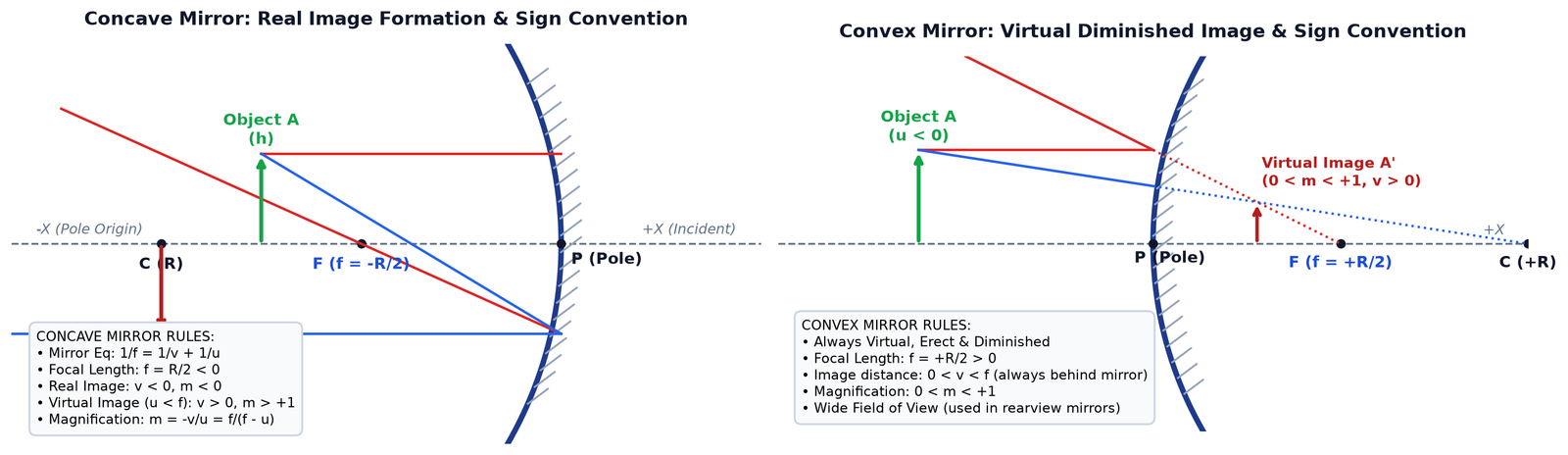
| Mirror Type | Focal Length (f) | Object Position | Image Position & Nature | Magnification (m) |
|---|---|---|---|---|
| Concave | Negative (f < 0) | u > 2f (Beyond C) | Between C & F, Real & Inverted | -1 < m < 0 (Diminished) |
| Concave | Negative (f < 0) | u = 2f (At C) | At C, Real & Inverted | m = -1 (Same size) |
| Concave | Negative (f < 0) | f < u < 2f (Between C & F) | Beyond C, Real & Inverted | m < -1 (Magnified) |
| Concave | Negative (f < 0) | u < f (Between P & F) | Behind mirror, Virtual & Erect | m > +1 (Magnified) |
| Convex | Positive (f > 0) | Anywhere in front of mirror | Behind mirror between P & F, Virtual & Erect | 0 < m < +1 (Always diminished) |
2. Refraction of Light, Snell's Law & Total Internal Reflection
Refraction occurs because the phase velocity of light changes across different optical media. The frequency ν of light remains invariant across boundaries, whereas wavelength λ and speed v change:
Real and Apparent Depth (Normal Shift)
When an object in a denser medium of refractive index μ is observed from a rarer medium (such as air, μair = 1):
For multiple immiscible liquid layers of depths d1, d2, … and refractive indices μ1, μ2, …, the total apparent depth is d'total = ∑ diμi.
Lateral Shift Through a Glass Slab
For a parallel glass slab of thickness t with angle of incidence i and angle of refraction r:
Total Internal Reflection (TIR)
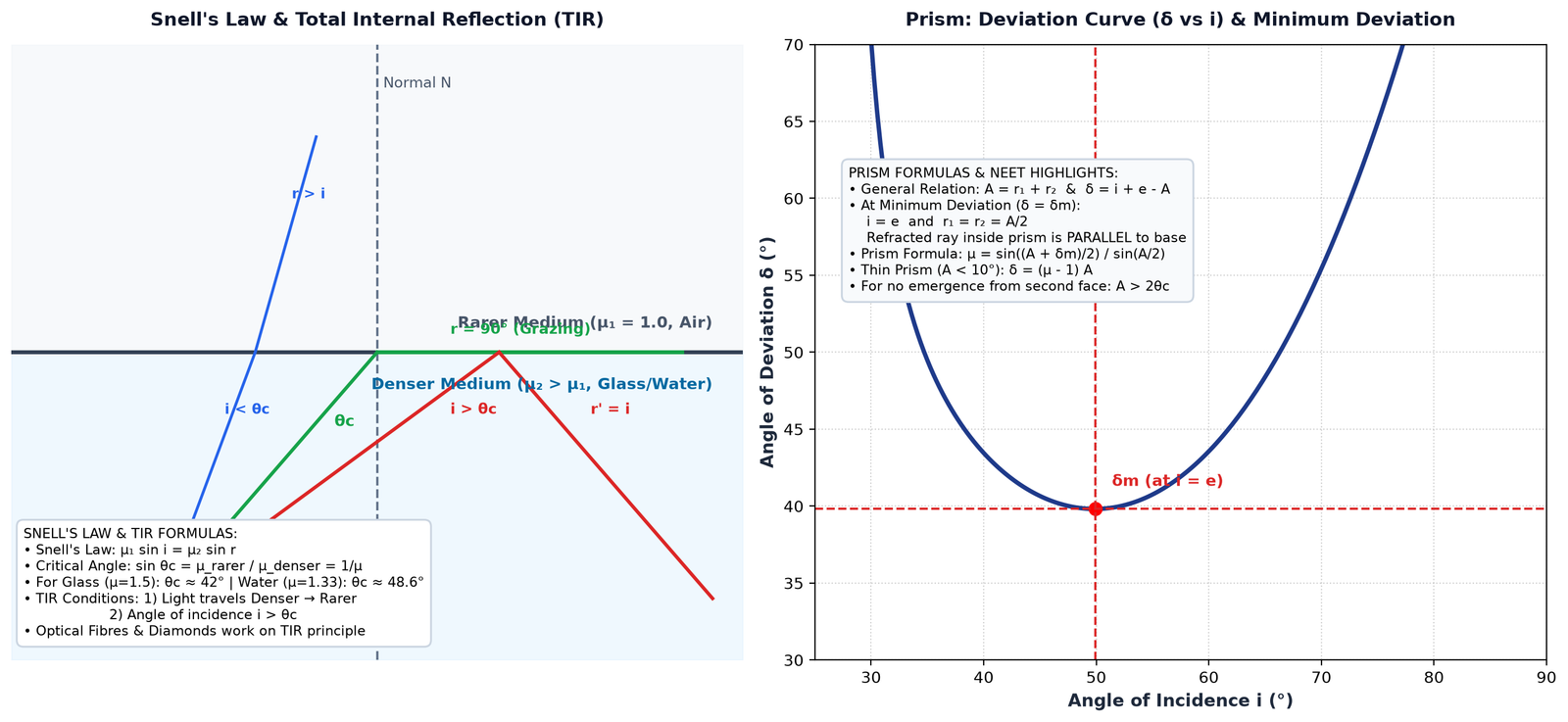
TIR occurs strictly under two mandatory physical conditions:
- Light must propagate from an optically denser medium toward an optically rarer medium (μdenser > μrarer).
- The angle of incidence must exceed the critical angle (i > θc).
A point light source submerged at depth h in a liquid of refractive index μ illuminates a circular patch of radius R on the surface:
Prism Theory & Minimum Deviation
For a triangular prism of refracting angle A:
At the condition of Minimum Deviation (δ = δm):
- The angle of incidence equals the angle of emergence: i = e.
- The internal refracted angles are equal: r1 = r2 = A2.
- The refracted ray inside the prism travels strictly parallel to the base for an equilateral/isosceles prism.
3. Refraction at Spherical Surfaces & Thin Lenses
For refraction at a single spherical boundary of radius of curvature R separating medium 1 (μ1) and medium 2 (μ2):
Lens Maker's Formula
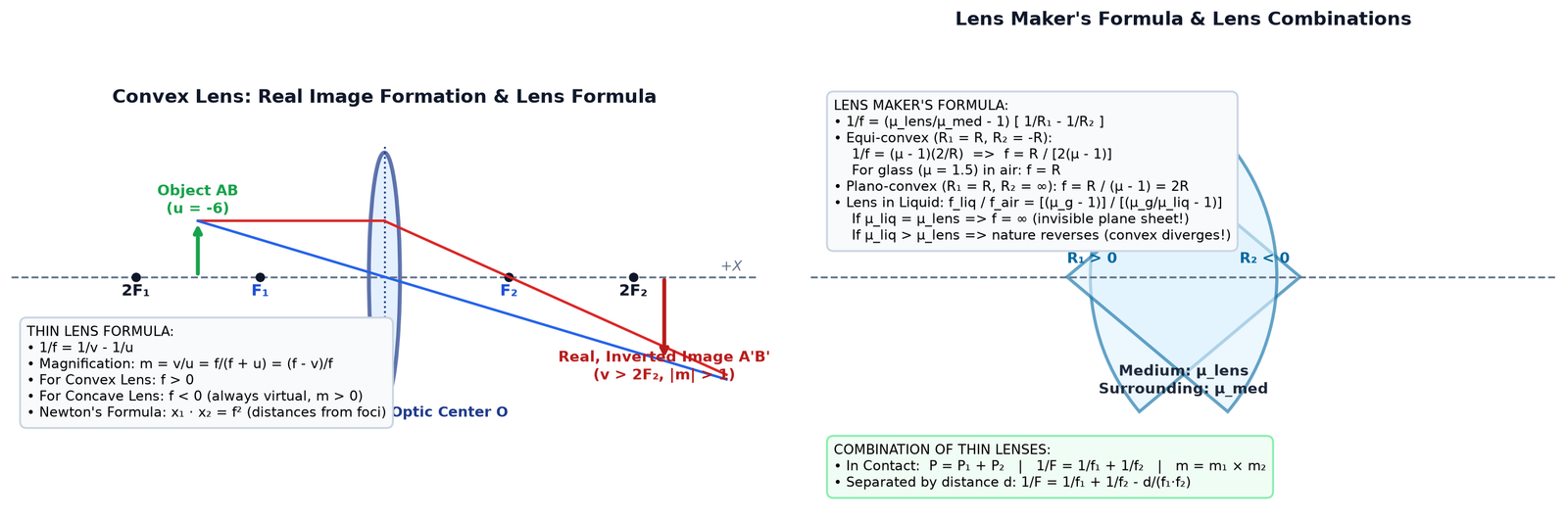
For a thin lens of material refractive index μL surrounded by a medium of refractive index μm:
- Equi-convex glass lens in air (μ = 1.5, R1 = +R, R2 = -R): 1f = (1.5 - 1)2R = 1R ⇒ f = R.
- Plano-convex glass lens in air (R1 = R, R2 = ∞): 1f = (1.5 - 1)1R ⇒ f = 2R.
- Lens immersed in water (μw = 4/3): fwaterfair = 1.5 - 11.54/3 - 1 = 0.50.125 = 4. Focal length quadruples in water!
- If μmedium > μlens: The focal length becomes negative — a convex lens turns into a diverging lens and a concave lens turns into a converging lens!
- If μmedium = μlens: f = ∞, P = 0 — the lens behaves as a flat glass slab and becomes completely invisible!
Thin Lens Formula & Optical Power
Combinations of Lenses
- Two thin lenses in contact:P = P1 + P2 | 1F = 1f1 + 1f2 | Total Magnification: m = m1 × m2
- Two thin lenses separated by distance d:1F = 1f1 + 1f2 - df1 f2 | P = P1 + P2 - d · P1 P2
Cutting and Silvering of Lenses
- Vertical cut (perpendicular to principal axis): A symmetrical biconvex lens of focal length f cut into two plano-convex lenses yields halves each having f' = 2f and power P' = P/2.
- Horizontal cut (along principal axis): Cutting a lens into two halves along its principal axis preserves each half's curvature: f' = f, but aperture area is halved, so image intensity is reduced by 50%.
- Silvering one surface of a lens: Light passes through the refracting surface, reflects off the silvered mirror, and refracts back out. The system behaves as an equivalent mirror with power:Peq = 2PL + PM ⇒ - 1F = 2fL - 1fM
4. Optical Instruments: Microscopes and Telescopes
1. Simple Microscope (Magnifying Glass)
A convex lens of short focal length held close to the eye forms a virtual, erect, magnified image of a tiny object placed within its focal length (u ≤ f):
- Near Point Adjustment (Image at D = 25 cm, Maximum Strain): m = 1 + Df
- Normal Adjustment (Image at Infinity ∞, Relaxed Eye): m = Df
2. Compound Microscope
Uses two convex coaxial lenses:
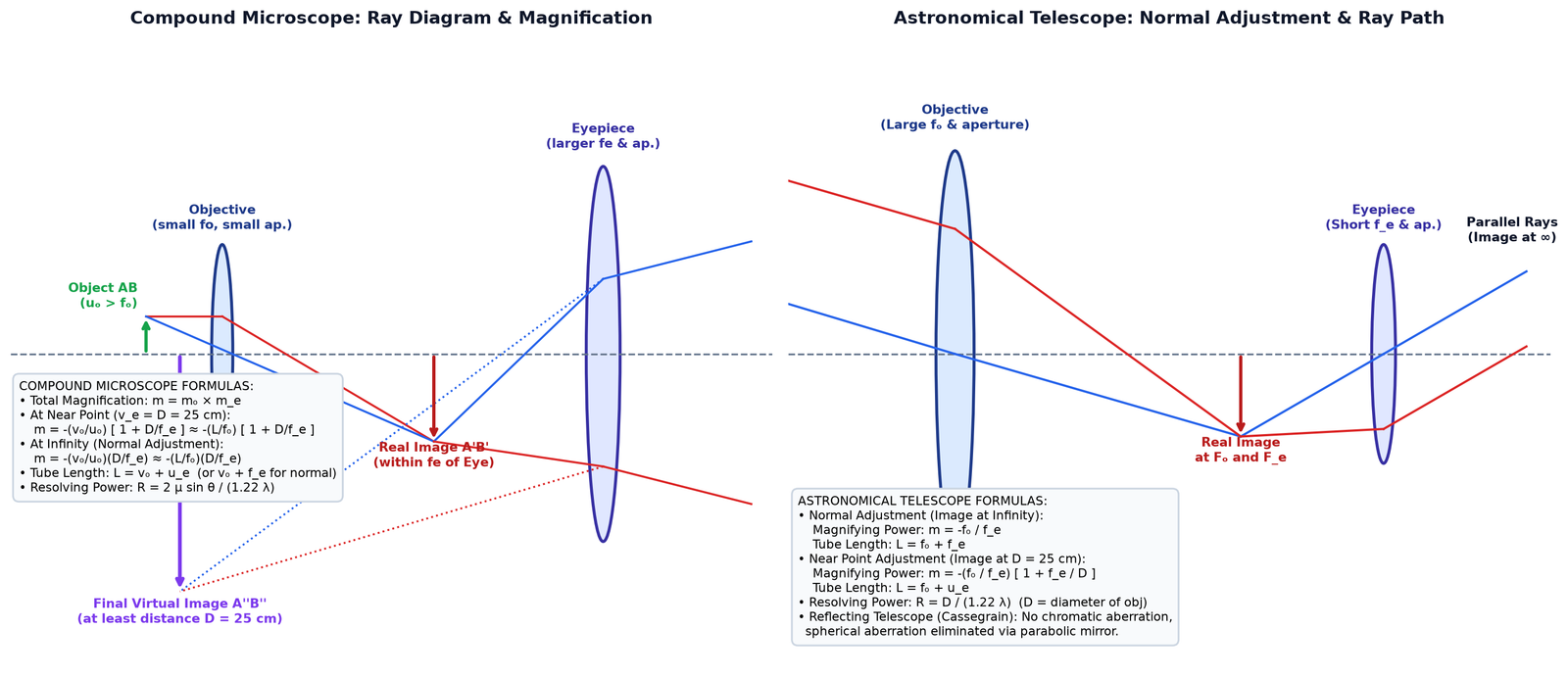
- Objective Lens: Small aperture and very short focal length (fo). Forms a real, inverted, magnified intermediate image (A'B') inside the tube.
- Eyepiece Lens: Moderate aperture and short focal length (fe > fo). Acts as a simple magnifier on intermediate image A'B', forming a final virtual, highly magnified, inverted image (A''B'').
- Near Point Adjustment (ve = D = 25 cm):m = - vouo [ 1 + Dfe ] ≈ - Lfo [ 1 + Dfe ] (Tube Length: L = vo + ue)
- Normal Adjustment (ve = ∞, Relaxed Eye):m = - vouo [ Dfe ] ≈ - Lfo [ Dfe ] (Tube Length: L = vo + fe)
- Resolving Power of Microscope:Resolving Power = 1dmin = 2 μ sin θ1.22 λwhere μ sin θ is the Numerical Aperture (NA) of the objective. Oil immersion increases μ, significantly enhancing resolution.
3. Astronomical Telescope (Refracting Type)
Used to view distant heavenly objects. Two lenses:
- Objective Lens: Large aperture (to collect abundant light) and very large focal length (fo).
- Eyepiece Lens: Small aperture and small focal length (fe ≪ fo).
- Normal Adjustment (Image at Infinity ∞, Relaxed Eye):Magnification: m = - fofe | Tube Length: L = fo + fe
- Near Point Adjustment (Image at D = 25 cm):Magnification: m = - fofe [ 1 + feD ] | Tube Length: L = fo + ue
- Resolving Power of Telescope:Resolving Power = 1Δθ = D1.22 λwhere D is the aperture diameter of the objective lens.
4. Reflecting Telescope (Cassegrain Telescope)
Modern professional observatories utilize reflecting telescopes instead of refractors because of overwhelming physical advantages:
- Zero Chromatic Aberration: Reflection is governed strictly by the law of reflection and is completely independent of wavelength λ.
- Reduced Spherical Aberration: Achieved easily using parabolic primary mirrors.
- Superior Mechanical Support: Giant concave mirrors can be supported across their entire back surface, whereas giant glass lenses can only be held at their rims and sag under their own gravitational weight.
5. Defects of Vision & Corrective Lenses
| Defect | Physical Cause | Image Formed | Corrective Lens | Formula |
|---|---|---|---|---|
| Myopia (Nearsightedness) | Eyeball too elongated or lens excessively curved | In front of the retina | Concave Lens (f < 0, P < 0) | f = -d (where d is far point) |
| Hypermetropia (Farsightedness) | Eyeball too short or lens curvature too flat | Behind the retina | Convex Lens (f > 0, P > 0) | 1f = 1d - 1D |
| Presbyopia (Old Eye) | Loss of ciliary muscle elasticity with aging | Difficulty focusing near objects | Bifocal Lens (upper concave, lower convex) | Combined correction |
| Astigmatism | Non-spherical cornea curvature in different meridians | Cannot focus horizontal & vertical lines together | Cylindrical Lens | Axis-specific curvature |
Master Formula Matrix & 20 Golden NEET Facts
This high-yield matrix condenses all essential equations, sign rules, and high-frequency examiner traps into a quick-revision sheet for NEET Physics.
Master Formula Matrix
| Domain | Key Mathematical Formulas | NEET Conditions & Sign Convention |
|---|---|---|
| Spherical Mirrors |
1f = 1v + 1u m = - vu = ff - u = f - vf vI = - m2 vO (axial velocity) |
Concave: f < 0 Convex: f > 0 Real Object: u < 0 Real Image: v < 0 (m < 0) Virtual Image: v > 0 (m > 0) |
| Snell's Law & Refraction |
μ1 sin i = μ2 sin r μ = cv = λairλmed Apparent Depth: d' = dμ Shift: Δx = d [ 1 - 1μ ] |
Frequency ν is strictly constant. Normal shift is independent of the position of object inside medium. |
| TIR & Critical Angle |
sin θc = 1μ = μrarerμdenser Circle of Vision Radius: R = h√μ2 - 1 Illuminated Area: A = π h2μ2 - 1 |
Requires μdenser → μrarer and i > θc. Glass: θc ≈ 42° Water: θc ≈ 48.6° Diamond: θc ≈ 24.4° |
| Prisms |
A = r1 + r2 δ = i + e - A At Minimum Deviation: μ = sinA + δm2sinA2 Thin Prism: δ = (μ - 1) A |
At δm: i = e, r1 = r2 = A/2. Ray inside is parallel to base. Condition for no emergence: A > 2θc. |
| Refraction at Spherical Surface | μ2v - μ1u = μ2 - μ1R |
Light travels from medium 1 to medium 2. R > 0 if center of curvature is on transmitted side. |
| Lens Maker's Formula & Thin Lenses |
1f = (μLμm - 1)[1R1 - 1R2] 1f = 1v - 1u m = vu = ff + u = f - vf |
Biconvex: R1 > 0, R2 < 0 Biconcave: R1 < 0, R2 > 0 If μm > μL: Lens reverses character (convex diverges). |
| Lens Combinations & Silvering |
In contact: P = P1 + P2, 1F = 1f1 + 1f2 Separated: 1F = 1f1 + 1f2 - df1 f2 Silvered lens: Peq = 2PL + PM |
Vertical cut: f' = 2f, P' = P/2 Horizontal cut: f' = f, Intensity halves. Silvered lens acts as an equivalent mirror. |
| Compound Microscope |
Near Point (ve = D): m = - vouo [ 1 + Dfe ] ≈ - Lfo [ 1 + Dfe ] Normal (ve = ∞): m = - vouo [ Dfe ] ≈ - Lfo [ Dfe ] Resolving Power = 2 μ sin θ1.22 λ |
Both lenses short focal length. fo < fe and aperture of objective is small. Tube length L ≈ vo + fe. |
| Astronomical Telescope |
Normal (ve = ∞): m = - fofe, Length L = fo + fe Near Point (ve = D): m = - fofe [ 1 + feD ], L = fo + ue Resolving Power = D1.22 λ |
Objective has large fo and large aperture. Eyepiece has small fe. Final image is inverted. |
20 Golden NEET Must-Know Facts & Examiner Traps
When light passes from one medium to another, its frequency ν remains strictly invariant because frequency is determined solely by the oscillating source. Wavelength λ and velocity v change proportionally: vλ = ν = constant. Colors inside media are determined by frequency, but perception by human photoreceptors in the eye depends on frequency.
For a standard glass lens (μg = 1.5 = 3/2) immersed in water (μw = 4/3): fwaterfair = μg - 1μgμw - 1 = 0.598 - 1 = 0.51/8 = 4 The focal length of a glass lens in water is always exactly 4 times its focal length in air, and its power reduces to one-fourth.
If a lens is immersed in a liquid having a refractive index higher than the lens material (μliquid > μlens), the quantity (μlens / μliquid - 1) becomes negative. Hence, a convex lens behaves as a diverging (concave) lens, and an air bubble inside water behaves as a diverging lens!
When μliquid = μlens, 1f = 0 ⇒ f = ∞ and P = 0. Light passes undeflected through the lens without any reflection or refraction. The lens disappears completely inside the liquid!
While the focal length of a lens changes significantly when immersed in liquid, the focal length of a spherical mirror remains completely unchanged! Mirror focal length depends strictly on geometry: f = R/2, governed by reflection, which has zero dependence on the surrounding medium's refractive index.
Vertical Cut (perpendicular to principal axis): A biconvex lens of focal length f cut into two halves yields two plano-convex lenses. Each half has f' = 2f, power P' = P/2, and full intensity.
Horizontal Cut (along principal axis): The radii of curvature are untouched, so each half retains f' = f and power P' = P, but because half the light-collecting area is lost, the image intensity is reduced to 50% (I' = I/2).
If the central half or lower half of a lens is painted black or covered with black paper, the full complete image is still formed! Every point on the exposed area receives rays from all object points. The only change is that image brightness/intensity decreases proportionally to the exposed surface area.
When one face of a thin lens of focal length fL is silvered (radius of curvature R), light refracts twice through the lens and reflects once off the silvered mirror. The system behaves as an equivalent mirror with power: Peq = 2 PL + PM ⇒ - 1F = 2fL - 1fM Remember: Power of a mirror is PM = -1/fM. The final system is ALWAYS a mirror!
At minimum deviation (δ = δm), the ray path inside the prism is strictly symmetric: i = e and r1 = r2 = A/2. For an equilateral or isosceles prism, this guarantees that the refracted ray inside the prism is strictly parallel to the prism base.
A ray incident at grazing incidence (i → 90°) on the first face will suffer total internal reflection at the second face if the prism angle satisfies: A > 2 θc where θc is the critical angle. For glass with θc = 42°, if A > 84°, no ray can emerge from the opposite face regardless of the incidence angle!
The normal shift produced by a transparent slab of thickness t and refractive index μ is: Δx = t [ 1 - 1μ ] Notice that Δx depends only on slab thickness t and refractive index μ. It is completely independent of the distance of the object from the front surface of the slab!
A diver or underwater fish looking upward sees the entire 180° exterior hemispherical sky compressed into a circular luminous cone of semi-vertical angle equal to the critical angle θc. The radius of this circle at depth h is: R = h√μ2 - 1 For water (μ = 4/3), √(16/9) - 1 = √73, so R = 3h√7.
Light undergoes repeated TIR inside the core (μ1) surrounded by cladding (μ2 < μ1). The maximum angle of incidence in air for successful waveguiding is the acceptance angle θa: sin θa = √μ12 - μ22 = Numerical Aperture (NA) If μ12 - μ22 ≥ 1, then θa = 90°, meaning light incident at any angle will guide!
If object distance x1 and image distance x2 are measured from the principal foci (F1 and F2) rather than from the pole or optical center: x1 · x2 = f2 This provides an instant 5-second calculation for NEET questions giving distances from foci!
For a small object of length Δu placed along the principal axis: mL = - dvdu = m2 = (ff - u)2 Since mL = m2 > 0, longitudinal magnification is always positive. If an object moves towards a concave mirror, its image moves away with velocity vI = - m2 vO.
In a compound microscope, both fo and fe are small, but fo < fe. A very small fo allows the object to be placed extremely close to the objective lens, maximizing linear magnification mo ≈ L/fo. The intermediate image is formed inside the tube within the focal length fe of the eyepiece.
In an astronomical telescope:
- Normal adjustment (Image at ∞): Tube length is L = fo + fe.
- Near point adjustment (Image at D = 25 cm): Tube length is L = fo + ue = fo + fe Dfe + D.
In Cassegrain and Newtonian telescopes, the primary light gatherer is a curved mirror rather than a lens:
- No Chromatic Aberration: Law of reflection (i = r) is completely independent of wavelength λ.
- No Spherical Aberration: Eliminable by parabolic contouring.
- Full Mechanical Support: Giant mirrors can be supported from behind across their entire back surface, preventing mechanical sagging that plagues heavy glass lenses.
For both microscope and telescope, resolving power is inversely proportional to wavelength: Rmicroscope = 2 μ sin θ1.22 λ | Rtelescope = D1.22 λ Using violet light (λ ∼ 400 nm) instead of red light (λ ∼ 700 nm) significantly increases the resolving power of both instruments!
Primary Rainbow: Two refractions and ONE internal reflection inside water drops. Violet ray emerges at 40°, red ray at 42°. Red is at the outer rim, violet at the inner rim. Brighter and narrower.
Secondary Rainbow: Two refractions and TWO internal reflections. Red emerges at 50°, violet at 53°. Order of colors is reversed (violet outer, red inner). Fainter due to two internal reflection energy losses.
8 Solved Numericals (Strict 3-Box Pedagogy)
Every problem is solved using the standard 3-box framework: Box 1 (Given & Core Concept), Box 2 (Step-by-Step Calculation), and Box 3 (NEET Speed Shortcut / Pro Tip).
- Object distance: u = -15.0 cm (in front of mirror)
- Focal length of concave mirror: f = -10.0 cm
- Object height: ho = +3.0 cm
- Core Concept: Mirror formula 1f = 1v + 1u and magnification m = hiho = - vu.
1. Apply the mirror formula to find image distance v:
Therefore, v = -30.0 cm. The negative sign confirms the image is real and formed 30.0 cm in front of the mirror (beyond C).
2. Calculate magnification m and image height hi:
The image is inverted, magnified (2×), and 6.0 cm tall.
Direct Formula: m = ff - u = -10-10 - (-15) = -10+5 = -2.
Instantly gives m = -2 in 5 seconds! Then v = -m · u = -(-2)(-15) = -30 cm. Saves writing the reciprocal fraction steps entirely.
- Thickness of glass slab: t = 6.0 cm
- Refractive index of glass: μ = 1.5 = 32
- Core Concept: A transparent slab raises the apparent position of an object towards the observer by a normal shift: Δt = t [ 1 - 1μ ].
1. Substitute the given values into the normal shift equation:
The ink dot appears to be raised upward by 2.0 cm. Therefore, the microscope must be shifted 2.0 cm vertically upwards.
For Glass (μ = 1.5): Shift is always exactly one-third of the thickness: Δt = t3.
Direct mental calculation: 6.03 = 2.0 cm upwards.
- Depth of water: h = √7 m
- Refractive index of water: μ = 43
- Core Concept: Rays incident at angles i ≤ θc emerge into air. Rays with i > θc suffer TIR. The illuminated region is a circle with radius R = h√μ2 - 1.
1. Compute the critical angle term √μ2 - 1:
2. Calculate the radius R:
3. Calculate the illuminated area A:
Universal Water Formula (μ = 4/3):
R = 3 h√7. Since h = √7, the √7 immediately cancels to give R = 3 m in 2 seconds flat!
- Equilateral prism angle: A = 60°
- Refractive index: μ = √3
- Core Concept: Prism formula μ = sinA + δm2sinA2. At minimum deviation, i = A + δm2.
1. Substitute A = 60° and μ = √3 into the prism formula:
Since sin(30°) = 12:
2. We know sin(60°) = √32. Therefore:
3. Calculate angle of incidence i:
Golden Prism Symmetry: Whenever μ = √3 for an equilateral prism (A = 60°), i = e = A = δm = 60°! All four angles equal 60°.
- Distance from center = 4.0 cm; Radius R = 10.0 cm.
- Distance of bubble from nearest pole P: u = -(10.0 - 4.0) = -6.0 cm
- Radius of curvature of boundary: R = -10.0 cm (center is inside glass, opposite to emergent ray direction)
- Refracting media: Light travels from Glass (μ1 = 1.5) into Air (μ2 = 1.0).
- Core Concept: Single spherical surface formula: μ2v - μ1u = μ2 - μ1R.
1. Substitute μ1 = 1.5, μ2 = 1.0, u = -6.0 cm, and R = -10.0 cm:
The bubble appears to be located at a depth of 5.0 cm below the nearest surface (shifted 1.0 cm closer to the surface).
Sanity Check: As light travels from denser (glass) to rarer (air) through a concave boundary (from inside), the image MUST shift towards the boundary. Since real depth was 6.0 cm, apparent depth must be strictly < 6.0 cm. Only -5.0 cm fits physically.
- Focal length in air: fa = +20.0 cm
- Refractive index of glass: μg = 1.5 = 32
- Refractive index of water: μw = 43
- Core Concept: Lens Maker's ratio formula: fwfa = μg - 1μgμw - 1.
1. Evaluate relative refractive index of glass with respect to water:
2. Form the ratio of focal lengths:
3. Calculate fw:
Universal NEET Memory Multiplier: For glass (μ = 1.5) immersed in water (μ = 4/3), fwater = 4 × fair ALWAYS! Immediate calculation: 4 × 20 = 80 cm.
- Curvature: R = 20.0 cm
- Refractive index: μ = 1.5
- Silvered surface: Curved surface silvered (acts as a concave mirror of radius R = 20 cm)
- Core Concept: Silvered lens power: Peq = 2 PL + PM ⇒ - 1F = 2fL - 1fM.
1. Focal length of the plano-convex lens:
2. Focal length of the silvered curved mirror (concave mirror):
3. Apply the equivalent system power formula:
The negative sign confirms the system acts as an equivalent Concave Mirror of focal length 203 cm.
Plano-Convex Silvering Quick Rules (μ = 1.5):
- Curved surface silvered: F = - R2μ = - R3 = - 203 cm.
- Flat surface silvered: F = - R2(μ - 1) = - R = -20 cm.
- Focal length of objective: fo = 100 cm
- Focal length of eyepiece: fe = 5 cm
- Least distance of distinct vision: D = 25 cm
- Core Concept:
- Normal adjustment: m = - fofe, Length L = fo + fe
- Near-point adjustment: m = - fofe [ 1 + feD ], Length L = fo + ue
Part (a): Normal Adjustment (Image at ∞)
Part (b): Near-Point Adjustment (Image at D = 25 cm)
To find tube length, calculate ue using lens formula for eyepiece (1fe = 1ve - 1ue with ve = -25 cm, fe = +5 cm):
Quick Ratio Check: Magnification at near point is always greater than at infinity by the factor (1 + fe/D):
|mnear| = |mnormal| × (1 + 5/25) = 20 × 1.2 = 24.
And tube length at near point is ALWAYS slightly shorter than normal adjustment by fe2fe + D = 2530 ≈ 0.83 cm ⇒ 105 - 0.83 = 104.17 cm!