Wave optics treats light as a wave phenomenon. It successfully explains interference, diffraction, and polarization, which cannot be explained by geometric ray optics.
What is a Wavefront?
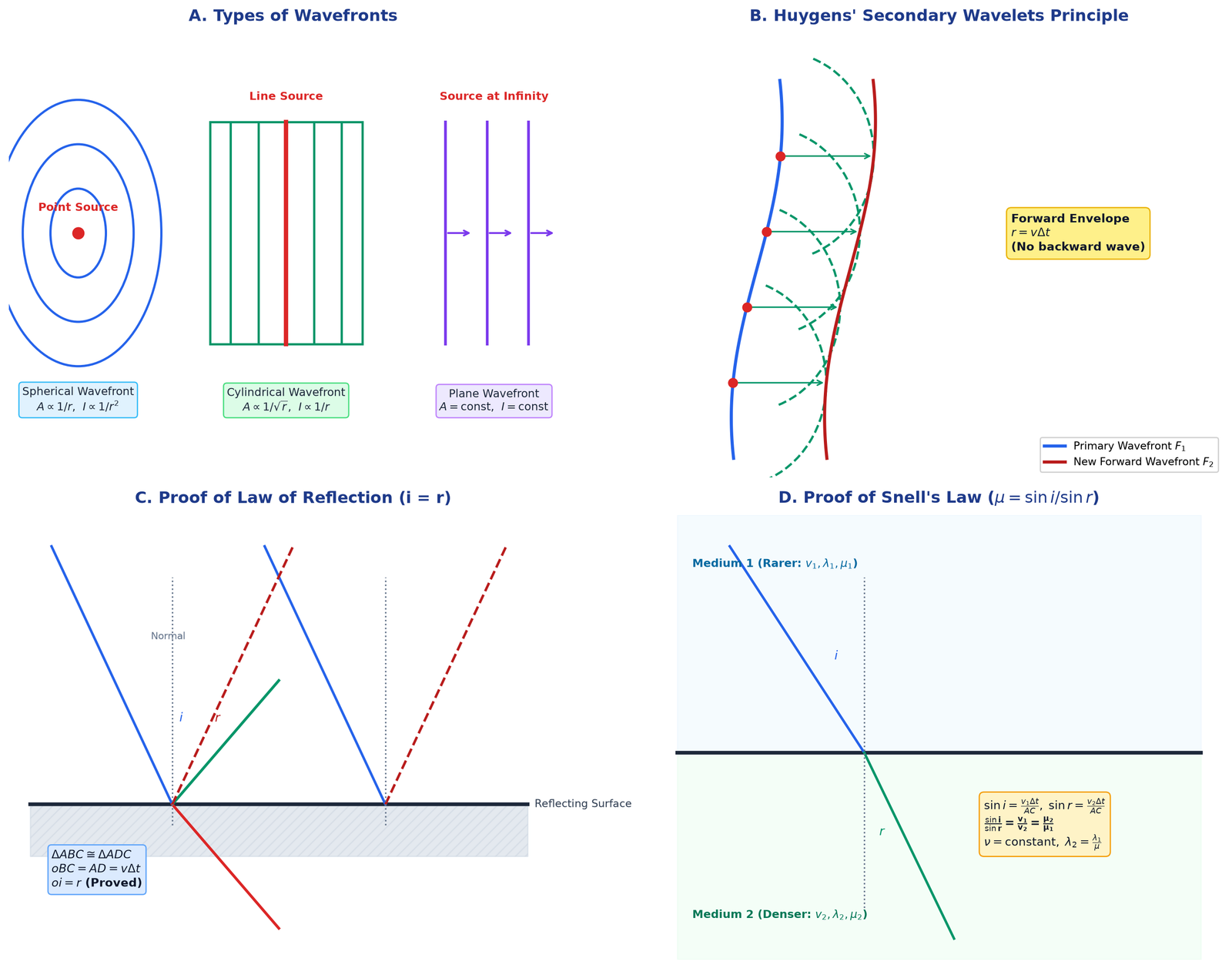
A wavefront is defined as the continuous locus of all medium points oscillating in the same phase. Rays of light are always strictly perpendicular (⊥) to the wavefront at every point.
Source Type
Wavefront Shape
Amplitude ($A$)
Intensity ($I$)
Point Source (finite dist.)
Spherical
A ∝ 1r
I ∝ 1r2
Linear Source (slit/tube)
Cylindrical
A ∝ 1√r
I ∝ 1r
Source at Infinity
Plane
A = constant
I = constant
Postulates of Huygens' Principle:
• Primary Source: Every point on a given wavefront acts as a fresh source of secondary spherical wavelets.
• Wavelet Propagation: These secondary wavelets spread out in forward directions with the speed of light in that medium (v).
• Forward Envelope: The common forward tangential surface touching these secondary wavelets at any later time t + Δt gives the new position of the wavefront.
• Absence of Back-Wave: Huygens assumed wavelets radiate strictly in the forward direction. (Later justified rigorously by Voigt and Fresnel with an obliquity factor (1 + cos θ)/2, which vanishes at θ = 180°).
Reflection & Refraction on Wave Theory
Huygens successfully proved the laws of geometric optics using wave propagation:
• Law of Reflection: Considering incident wavefront AB encountering a plane mirror, congruent right triangles yield:
∠ i = ∠ r
• Snell's Law of Refraction: Considering a wavefront passing from rarer medium 1 into denser medium 2:
sin isin r = v1v2 = μ2μ1
• Frequency Invariance: The frequency ν is determined solely by the source and does NOT change upon reflection or refraction! The wavelength and velocity change proportionally:
λ' = λμ, v' = cμ, ν' = ν
Figure 1: Wavefront Geometries, Huygens Wavelet Construction, and Proofs of Reflection & Snell's Law
2. Superposition Principle & Coherent Sources
When two or more light waves travel simultaneously through a medium, the resultant displacement at any instant is the vector sum of individual displacements:
y = y1 + y2
Coherent vs. Incoherent Sources
• Coherent Sources: Sources that emit continuous light waves having the same frequency, same wavelength, and a constant phase difference (Δφ) that does not change with time.
• Independent Sources Trap: Two independent light sources (e.g. two separate laser pointers or two electric bulbs) can NEVER be coherent because atomic emissions undergo random, uncorrelated phase shifts roughly every 10-9 seconds!
• Method to Obtain Coherence: Split light from a single primary source into two by division of wavefront (YDSE, Fresnel biprism) or division of amplitude (thin films, Michelson).
Resultant Amplitude & Intensity
Let two interfering waves be y1 = a1 sin(ωt) and y2 = a2 sin(ωt + φ):
A = √a12 + a22 + 2 a1 a2 cos φ
I = I1 + I2 + 2√I1 I2 cos φ
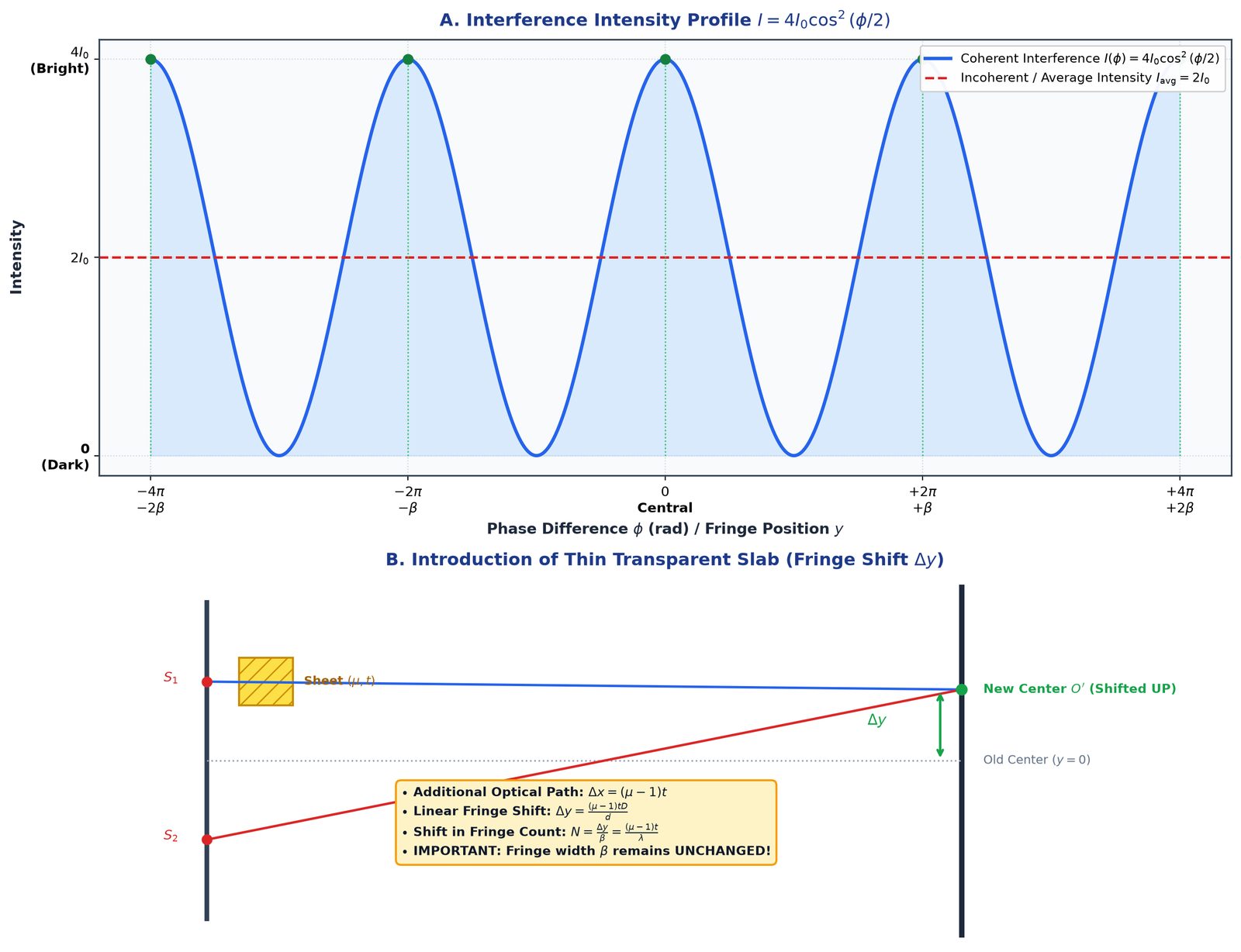
Special Case: Equal Identical Sources (I1 = I2 = I0):
I = 4 I0 cos2φ2
• Constructive Interference (Bright): φ = 2nπ ⇒ Imax = 4 I0.
• Destructive Interference (Dark): φ = (2n - 1)π ⇒ Imin = 0.
• Average Intensity: Iavg = Imax + Imin2 = 2 I0 = I1 + I2. Energy is not created or destroyed; it is merely redistributed from minima to maxima in accordance with the Law of Conservation of Energy!
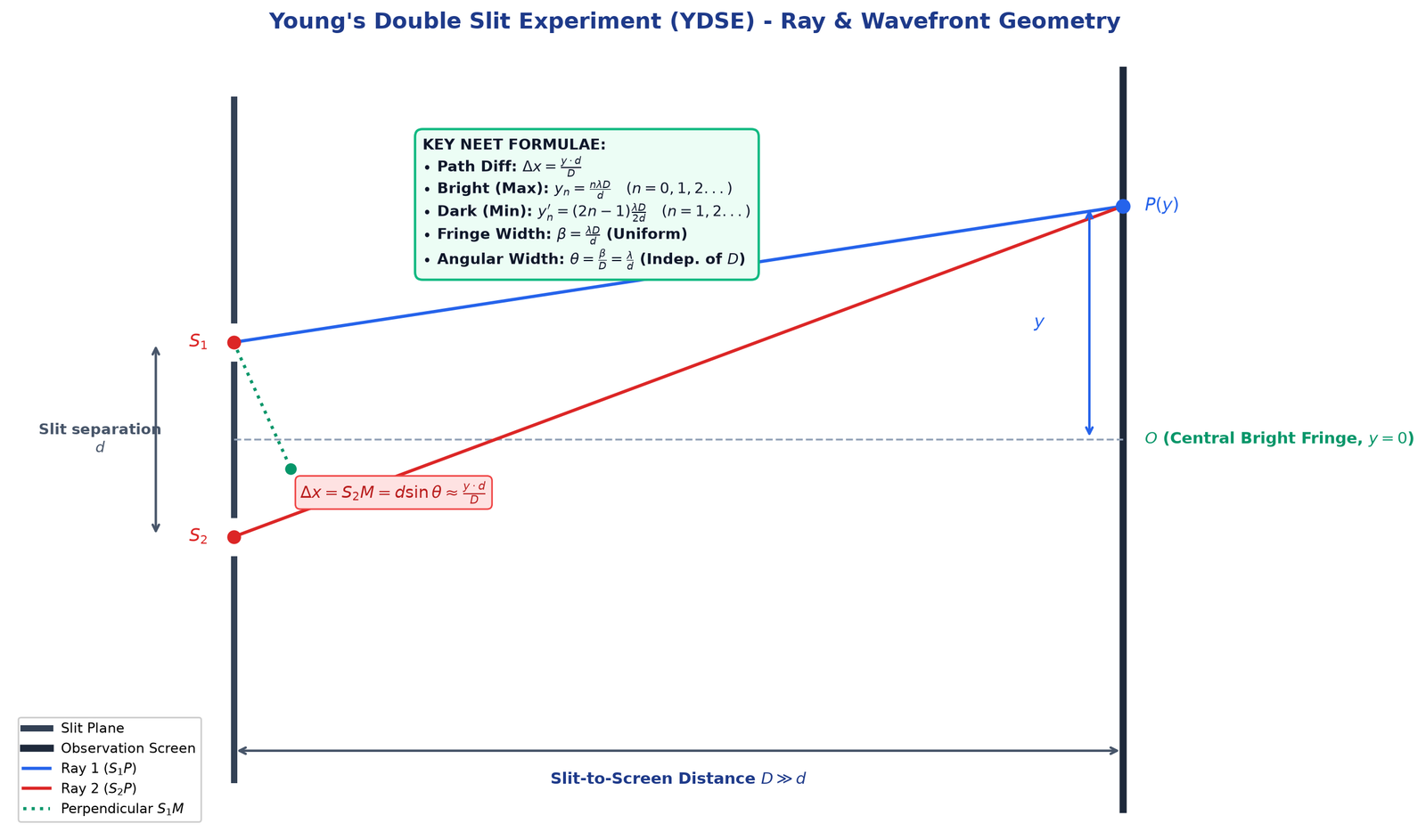
Central bright fringe is at y0 = 0 (zero path difference).
• Dark Fringes (Minima): Destructive interference occurs when Δx = (2n - 1)λ2 (n = 1, 2, 3 ...):
yn' = (2n - 1) λ D2d
1st dark fringe is at y1' = λ D2d = β2.
Fringe Width (β) & Angular Fringe Width (θ)
Linear Fringe Width (β): The separation between any two successive bright fringes (or two successive dark fringes):
β = yn+1 - yn = λ Dd
All fringes in YDSE have strictly equal width!
Angular Fringe Width (θ): The angle subtended by one fringe at the slits:
θ = βD = λd
Crucial NEET Point: The angular fringe width θ is completely independent of the screen distance D! Moving the screen further away increases β but leaves θ constant!
When the entire YDSE apparatus is immersed in a liquid of refractive index μ:
λ' = λμ ⇒ β' = βμ, θ' = θμ
The fringe pattern shrinks and fringes become closer together.
2. Introduction of a Thin Transparent Slab
When a thin transparent sheet of thickness t and refractive index μ is placed across one slit (e.g. S1):
• Extra Optical Path: Light in the sheet travels with speed c/μ. Time in slab Δt = t / (c/μ) = μt / c. Effective optical path = μt. In vacuum it would be t. Net path increase:
Δxextra = (μ - 1) t
• Linear Shift of Entire Pattern: The entire fringe pattern shifts towards the slit covered by the slab by distance:
Δy = (μ - 1) t Dd = (μ - 1) tλ β
• Number of Fringes Shifted:
N = Δyβ = (μ - 1) tλ
• NO CHANGE in Fringe Width: Fringe width β remains strictly unaltered! Only the coordinate origin shifts.
3. White Light Illumination in YDSE
• Central Fringe: At y = 0, path difference Δx = 0 for all wavelengths. Thus, the central fringe is completely WHITE.
• Immediate Fringes: Since β ∝ λ, violet light (λv ≈ 400 nm) has the smallest fringe width, so violet/blue appears closest to the center, while red (λr ≈ 700 nm) appears farthest.
• Higher Orders: After a few colored fringes, various colors overlap and the screen exhibits uniform general illumination.
4. Missing Wavelengths in Front of One Slit
A point directly in front of slit S1 lies at y = d/2. Path difference:
Diffraction is the phenomenon of bending of light waves around corners and edges of obstacles or apertures into the geometrical shadow region. It is prominent only when the size of the aperture/obstacle a is comparable to the wavelength of light (a ∼ λ).
Fraunhofer Single Slit Diffraction
Let a plane wavefront of wavelength λ fall on a slit of width a, with the screen at distance D.
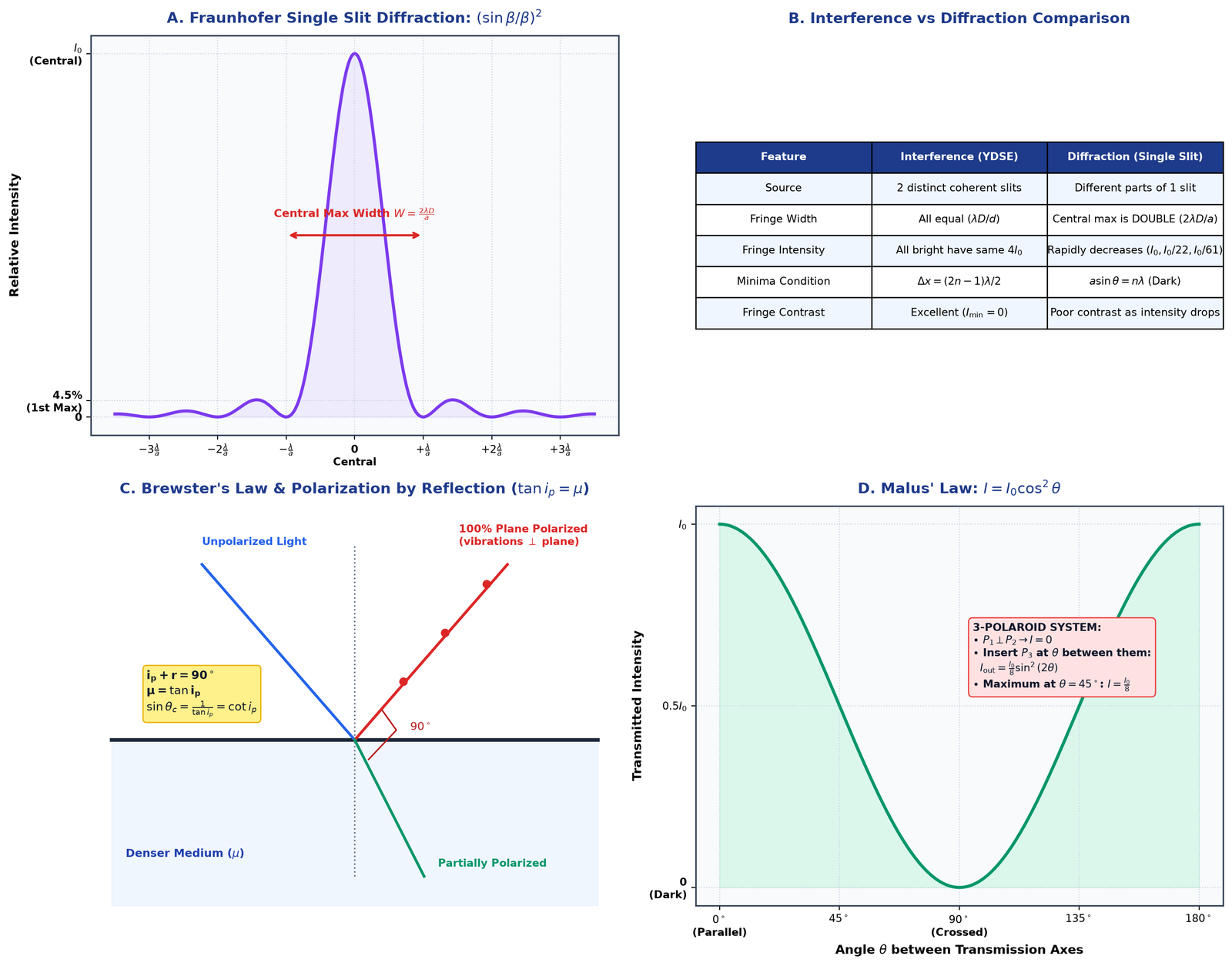
• Width of Central Maximum: Lies between the first minima on either side (θ = ±λ/a):
Angular Width = 2θ = 2λa
Linear Width: Wc = 2 λ Da = 2 βsec
The central maximum is twice as wide as any secondary maximum!
Interference vs. Diffraction Master Comparison
Feature
Interference (YDSE)
Diffraction (Single Slit)
Origin
Superposition of waves from two separate coherent slits.
Superposition of secondary wavelets from different portions of the same slit.
Fringe Width
All fringes have equal width (β = λD/d).
Central max has double width (2λD/a); secondary fringes are narrower (λD/a).
Intensity
All bright fringes have equal intensity (4I0).
Central max is intensely bright (I0); secondary maxima fade drastically (4.5%, 1.6%).
Minima Condition
Δx = (2n - 1)λ/2
a sin θ = nλ
Fringe Contrast
Good, sharp contrast with pitch-black minima (Imin = 0).
Poor contrast with hazy, fading fringes.
Fresnel Distance & Validity of Ray Optics
The Fresnel Distance (Zf) is the minimum propagation distance beyond which diffraction spreading exceeds the slit size:
Zf = a2λ
• For distance z ≪ Zf: Ray optics is valid (diffraction spreading is negligible).
• For distance z ≫ Zf: Wave optics must be used.
Figure 4: Single Slit Intensity Profile, Interference vs Diffraction, Brewster's Law & Malus' Law
6. Polarization of Light Waves
Polarization is the phenomenon of restricting electric field vibrations of a wave to a single plane perpendicular to the direction of wave propagation.
Ultimate NEET Golden Fact:
Polarization is the exclusive, definitive proof that light is a TRANSVERSE wave! Longitudinal waves (e.g. sound waves in air) possess cylindrical symmetry along their propagation direction and can NEVER be polarized!
Malus' Law
When completely plane-polarized light of intensity I0 falls on an analyzer whose transmission axis makes an angle θ with the transmission axis of the polarizer:
I = I0 cos2 θ
• If θ = 0° (parallel axes): I = I0 (Maximum transmission).
• If θ = 90° (crossed axes): I = 0 (Total extinction / darkness).
Unpolarized Light on 1st Polaroid:
When completely unpolarized light of intensity Iin falls on a polaroid, the transmitted light is always:
Iout = Iin2
This is because the average value of cos2θ over all random orientations (0 to 2π) is exactly 1/2! Rotating the first polaroid does NOT change this transmitted intensity.
Three-Polaroid System (NEET Super-Favorite)
Consider two crossed polaroids P1 and P2 (θ = 90°). Transmitted intensity is zero. Now, a third polaroid P3 is inserted between them at an angle θ to P1:
1. After P1: I1 = I02.
2. After P3: I2 = I1 cos2 θ = I02 cos2 θ.
3. Angle between P3 and P2 is (90° - θ). After P2:
Ifinal = I2 cos2(90° - θ) = I02 cos2 θ sin2 θ
Ifinal = I08 sin2(2θ)
Maximum output occurs at θ = 45°:
Imax = I08
Brewster's Law & Polarization by Reflection
When unpolarized light strikes a transparent dielectric surface (refractive index μ) at a specific angle of incidence ip (called the polarizing angle or Brewster's angle):
• The reflected ray is 100% plane-polarized with its electric field vectors strictly perpendicular to the plane of incidence (dots).
• The reflected ray and the refracted ray are mutually perpendicular:
ip + r = 90° ⇒ r = 90° - ip
• Applying Snell's Law: μ = sin ipsin r = sin ipsin(90° - ip) = sin ipcos ip:
μ = tan ip
• Critical Angle Connection: Since μ = 1sin θc:
sin θc = 1tan ip = cot ip
Wave Optics: Solved Numericals
Step-by-Step Pedagogical Solutions
Solved Numericals: Wave Optics
8 High-Yield NEET Problems Solved with 3-Box Pedagogy & Pro Speed Shortcuts
Problem 1 • YDSE Fringe Width & CountNEET High-Yield
In a Young's double slit experiment, monochromatic light of wavelength 600 nm illuminates two slits separated by 0.8 mm. The interference pattern is observed on a screen placed 1.6 m away. Calculate: (a) the linear fringe width β, and (b) the number of complete fringes observed across a 15 mm section on the screen.
Given & Core Concept:
• Wavelength λ = 600 nm = 600 × 10-9 m = 6 × 10⁻⁷ m
• Slit separation d = 0.8 mm = 0.8 × 10⁻³ m
• Screen distance D = 1.6 m
• Section width w = 15 mm = 15 × 10-3 m
• Linear fringe width: β = λ Dd
• Total fringes in span w: N = wβ
Step-by-Step Mathematical Calculation:
1. Calculating Fringe Width (β):
β = λ Dd
= (6 × 10⁻⁷ m) × (1.6 m)0.8 × 10⁻³ m
Since 1.60.8 = 2:
β = 6 × 10-7 × 2 × 103 = 12 × 10-4 m = 1.2 mm.
2. Number of Fringes in 15 mm Section:
N = wβ
= 15 mm1.2 mm
= 15012
= 12.5 fringes (or 12 complete fringes).
NEET Speed Shortcut:
Notice the ratio D/d = 1.6 / (0.8 × 10⁻³) = 2000. So β = 2000 × λ = 2000 × (6 × 10-4 mm) = 1.2 mm. Then 15 / 1.2 = 12.5. Solved in 8 seconds flat without cumbersome scientific notation!
In a YDSE setup, the ratio of widths of the two slits is 4 : 1. Assuming slit width is proportional to wave intensity, determine: (a) the ratio of maximum to minimum intensity in the interference pattern, and (b) the fringe visibility (contrast).
NEET Speed Shortcut:
Whenever I1I2 = k2, the amplitude ratio is k. Then ImaxImin is instantly (k + 1)2(k - 1)2. Here k = 2 ⇒ (2+1)2/(2-1)2 = 9/1!
Problem 3 • Immersion in Medium & Angular WidthNEET 2019 / 2021 PYQ
In air, a YDSE setup produces an interference fringe width of 0.40 mm and an angular fringe width of 0.20°. If the entire apparatus is immersed in water of refractive index μ = 4/3, calculate: (a) the new linear fringe width β', and (b) the new angular fringe width θ'.
Given & Core Concept:
• In air: β = 0.40 mm, θ = 0.20°
• Refractive index of water: μ = 43
• Wavelength in medium: λ' = λμ
• Scaling laws: β' = βμ, θ' = θμ
Step-by-Step Mathematical Calculation:
1. New Linear Fringe Width (β'):
β' = βμ
= 0.40 mm4/3
= 0.40 × 34
= 0.30 mm.
In a YDSE using light of wavelength 500 nm, a thin transparent mica sheet (μ = 1.60) is placed in front of one slit. As a result, the central bright fringe shifts to the original position occupied by the 6th bright fringe. Find the thickness of the mica sheet.
Given & Core Concept:
• Wavelength λ = 500 nm = 5 × 10⁻⁷ m
• Refractive index μ = 1.60
• Shift: Δy = 6 β ⇒ Number of fringes shifted N = 6
• Shift formula: Δy = (μ - 1) t Dd = N β
• Fringe count relation: N = (μ - 1) tλ
Step-by-Step Mathematical Calculation:
1. Equating Optical Path Difference:
The shift of 6 fringes corresponds to an optical path increase of 6 wavelengths:
(μ - 1) t = N λ = 6 λ.
2. Solving for Thickness t:
t = N λμ - 1
= 6 × (500 × 10-9 m)1.60 - 1.00
t = 3000 × 10-9 m0.60
= 3 × 10-60.6
= 5 × 10⁻⁶ m = 5.0 μm (or 5 × 10⁻⁴ cm).
NEET Speed Shortcut:
Use the direct relation: t = N λμ - 1. Notice that (μ - 1) = 0.6 = 3/5. Therefore, t = 6 λ × (5/3) = 10 λ! For λ = 500 nm, t = 10 × 500 nm = 5000 nm = 5 μm! 5-second mental solution!
Problem 5 • Coincidence of Two WavelengthsNEET 2018 / 2023 PYQ
A double slit apparatus with slit separation d = 0.5 mm and screen distance D = 1.5 m is illuminated simultaneously with two wavelengths λ1 = 650 nm and λ2 = 520 nm. Find the minimum non-zero distance from the central maximum where bright fringes of both wavelengths coincide.
Given & Core Concept:
• λ1 = 650 nm = 6.5 × 10⁻⁷ m, λ2 = 520 nm = 5.2 × 10⁻⁷ m
• d = 0.5 mm = 5 × 10⁻⁴ m, D = 1.5 m
• Condition for coincidence of bright fringes: y1 = y2 ⇒ n1 λ1 = n2 λ2
• Coincidence position: y = n1 λ1 Dd
Step-by-Step Mathematical Calculation:
1. Finding Minimum Integer Order Ratio:
n1 λ1 = n2 λ2 ⇒
n1n2
= λ2λ1
= 520650
= 5265
= 45.
Thus, the smallest non-zero integers are n1 = 4 and n2 = 5.
2. Calculating Coincident Position y:
y = n1 λ1 Dd
= 4 × (650 × 10-9 m) × 1.5 m0.5 × 10-3 m
y = 4 × 6.5 × 10-7 × 1.55 × 10-4
= 3.9 × 10-65 × 10-4
= 0.78 × 10⁻² m = 7.8 mm (or 0.78 cm).
NEET Speed Shortcut:
Always reduce λ1 / λ2 to lowest coprime fraction: 650 / 520 = 5 / 4. Invert to get order: the 4th bright fringe of λ1 coincides with the 5th bright fringe of λ2. Then evaluate 4 × 650 × 3 = 7.8 mm.
Problem 6 • Single Slit Diffraction WidthsNEET 2017 / 2020 PYQ
Light of wavelength 589 nm is incident normally on a single slit of width 0.20 mm. The diffraction pattern is projected on a screen placed 2.0 m away. Calculate: (a) the linear width of the central maximum, and (b) the linear distance from the center to the second secondary maximum.
Given & Core Concept:
• Wavelength λ = 589 nm = 5.89 × 10⁻⁷ m
• Slit width a = 0.20 mm = 2.0 × 10⁻⁴ m
• Screen distance D = 2.0 m
• Central maximum linear width: Wc = 2 λ Da
• n-th secondary maximum position: yn' = (2n + 1)λ D2a
Step-by-Step Mathematical Calculation:
1. Linear Width of Central Maximum (Wc):
Wc = 2 λ Da
= 2 × (5.89 × 10-7 m) × 2.0 m2.0 × 10-4 m
Wc = 2 × 5.89 × 10-3 m = 11.78 × 10⁻³ m = 11.78 mm ≈ 1.18 cm.
2. Distance to 2nd Secondary Maximum (n = 2):
For n = 2: (2n + 1) = 2(2) + 1 = 5.
y2' = 5 λ D2a
= 54 × 2 λ Da
= 54 × (11.78 mm)
= 52 × λ Da
Since λ Da = 5.89 mm:
y2' = 2.5 × 5.89 mm = 14.725 mm ≈ 1.47 cm.
NEET Speed Shortcut:
Notice that D/a = 2.0 / (2 × 10⁻⁴) = 104. Thus, λ Da is simply λ × 104 = 589 × 10-5 m = 5.89 mm. Central width is 2 × 5.89 = 11.78 mm; 2nd secondary max is 2.5 × 5.89 = 14.73 mm.
Unpolarized light of intensity I0 is incident on a system of two crossed Polaroids P1 and P2 (axes at 90°). A third Polaroid P3 is inserted between them with its transmission axis oriented at 30° with respect to that of P1. Calculate the intensity of light emerging from P2.
Given & Core Concept:
• Incident intensity: I0 (unpolarized)
• Angle of P3 relative to P1: θ1 = 30°
• Angle of P3 relative to P2: θ2 = 90° - 30° = 60°
• First Polaroid rule: I1 = I02
• Malus' Law: I = Iin cos2 θ
• Master formula: Ifinal = I08 sin2(2θ)
Step-by-Step Mathematical Calculation:
1. Intensity after P1:
I1 = I02.
3. Intensity after P2:
The angle between P3 and P2 is 60°:
I3 = I2 cos2(60°)
= (3 I08) × (12)2
= 3 I08 × 14
= 3 I032 (or 0.09375 I0).
NEET Speed Shortcut:
Direct shortcut: Iout = I08 sin2(2θ). For θ = 30°, 2θ = 60°. Since sin 60° = √3/2, sin2(60°) = 3/4. Therefore: Iout = I08 × 34 = 3 I032! Solved in 3 seconds!
Problem 8 • Brewster's Law & Critical AngleNEET 2020 / 2022 PYQ
When light incident from air on the surface of a transparent medium is reflected, it is found to be completely plane-polarized when the angle of incidence is 60°. Calculate: (a) the refractive index of the medium, (b) the angle of refraction r, and (c) the critical angle θc for total internal reflection in this medium.
Given & Core Concept:
• Polarizing angle: ip = 60°
• Brewster's Law: μ = tan ip
• Perpendicularity condition: ip + r = 90°
• Critical angle formula: sin θc = 1μ = cot ip
Step-by-Step Mathematical Calculation:
1. Refractive Index of the Medium (μ):
μ = tan(60°) = √3 ≈ 1.732.
2. Angle of Refraction (r):
At the polarizing angle, the reflected and refracted rays are perpendicular:
ip + r = 90° ⇒ r = 90° - 60° = 30°.
NEET Speed Shortcut:
Remember the classic pairing: sin θc = cot ip. For ip = 60°, cot 60° = 1/√3, so sin θc is immediately 1/√3. No intermediate decimal division needed!
Path Diff: Δx = y · dD = d sin θ
n-th Bright Fringe: yn = n λ Dd (n = 0, 1, 2...)
n-th Dark Fringe: yn' = (2n - 1) λ D2d (n = 1, 2...)
Linear Fringe Width: β = λ Dd
Angular Fringe Width: θ = βD = λd (indep. of D)
4. Medium Immersion & Thin Slab Displacement
Apparatus in medium μ:
β' = βμ,
θ' = θμ
Slab Extra Optical Path: Δx = (μ - 1) t
Linear Fringe Shift: Δy = (μ - 1) t Dd = (μ - 1) tλ β
Number of Fringes Shifted: N = Δyβ = (μ - 1) tλ
5. Fraunhofer Single Slit Diffraction
n-th Minima (Dark): a sin θ = n λ ⇒ yn = n λ Da
n-th Secondary Maxima: a sin θ = (2n + 1) λ2 ⇒ yn' = (2n + 1) λ D2a
Angular Width of Central Max: 2θ = 2λa
Linear Width of Central Max: W = 2 λ Da = 2 βsec
Fresnel Distance: Zf = a2λ
Malus' Law: I = I0 cos2 θ
Unpolarized Light on 1st Polaroid: I1 = I02
3-Polaroid System (middle at θ between crossed): I = I08 sin2(2θ) [Max = I0/8 at 45°]
Brewster's Law: μ = tan ip with ip + r = 90°
Critical Angle Relation: sin θc = 1tan ip = cot ip
20 Golden NEET Must-Know Facts & Traps
Fact 1Frequency Invariance: Frequency ν depends strictly on the source. When light enters a denser medium (μ), ν remains invariant, velocity decreases (v = c/μ), and wavelength shortens (λ' = λ/μ).
Fact 2Coherence Impossibility: Two independent light sources (e.g. two candles or two identical laser pointers) can never produce sustained interference because their random atomic transitions cause uncorrelated phase jumps every ~10-9 s.
Fact 3White Light Central Fringe: When white light is used in YDSE, the central fringe is pure white because Δx = 0 for all wavelengths. The closest adjacent colored fringe is violet/blue (λ is smallest) and the outer edge is red.
Fact 4Apparatus in Liquid: If the whole YDSE apparatus is submerged in water (μ = 4/3), fringe width decreases to β' = β/μ = 3β/4 (a 25% reduction). Fringes contract!
Fact 5Slab Shift Invariance: Placing a mica sheet across one slit shifts the entire fringe pattern by Δy = (μ - 1)t D/d towards that slit, but the fringe width β does NOT change at all.
Fact 6Energy Conservation: Interference does not destroy energy. It merely redistributes energy from dark regions (0) to bright regions (4I0). Average intensity is (4I0 + 0)/2 = 2I0 = I1 + I2.
Fact 7Incoherent Illumination: If two sources are incoherent, interference term 2√(I1I2) cosφ averages to zero over time, resulting in uniform, flat illumination: I = I1 + I2 = 2I0 across the screen.
Fact 8Transverse Proof: Polarization is the sole phenomenon proving light is a transverse electromagnetic wave. Sound waves in air are longitudinal and cannot be polarized under any condition!
Fact 9The 50% Rule: When completely unpolarized light of intensity I0 passes through an ideal Polaroid, the transmitted intensity is always exactly I0/2, regardless of how the Polaroid is rotated.
Fact 10Restoring Light with 3rd Polaroid: Two crossed Polaroids block all light (I = 0). Inserting a third Polaroid between them at 45° restores transmitted light to I0/8 (12.5% of incident unpolarized light)!
Fact 11Brewster's Perpendicularity: At Brewster's angle ip, the reflected ray is 100% plane-polarized perpendicular to the plane of incidence, and the reflected and refracted rays are strictly perpendicular (ip + r = 90°).
Fact 12Brewster vs Critical Angle Trap: Since μ = tan ip and μ = 1/sin θc, we have sin θc = cot ip. For glass (μ = 1.732 = √3), ip = 60°, so θc = sin-1(1/√3) ≈ 35.26°.
Fact 13Diffraction Central Width: In Fraunhofer single slit diffraction, the central maximum extends from -λ/a to +λ/a. Its linear width W = 2λD/a is exactly twice the width of any secondary maximum (λD/a).
Fact 14Diffraction Energy Decay: While all interference maxima have identical intensity (4I0), diffraction secondary maxima fade drastically: 1st secondary max ≈ I0/22 (4.5%), 2nd secondary max ≈ I0/61 (1.6%).
Fact 15Missing Orders in YDSE: If slit separation d is an integer multiple of slit width a (d = m · a), the m-th interference maximum coincides with the 1st diffraction minimum and is completely missing from the pattern.
Fact 16Fresnel Distance Criterion: Ray optics is valid when propagation distance z is much smaller than the Fresnel distance Zf = a2/λ. For z ≫ Zf, beam spreading by diffraction dominates and wave optics must be applied.
Fact 17Microscope Resolving Power: RP = (2μ sin θ) / (1.22λ). To resolve finer biological specimens, use oil-immersion objectives (μ ≈ 1.5) and ultraviolet light (shorter λ).
Fact 18Telescope Resolving Power: RP = D / (1.22λ). It depends solely on the objective aperture diameter D, NOT on its focal length! A larger mirror or lens gives sharper angular resolution.
Fact 19Stokes' Phase Change: Reflection from an optically denser medium introduces an automatic phase jump of π radians (equivalent to Δx = λ/2). Reflection from a rarer medium introduces zero phase change.
Fact 20Angular Fringe Width Trap: Angular fringe width θ = λ/d depends only on wavelength λ and slit separation d. Moving the screen closer or farther changes β, but θ remains strictly constant!